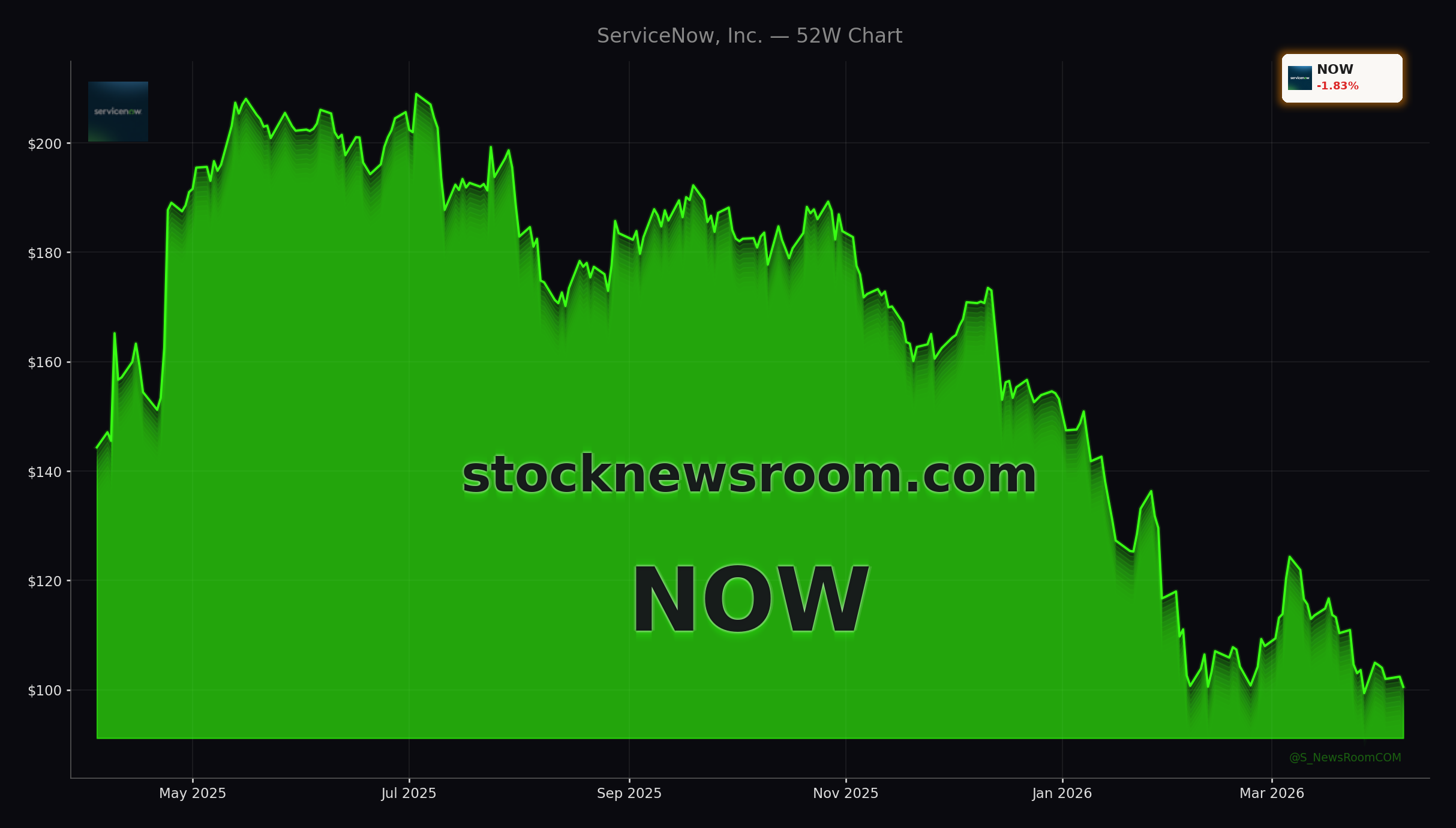

Can the new ServiceNow AI Partnership with DXC turn today’s share price weakness into tomorrow’s proof point for long-term upside?

How does the ServiceNow AI Partnership with DXC work?
The new ServiceNow AI Partnership centers on a multi-year agreement with DXC Technology, one of the largest global IT services players. DXC will act as “Customer Zero” for ServiceNow’s new Core Business Suite, rolling out agentic AI across its own back office before offering standardized solutions to clients worldwide. The goal is to replace fragmented, manual processes with AI-driven workflows that automate high-volume tasks, surface real-time insights and resolve issues proactively.
DXC is moving to a centralized Global Business Services model, using the ServiceNow AI Platform to unify support functions globally. By doing so, DXC and ServiceNow aim to build a library of repeatable AI use cases and automation patterns that can be deployed at scale in complex, multivendor environments. For investors, the ServiceNow AI Partnership is less about a single customer win and more about proving that the platform can orchestrate AI agents across core finance, HR, procurement and IT workflows in real-world enterprises.
This deal also deepens a 17-year relationship between the companies and builds on their joint AI Innovation Center of Excellence, which is tasked with industrializing AI assets and accelerators. If DXC can demonstrate tangible productivity gains and faster time-to-value, it gives ServiceNow a strong reference case as CIOs look to consolidate vendors around an “AI control tower” rather than piecemeal tools from dozens of startups.
What does this mean for ServiceNow versus rivals?
The ServiceNow AI Partnership lands at a time when investors are questioning whether traditional SaaS workflow platforms can defend their moats against horizontal AI tools from cloud hyperscalers and foundation model providers. While infrastructure players like NVIDIA dominate the AI hardware narrative and platform giants such as Apple and Tesla push their own ecosystems, ServiceNow is fighting to remain the orchestration layer for enterprise processes.
Unlike many point-solution vendors, ServiceNow sits beneath a company’s core security and data controls, deeply embedded in ticketing, asset management and employee workflows. Swapping it out wholesale would be disruptive, but generative AI agents could tempt some organizations to bypass parts of the stack. Management’s move toward agentic AI workflows and usage-based billing is intended to turn AI from a threat into a growth lever, allowing pricing to scale with activity even if headcount-based licenses come under pressure.
For US investors comparing AI opportunities across the NASDAQ and S&P 500, the ServiceNow AI Partnership offers a differentiated angle: it is not about inventing new AI chips or consumer apps, but about monetizing the integration of AI into existing mission-critical processes. That is a slower but often stickier path than speculative AI bets tied to a single breakthrough product cycle.
How is Wall Street recalibrating expectations?
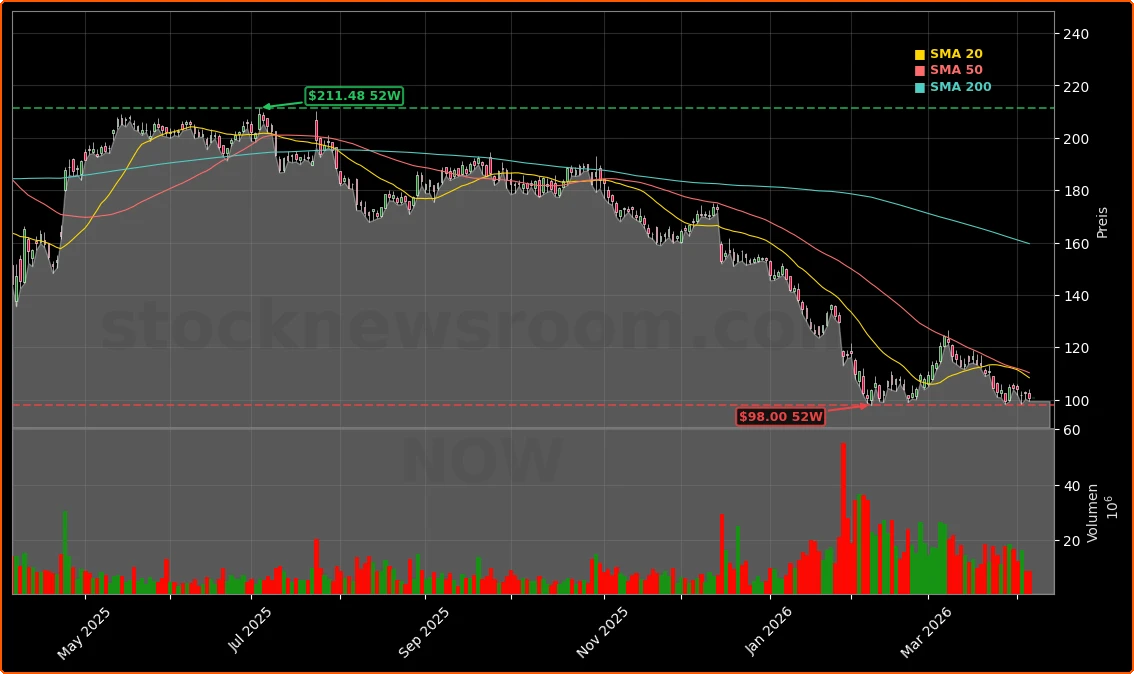
Despite the stock being roughly 56% below its high, the Street remains broadly positive. BTIG’s Allan Verkhovski this week reiterated a “Buy” rating but trimmed his price target on ServiceNow, Inc. to $185 from $200, citing limited near-term upside in the company’s subscription guidance for fiscal 2026 and what he views as somewhat aggressive consensus estimates for 2027 and 2028. Even after that cut, the target still implies an upside of more than 80% from current levels.
Across the analyst community, roughly nine out of ten coverage firms rate the shares a buy, with median targets around the high-$180s. Some research houses highlight that NOW trades at under 25 times projected 2026 earnings while analysts still model mid-20% annual EPS growth over the next three to five years. That multiple is not cheap in absolute terms, but it is markedly below the valuation peaks the name commanded during the last SaaS cycle, especially given the potential upside from AI monetization if the ServiceNow AI Partnership and similar deals scale successfully.
Institutional interest also remains solid. Recent 13F filings show investors such as Stock Yards Bank & Trust and Portside Wealth Group sharply increasing their positions in the stock in Q4, even as company insiders have been net sellers over the last 90 days. The divergence underscores a classic Wall Street tug of war between near-term execution risk and a long-duration growth story built around AI-enabled workflows.
Is AI a moat or a margin risk for ServiceNow?
The market’s hesitation reflects a simple tension: AI can both erode and enhance ServiceNow’s economics. On one hand, generic AI agents could undercut parts of the value the company historically charged for, pressuring seat-based pricing around basic workflows and ticket handling. On the other, ServiceNow is leaning into AI to expand its addressable workload, deepen stickiness and capture usage-driven revenue as automation volume grows.
By embedding digital agents that continuously monitor enterprise activity, propose next-best actions and handle routine resolutions, the company aims to free human teams for higher-value analysis and strategy. If customers view these capabilities as critical, the platform could become even more central to their operations, supporting premium pricing and cross-sell into adjacent modules. The ServiceNow AI Partnership with DXC is designed to validate exactly that thesis: can AI-first operations deliver enough hard ROI on cost, speed and quality to justify larger, longer-term commitments?
For investors building diversified AI exposure that already includes infrastructure names like NVIDIA or automotive autonomy plays such as Tesla, ServiceNow offers a workflow layer that monetizes AI adoption further up the enterprise stack. The risk is that execution lags expectations or that cheaper, more flexible AI-native competitors gain traction faster than large incumbents can adapt.
Related Coverage
For a deeper dive into ServiceNow’s balance sheet firepower, including its new $3 billion credit line and upgraded credit rating, read ServiceNow Financing: $3B Credit Line and Rating Shock, which explores whether the company is quietly preparing for a more aggressive AI land grab. To broaden the sector view beyond workflow software, the article AMD AI Strategy Record: Can Data-Center Boom Last? examines how AMD’s data-center push compares with other AI beneficiaries and what that could mean for investors balancing software and semiconductor exposure.
Putting ServiceNow’s Core Business Suite to work inside DXC allows us to prove what AI-powered operations look like in practice across complex, multivendor environments.— Russell Jukes, Chief Digital Information Officer, DXC Technology
In conclusion, the ServiceNow AI Partnership with DXC gives Wall Street a concrete test case for whether agentic AI can materially enhance the company’s growth story rather than dilute it. Analyst targets near $185 and strong institutional buying signal that many see the risk/reward as attractive after the stock’s sharp drawdown. The next few quarters of customer wins, AI adoption metrics and subscription guidance will show whether this AI-first strategy can translate into the durable earnings expansion long-term investors are betting on.