
Can the new ServiceNow AI Strategy calm Wall Street just as agentic AI hype hammers the stock by nearly 9%?

Why is ServiceNow under pressure today?
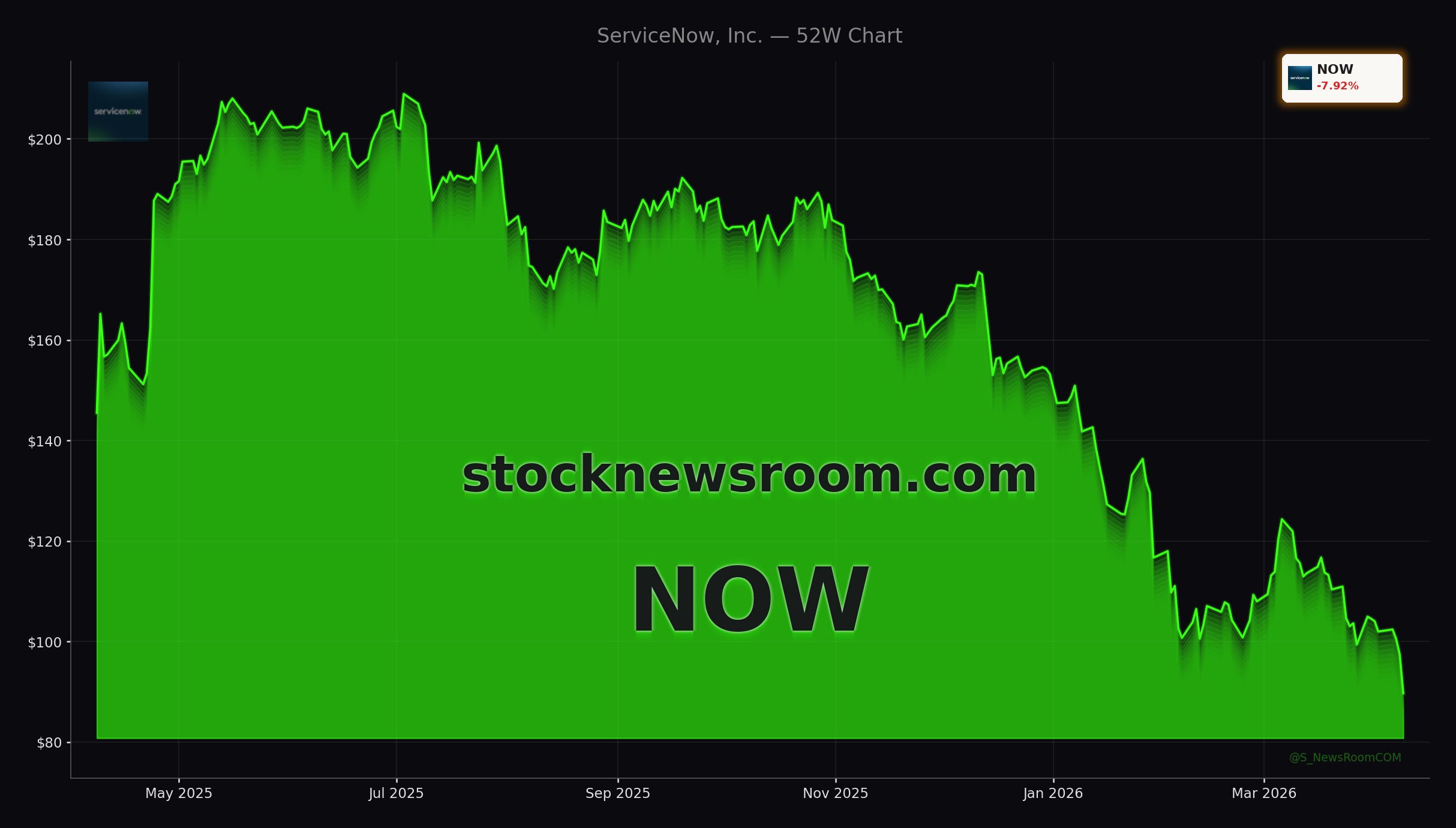
ServiceNow stock dropped roughly 8.5% in Thursday trading to around $89.20, extending a year-to-date decline of more than 30% and leaving the name near its 12‑month lows. The sell-off came amid a broad rout in enterprise software after new managed AI agent offerings from Anthropic and Meta reignited concerns that AI could compress software-as-a-service (SaaS) valuations across the board. Names such as Salesforce, Adobe, Autodesk and Workday also traded sharply lower, reflecting a sector-wide repricing rather than company-specific news alone.
The anxiety is simple: if horizontal AI agents from OpenAI, Anthropic or even hyperscalers can handle tasks like ticket routing, IT service automation, or workflow orchestration out of the box, investors worry about what they are still paying premium SaaS multiples for. That debate hits ServiceNow particularly hard because its core franchise sits exactly at the intersection of IT service management and workflow automation — the segments most exposed to agentic AI narratives.
What is new in the ServiceNow AI Strategy?
Against this backdrop, the refreshed ServiceNow AI Strategy is essentially a bet that context-rich, governed, enterprise-grade AI will beat generic agents. The company announced that every ServiceNow product now ships with embedded AI, data connectivity, workflow execution, security and governance – not as bolt-on modules but as default capabilities. That includes a conversational front door (EmployeeWorks), Workflow Data Fabric for cross-enterprise data context, AI Control Tower for visibility and governance, and autonomous workflows that can increasingly act on behalf of employees.
Center stage is a new Context Engine designed to give AI agents deep awareness of an organization’s assets, policies, approval chains, vendor histories and data lineage. With more than 85 billion workflows and trillions of transactions running annually on its platform, ServiceNow argues it can ground large language models in live enterprise behavior rather than just text, turning workflows into a continuously learning system. For CIOs worried about AI hallucinations and compliance, that tight coupling of context, execution and governance is the differentiator the ServiceNow AI Strategy is built on.

How does ServiceNow court developers and mid-market clients?
To broaden adoption, ServiceNow is rolling out a software development kit (SDK) and “Build Agent” skills that let developers use familiar AI coding tools — including Antigravity, Claude Code, Cursor, OpenAI-based tools and Windsurf — and then deploy directly to the ServiceNow AI Platform. In practice, that means engineers can stay inside their preferred IDE while citizen developers describe workflows in plain English, with working apps generated on ServiceNow in minutes. Each customer gets a starter allotment of free Build Agent calls, which should encourage experimentation.
For mid-sized organizations, a new Enterprise Service Management (ESM) Foundation bundle packages IT, HR, legal, finance, procurement and workplace services onto a single AI-native platform with AI-assisted setup. The pitch: get an enterprise-grade service backbone live in weeks instead of months, with AI deflecting routine tickets and automating cross-functional processes. Early adopters like Robinhood report deflecting about 70% of employee requests before human intervention and saving thousands of manual hours per month thanks to embedded AI in workflows.
How are analysts and big investors reacting?
Despite the product momentum, analyst sentiment has turned more cautious in the near term. Stifel recently cut its price target on ServiceNow from $180 to $135 while maintaining a Buy rating, citing weaker federal spending and softer channel checks as macro headwinds. Benchmark, by contrast, initiated coverage with a Buy and a $125 target, arguing that the integrated AI, workflow automation and data analysis stack positions the company to benefit from the growth of agentic AI rather than be displaced by it.
On the buy-side, several institutional investors have used the weakness to scale in. Market filings show firms such as Personal CFO Solutions, OFI Invest Asset Management, Prime Capital Investment Advisors and Greenleaf Trust all significantly increased their stakes in recent quarters, even as the stock slid toward its 52‑week lows. Broadly, the sell-off has pushed valuation to around the mid‑20s on forward earnings estimates, a multiple some growth investors see as more reasonable for a platform that still posted around 20%+ revenue growth and more than 30% earnings growth in the latest reported quarter.
Can ServiceNow outlast the agentic AI scare?
For long-term investors, the central question is whether managed agents from cloud AI providers will commoditize workflow platforms or whether companies like ServiceNow, NVIDIA and Salesforce can turn AI into a deeper moat. ServiceNow’s counter-argument is that enterprises will not rip out mission-critical systems that already orchestrate tens of billions of workflows; instead, they will plug best-of-breed models into existing platforms that already understand identity, assets, business rules and compliance. Partnerships with hyperscalers and AI specialists, including integrations with Microsoft Azure and Anthropic, are meant to ensure that ServiceNow remains the orchestration layer on top of which models compete.
Recent moves, such as a “Customer Zero” arrangement with DXC Technology where DXC uses ServiceNow’s agentic AI tools internally before taking them to clients, show how the ServiceNow AI Strategy is being tested at scale in complex environments. Combined with a revolving credit facility that adds balance-sheet flexibility, the company is clearly investing to accelerate AI-led adoption just as enterprises shift from pilots to broad deployment in 2026.
How does this stack up against other AI platform plays?
The tug-of-war between horizontal agents and verticalized platforms is playing out across the AI landscape. Chip and infrastructure leaders like NVIDIA are pouring billions into keeping data center dominance, while application-layer players such as Apple and Tesla pursue tightly integrated hardware-software-AI ecosystems. In the enterprise software layer, ServiceNow, Salesforce and others are effectively arguing that trusted execution and governance — not raw model performance — will determine who captures durable value.
Jim Cramer has highlighted ServiceNow’s steep multiple compression but also emphasized that customers “are paying” and sticking with the platform, while analysts such as Dan Ives at Wedbush characterize the sell-off in large-cap AI-exposed software, including Microsoft, Salesforce and ServiceNow, as overdone. If enterprises indeed make 2026 the year of full-scale AI rollout rather than experimentation, a well-executed ServiceNow AI Strategy could leave the company structurally stronger even if near-term volatility persists.
Related Coverage
For a deeper dive into how the DXC partnership fits into the broader AI narrative, see ServiceNow AI Partnership: -1.8% Shock Tests Bull Case, which examines whether “Customer Zero” wins can turn short-term stock pressure into long-term upside. For context on how infrastructure leaders are defending their turf, read NVIDIA AI Strategy Boom: $18B Bets to Defend Its Data Center Moat, which shows how spending at the chip layer could reinforce the value of orchestration platforms like ServiceNow.
ServiceNow brings it all together, so customers start with a complete AI-native experience across all products and packages, not a procurement project.— Amit Zavery, President, Chief Product Officer and COO at ServiceNow
In sum, the ServiceNow AI Strategy is a high-conviction push to turn the platform into an AI-native control tower just as Wall Street questions the durability of the SaaS model. For investors willing to stomach volatility, the mix of embedded AI across products, deep enterprise workflow roots and growing institutional interest could make the current slump a potential long-term entry point. The next few quarters of AI adoption and large-customer wins will be critical in proving whether this AI-native platform vision can translate into renewed multiple expansion and sustained earnings growth.