
Is the ServiceNow AI Strategy building a durable growth engine or just reshuffling software dollars in a nervous AI market?
Is ServiceNow turning AI fears into opportunity?
Wall Street’s mood on enterprise software has flipped in early 2026. After a multi‑year artificial intelligence boom, investors are now asking whether generative AI will cannibalize traditional software platforms instead of enhancing them. That sentiment shift has hit workflow-automation specialist ServiceNow, Inc., even though the ServiceNow AI Strategy is built on integrating AI directly into its platform rather than competing with it.
CEO Bill McDermott has pushed back strongly on the idea that AI will replace orchestration platforms like ServiceNow. His message to investors has been that “AI doesn’t replace enterprise orchestration. It depends on it,” arguing that large language models and autonomous agents still need a controlled environment, governance and workflows to avoid costly mistakes. That thesis is critical for U.S. portfolios trying to decide whether NOW belongs in the same long‑term AI infrastructure bucket as chip leaders like NVIDIA or in the group of legacy software names facing disruption.
Operationally, the company ended 2025 on solid footing. Revenue grew 21% year over year to roughly $13.3 billion, while net income climbed to about $1.7 billion from $1.4 billion in 2024. For Q1 2026, ServiceNow is guiding for subscription revenue growth of around 22% to approximately $3.7 billion, signaling no immediate slowdown despite tighter IT budgets and AI spending reallocations.
How does ServiceNow AI Strategy show up in products?
The ServiceNow AI Strategy is no longer theoretical; it is increasingly visible in new product lines. This week the company introduced Autonomous Workforce and EmployeeWorks, two AI‑powered cloud services aimed at automating knowledge work and IT support. Autonomous Workforce debuts with an AI specialist focused on Level 1 service desk tasks, while EmployeeWorks—built on technology gained through the Moveworks acquisition—allows employees to use natural language to search, visualize data and trigger automations across business applications.
ServiceNow emphasizes AI governance as a differentiator. Its autonomous agents are designed to escalate uncertain cases to human staff under policies defined by each enterprise, a response to concerns about AI hallucinations and compliance risk. Internally, the company says its own agents now resolve the vast majority of employee IT requests autonomously and significantly faster than human workers, an example it uses to sell the same architecture to large corporate and public-sector customers.
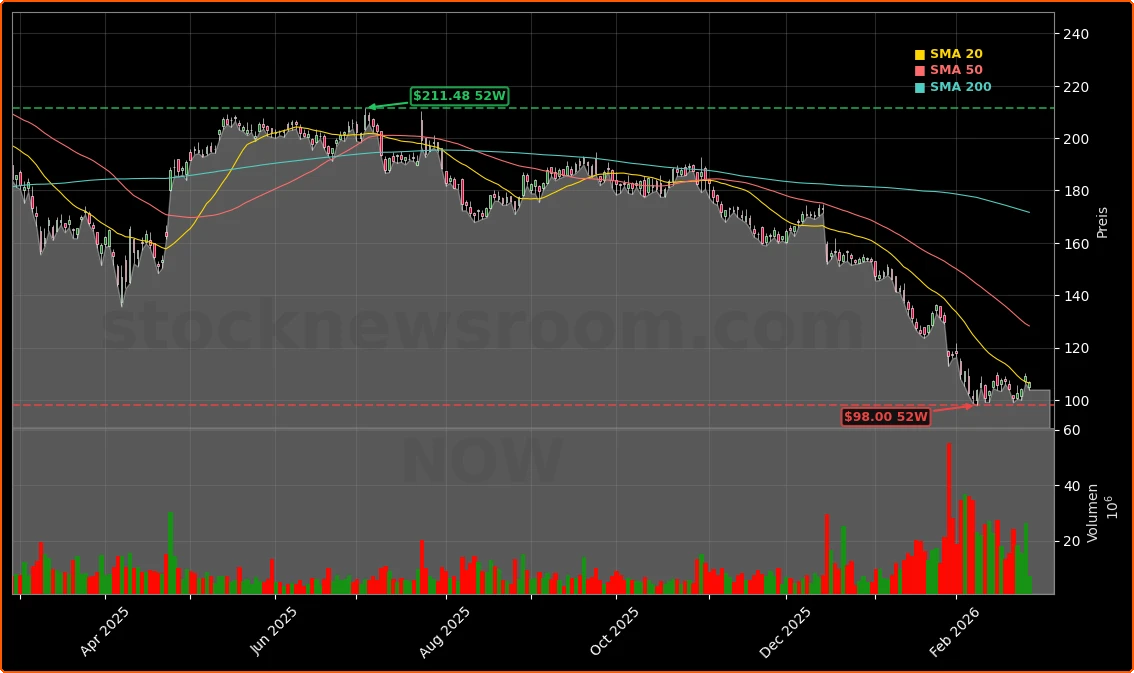
That product momentum has helped sentiment at times. Shares recently jumped intraday after investors focused on the company’s claim that it can resolve about 90% of IT tickets autonomously and on growing Moveworks traction, even as short interest has risen and valuation remains elevated versus the broader S&P 500 and NASDAQ software peers such as Apple’s services ecosystem and cloud‑first competitors.
What does AI mean for ServiceNow’s growth profile?
Two years ago, management began breaking out early AI revenue, and ServiceNow now expects around $1 billion in annual recurring revenue from AI-related products this year. At the same time, overall growth has moderated from earlier hyper‑growth levels, partly because some customers are shifting budgets from traditional modules into new AI offerings. That has sparked debate on Wall Street about whether AI is expanding ServiceNow’s total addressable market or simply remixing the same dollars.
Still, several institutional investors and portfolio managers argue that the ServiceNow AI Strategy should ultimately be a net positive margin and growth driver. They highlight vertical integration moves, including the purchase of an agentic AI cyber company, as signs that the platform is becoming a go‑to control layer for AI workflows. Some compare the setup to what NVIDIA has done in hardware: selling not just chips but full stacks that are hard to displace.
Analyst commentary remains mixed but generally constructive. While specific target changes from major banks such as Citigroup, Goldman Sachs or RBC Capital Markets have not dominated recent headlines, the broader analyst community continues to frame execution on AI monetization as the primary catalyst for multiple expansion. ServiceNow’s upcoming investor day in May is widely viewed as the next checkpoint for more detailed AI roadmaps and updated financial targets.
The broader software backdrop also matters. High‑growth cloud names across the NASDAQ have sold off sharply in 2026 on fears that AI will compress license pricing and reduce seat counts, affecting companies from identity providers like Okta to CRM platforms that compete with Tesla-style vertically integrated stacks in other industries. Against that, some research outlets now argue the selloff in quality names such as ServiceNow is overdone, pointing to resilient fundamentals and product innovation.
For U.S. investors, the key question is whether ServiceNow behaves more like a long‑duration AI infrastructure asset or a cyclical tool vendor exposed to budget rotations. With NOW hovering near the low end of its recent trading range and down with the rest of the software cohort, the risk‑reward profile looks increasingly tied to confidence in the ServiceNow AI Strategy and its ability to translate new products like Autonomous Workforce and EmployeeWorks into durable, high‑margin subscription streams.
AI doesn’t replace enterprise orchestration. It depends on it.
— Bill McDermott, CEO of ServiceNow
Conclusion
In the near term, volatility is likely to persist as markets reassess growth assumptions for enterprise software. But if subscription growth near the low‑20% range holds and AI ARR scales toward the company’s $1 billion goal, ServiceNow could emerge from the current reset as one of the clearer winners in orchestrating AI inside the modern enterprise. For long‑term Wall Street portfolios willing to ride out swings, the ServiceNow AI Strategy may prove more of a moat than a threat as the next phase of AI adoption unfolds.
Further Reading
- ServiceNow, Inc. (NOW) stock quote and profile (Yahoo Finance)
- ServiceNow debuts Autonomous Workforce, EmployeeWorks automation tools (SiliconANGLE)
- ServiceNow (NYSE:NOW) shares up 4.9% — what’s next? (MarketBeat)
- ServiceNow touts AI governance for its Autonomous Workforce (TechTarget)