
Is ServiceNow quietly arming itself for an AI land grab with fresh financing firepower and an ‘A’ credit rating to match?

How does ServiceNow Financing change the balance sheet?
ServiceNow Finanzierung und Bonitaet are moving into a new phase. On April 1, ServiceNow entered a $3 billion unsecured revolving credit facility with JPMorgan Chase that matures in 2031. The company can optionally upsize commitments by another $2 billion and has the ability to extend maturity once by up to five years, subject to lender consent. As of the latest filing, no funds have been drawn, leaving the facility as a pure backstop for working capital and general corporate purposes.
In parallel, ServiceNow established a commercial paper program that allows issuance of up to $3 billion in short-term, unsecured notes with maturities of up to 397 days. Like many large investment-grade issuers in the S&P 500 and on the NASDAQ, this structure gives ServiceNow access to very low-cost, short-term funding for everyday needs or opportunistic moves. Together, the credit line and commercial paper program significantly deepen ServiceNow Financing flexibility without immediately increasing leverage.
The new tools sit on top of a balance sheet that already included roughly $10 billion of cash and investments at year-end 2025. Even after funding a $2 billion accelerated share repurchase, the $1.25 billion Veza deal and the pending $7.75 billion Armis acquisition, S&P expects the company’s leverage to peak at only 0.5x-0.7x 2025 EBITDA and then fall rapidly toward 0.1x by the end of 2026.
What does S&P’s ‘A’ rating signal for investors?
S&P Global Ratings has affirmed its long-term ‘A’ issuer credit rating on ServiceNow and assigned a short-term ‘A-1’ rating tied to the new commercial paper program. It also rated the revolving credit facility ‘A’ and kept the outlook stable. The agency highlights ServiceNow’s mid-30% EBITDA margins, at least 20% annual revenue growth at scale, and remaining performance obligations near $28 billion, which support strong revenue and free operating cash flow visibility over the next two years.
This strong credit profile underpins the economics of ServiceNow Financing. Investment-grade status means low interest spreads on both the revolver and any future bond or commercial paper issuance, which should help offset rising compute costs from the company’s AI products. S&P notes that EBITDA and free operating cash flow have more than tripled over the past five years to just above $4.5 billion in 2025, and it projects free operating cash flow of $5.2 billion–$5.5 billion in 2026 despite heavier M&A and shareholder returns.
Importantly for bondholders and equity investors, S&P says leverage is expected to remain well below its 2x downgrade threshold even if ServiceNow leans further into acquisitions. An upgrade would require even greater scale, diversification beyond IT workflows, and leverage consistently below 1.5x—conditions that hinge on the success of the AI strategy and continued share gains against rivals like Microsoft, Salesforce and Oracle.
Is the liquidity build about offense—or defense?
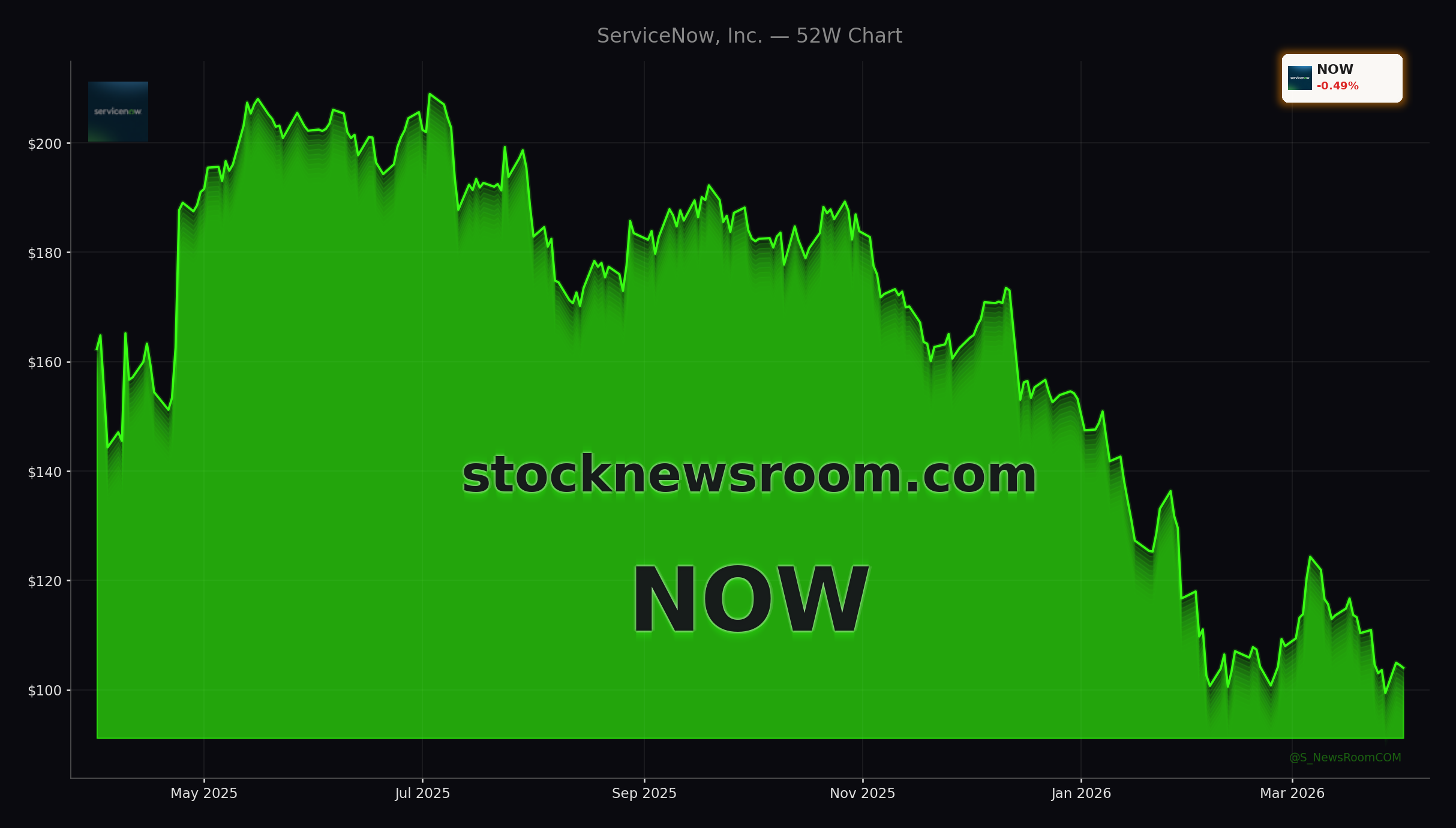
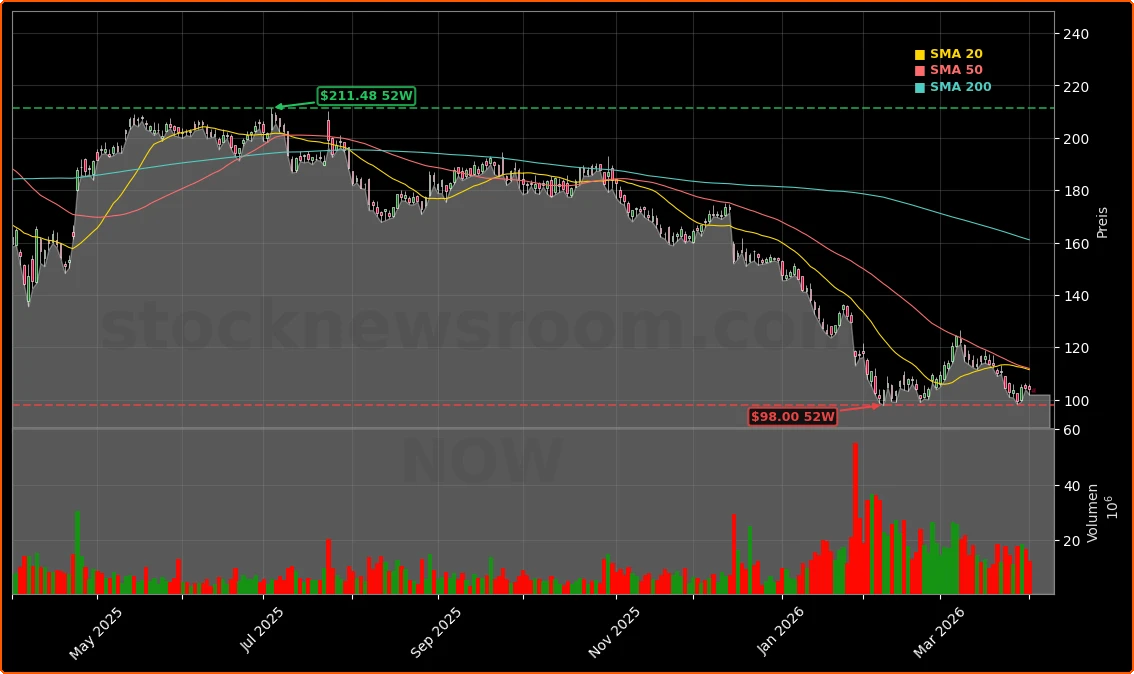
The expanded ServiceNow Financing toolkit arrives as the stock trades around $104.04, off its prior highs and roughly halved from last summer amid a broad sell-off in software and AI-sensitive names. While free cash flow margins expanded from 31% to over 34% last year, investors are increasingly focused on whether generative AI will erode ServiceNow’s moat in workflow automation.
The company’s core strength remains its configuration management database and deeply embedded workflows across the Fortune 500, delivering renewal rates around 98%. Yet the same AI technology it now sells—via its Now Assist generative AI suite, which surpassed $600 million in annual contract value and is targeting $1 billion in 2026—also threatens to replicate many process-driven tasks the platform automates today. Customers must often upgrade to higher-priced tiers and accept usage-based pricing to access these AI features, pushing some IT leaders to evaluate in-house or alternative tools.
That context helps explain why ServiceNow is pairing large AI and security acquisitions—about $11 billion committed—with a substantial liquidity buffer. The revolver and commercial paper program provide optionality: funding for deals like Armis, further AI infrastructure commitments, or additional shareholder returns, depending on market conditions and competitive pressures from Microsoft and others.
How does ServiceNow compare to other tech heavyweights?
For U.S. investors used to balance-sheet-heavy growth stories like NVIDIA or platform plays like Apple and Tesla, ServiceNow represents a hybrid: a high-growth software company that is also increasingly managed with the capital discipline of a mature blue chip. While some peers still operate with higher net leverage or less predictable cash flows, ServiceNow has chosen to keep significant firepower in reserve even as its stock multiple compresses.
The upside case is that this strong ServiceNow Financing position enables the company to consolidate emerging AI and security assets, defend its enterprise footprint and accelerate innovation without stressing the balance sheet. The bear case, highlighted by the stock’s near-50% slide from last year’s levels, is that AI gradually commoditizes workflows, compressing pricing power and turning ServiceNow into a lower-growth toll collector on corporate processes. Morgan Stanley has argued that the Armis deal should add strategic value beyond simple revenue accretion, but skeptics worry about M&A execution risk and integration complexity.
Related Coverage
Investors tracking the AI narrative around ServiceNow may want to read how its generative products fit into the broader thesis in ServiceNow AI Strategy -2.3%: Boom Catalyst or Red Flag?, which analyzes whether AI is a durable growth engine or a source of margin pressure. For a sector-wide lens on software and AI valuations, the defense-focused piece Palantir Maven Program Boom: Pentagon Deal Reshapes Valuation explores how major government contracts can re-rate leading data and AI platforms and what that might imply for enterprise software names like ServiceNow.
Overall, the latest ServiceNow Financing moves confirm a company preparing to play offense and defense at the same time. Robust liquidity, an affirmed ‘A’ rating and substantial free cash flow give management room to pursue AI-led growth while absorbing potential volatility in software valuations. The next milestones for investors will be execution on the Armis and Veza integrations, adoption trends for Now Assist and how quickly the company taps its new ServiceNow Financing capacity to support its evolving strategy.