
Is the latest plunge in ServiceNow’s stock a temporary AI panic or the start of a deeper reset in the ServiceNow Forecast?

Is ServiceNow losing its AI premium?
ServiceNow’s latest selloff came after UBS downgraded the stock from Buy to Neutral and slashed its price target to $100 from $170. The bank argued that while ServiceNow was once its preferred way to play AI in application software, confidence in that call has weakened. Conversations with enterprise customers indicated growing interest in using large language models and coding tools from players like OpenAI and Anthropic to build thinner, custom workflow apps and to have AI agents resolve a larger share of service tickets that ServiceNow’s platform currently handles.
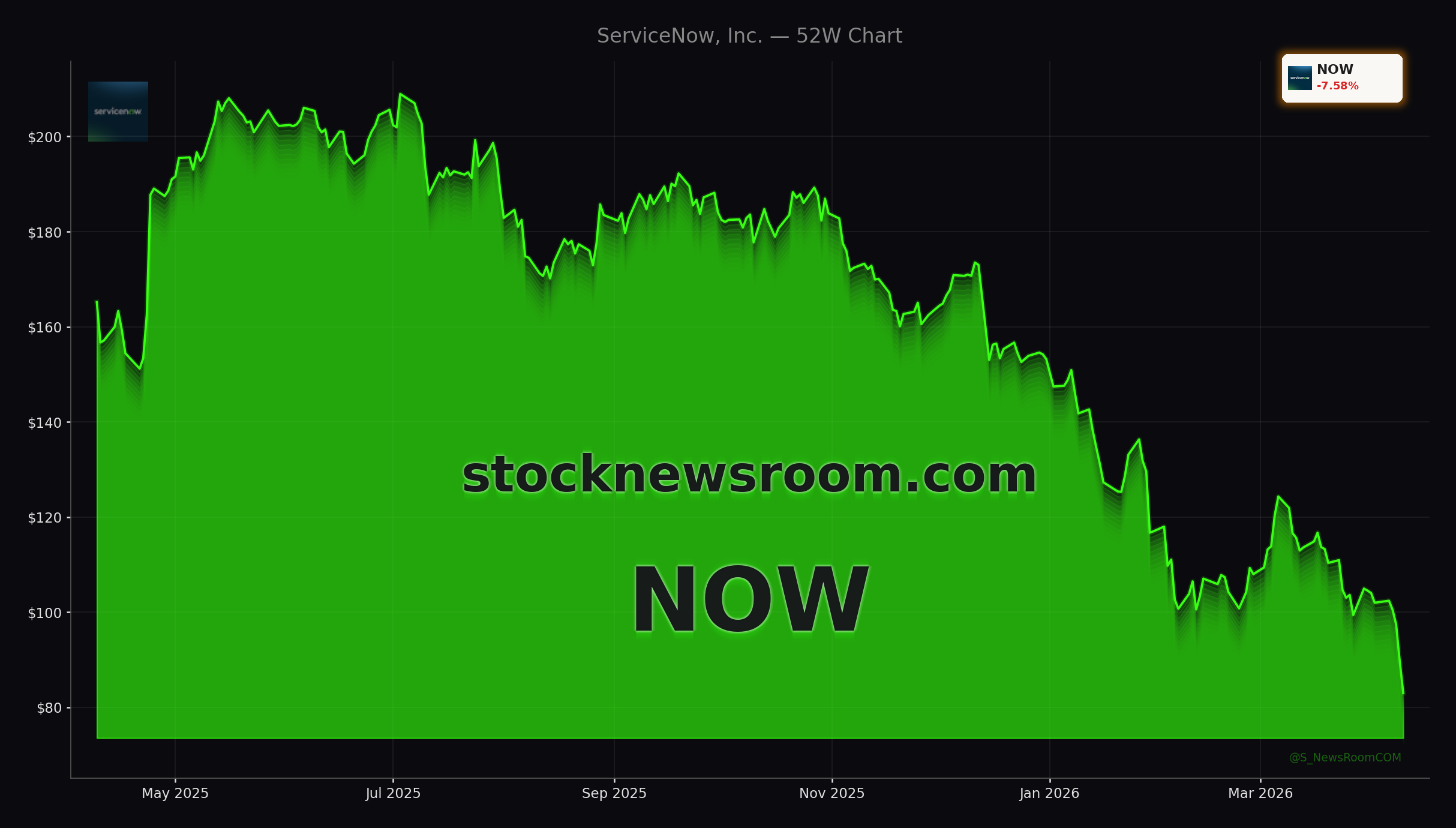
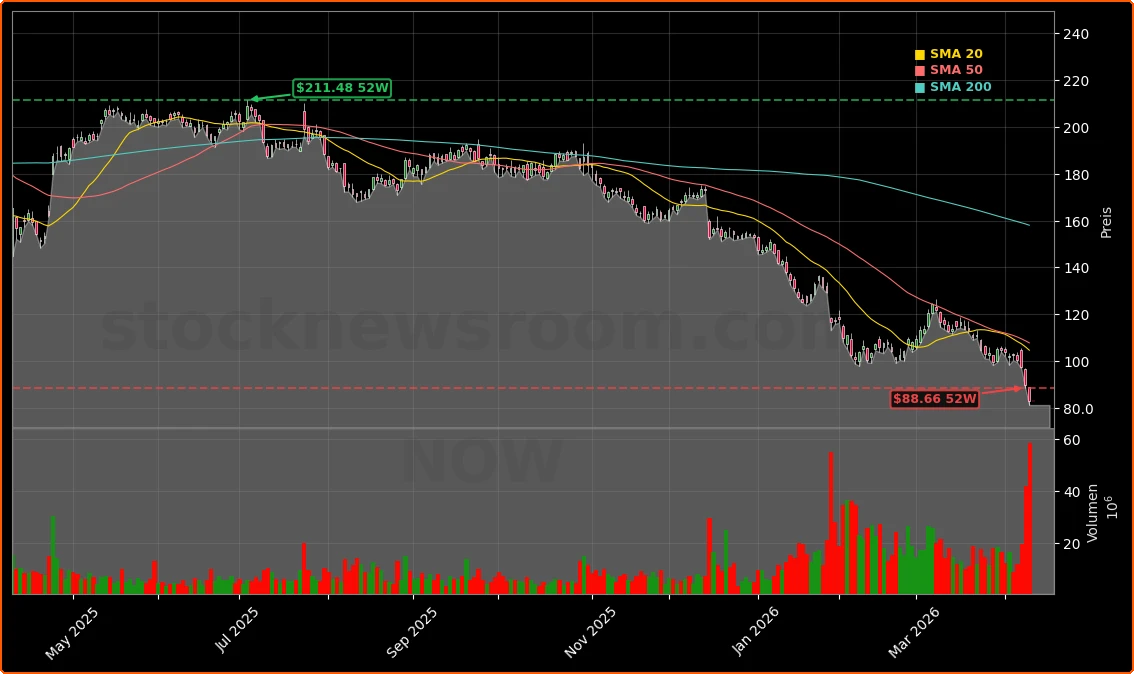
That shift is hitting the stock at a delicate moment. NOW has fallen about 46% year‑to‑date and now trades roughly 61% below its 52‑week high of $211.48 set in July 2025. Friday’s close at $83.00 on the NYSE, with heavy volume around 58 million shares, marked the fourth straight daily decline and a clear breakdown to new one‑year lows. For investors who once paid a rich multiple for ServiceNow as a pure‑play workflow winner in the AI era, the ServiceNow Forecast now embeds a lot more uncertainty on both growth and margins.
How are analysts resetting the ServiceNow Forecast?
UBS analyst Karl Keirstead said he now expects “skinnier‑than‑normal beats” over the coming quarters and trimmed current remaining performance obligations (cRPO) growth expectations for the end of 2026 to 16%, down from a prior 20%. He also cited mounting pressure on budgets for non‑AI application software as Fortune 500 IT departments shift dollars toward data, infrastructure and core AI initiatives. That backdrop leaves less room for upside to ServiceNow’s guidance for roughly 19% organic subscriber revenue growth in 2026.
UBS is not alone in taking a more cautious stance. TD Cowen recently cut ServiceNow to Hold with a $129 target, while other firms including Stifel and Wells Fargo have lowered price targets but kept positive ratings, arguing that the selloff has run ahead of fundamentals. Stifel, for example, still rates the stock Buy with a reduced target of $135, highlighting strong year‑end execution and a rebuilding backlog. Across Wall Street, consensus remains skewed toward Buy, and several houses continue to point to ServiceNow’s Now Assist generative AI suite, which has already surpassed $600 million in annual contract value, as evidence of real AI monetization.
What is driving the ‘SaaS‑pocalypse’ narrative?
ServiceNow is being hit in the crossfire of a broader de‑rating of software as investors price in the risk that AI agents could commoditize traditional subscription moats. The launch of Anthropic’s Claude Managed Agents and Claude Code Security has intensified concerns that autonomous AI systems could take over functions ranging from IT service management to cybersecurity triage—areas served today by names like ServiceNow, Cloudflare and CrowdStrike. At the same time, Meta Platforms’ latest open‑weight AI model has reinforced the idea that foundational models might shift value away from SaaS front‑ends and toward cloud and chip providers such as NVIDIA.
Within ServiceNow’s portfolio, analysts see customer service management as a particular flashpoint. UBS flagged customer support as “ground zero” for AI‑driven headcount reductions, which could cap seat expansion in that roughly 10% revenue segment. That feeds directly into the bearish ServiceNow Forecast: slower seat growth, potentially lower pricing power if customers can offload tickets to cheaper agentic AI, and thinner upside versus guidance.
Yet the disruption story is not one‑sided. ServiceNow has moved aggressively to embed AI across its platform and has a direct partnership with Anthropic, integrating Claude models into its AI capabilities. CEO Bill McDermott has insisted that no enterprise AI company is better positioned for sustainable profitable growth, emphasizing deep integration into mission‑critical workflows at large customers. Bulls argue that those deep hooks and compliance, security and governance features are difficult for raw models to replicate on their own.
How do peers and contrarians view today’s selloff?
Friday’s decline also underscored how crowded the software‑AI fear trade has become. Other enterprise names, including Salesforce, Datadog, Palantir, Intuit, Atlassian, Autodesk, Adobe, Oracle and Workday, were all under pressure this week as Wall Street reallocated toward infrastructure and semiconductor winners. Chip suppliers and hyperscaler allies—from Broadcom to Apple and Tesla on the hardware side—have generally held up better as investors focus on who supplies the compute, not who delivers the workflow.
Despite the negative momentum and a middling technical profile—ServiceNow holds a composite rating of just 49 out of 99 at one major research service—there are early signs of contrarian interest. Institutional investors such as DDD Partners have sharply increased their holdings, and some portfolio managers publicly argue that the recent 70–80% drawdowns in high‑quality SaaS names resemble prior panic phases that were followed by V‑shaped recoveries. One frequently cited trading roadmap is to accumulate shares around or below $100 with an intermediate‑term target in the $150 area, assuming that growth stabilizes and AI revenue ramps.
What should US investors watch next for the ServiceNow Forecast?
Fundamentally, ServiceNow still targets more than 20% subscription revenue growth in 2026 and a free‑cash‑flow margin around 36%, up from roughly 31.5% and 35% in 2024 and 2025. The company has also authorized an additional $5 billion in share repurchases and plans a $2 billion accelerated buyback, a sign that management views the current valuation as compelling. At the same time, concerns linger around the $7.75 billion cash acquisition of Israeli cybersecurity firm Armis, which has raised questions about organic growth, and around whether AI‑driven efficiencies will limit seat‑based pricing models across the sector.
The next major catalyst for the ServiceNow Forecast will be the company’s upcoming Q1 2026 earnings report on April 22, where investors will scrutinize subscription growth, cRPO trends, early Now Assist adoption data and any updated commentary on AI agents. A clear reaffirmation of long‑term targets, plus evidence that AI is expanding, not cannibalizing, the platform could help ease talk of a “SaaS‑pocalypse.” Conversely, any hint of decelerating deals or enterprise pushback on pricing would bolster the bear case and could force another round of estimate cuts.
Related Coverage
For a deeper dive into how generative AI is reshaping sentiment around the stock, including details on the company’s latest AI products and strategy, investors can read this analysis of ServiceNow’s AI strategy and recent share price crash. To understand the other side of the trade—where the market is rewarding infrastructure and chip players that power AI workloads—have a look at our coverage of Broadcom’s AI chips and the custom silicon boom, which highlights why capital may be rotating away from SaaS and toward data‑center enablers.
We now also expect skinnier-than-normal beats in the coming quarters and are trimming our growth estimates.— Karl Keirstead, UBS analyst
In the end, the ServiceNow Forecast now reflects a tug‑of‑war between AI disruption fears and a still‑solid growth and cash‑flow profile. For US investors, the stock has clearly lost its AI premium, but the coming quarters will show whether that gap closes through better execution or weaker fundamentals. With sentiment washed out and volatility high, the next earnings print and AI adoption metrics will be pivotal in determining whether today’s “SaaS‑pocalypse” narrative proves durable—or just another buying opportunity in a quality franchise.