
Is the latest SLB Forecast cut just short-term conflict noise, or the start of a much bigger rerating story?

How is the SLB Forecast impacting the stock today?
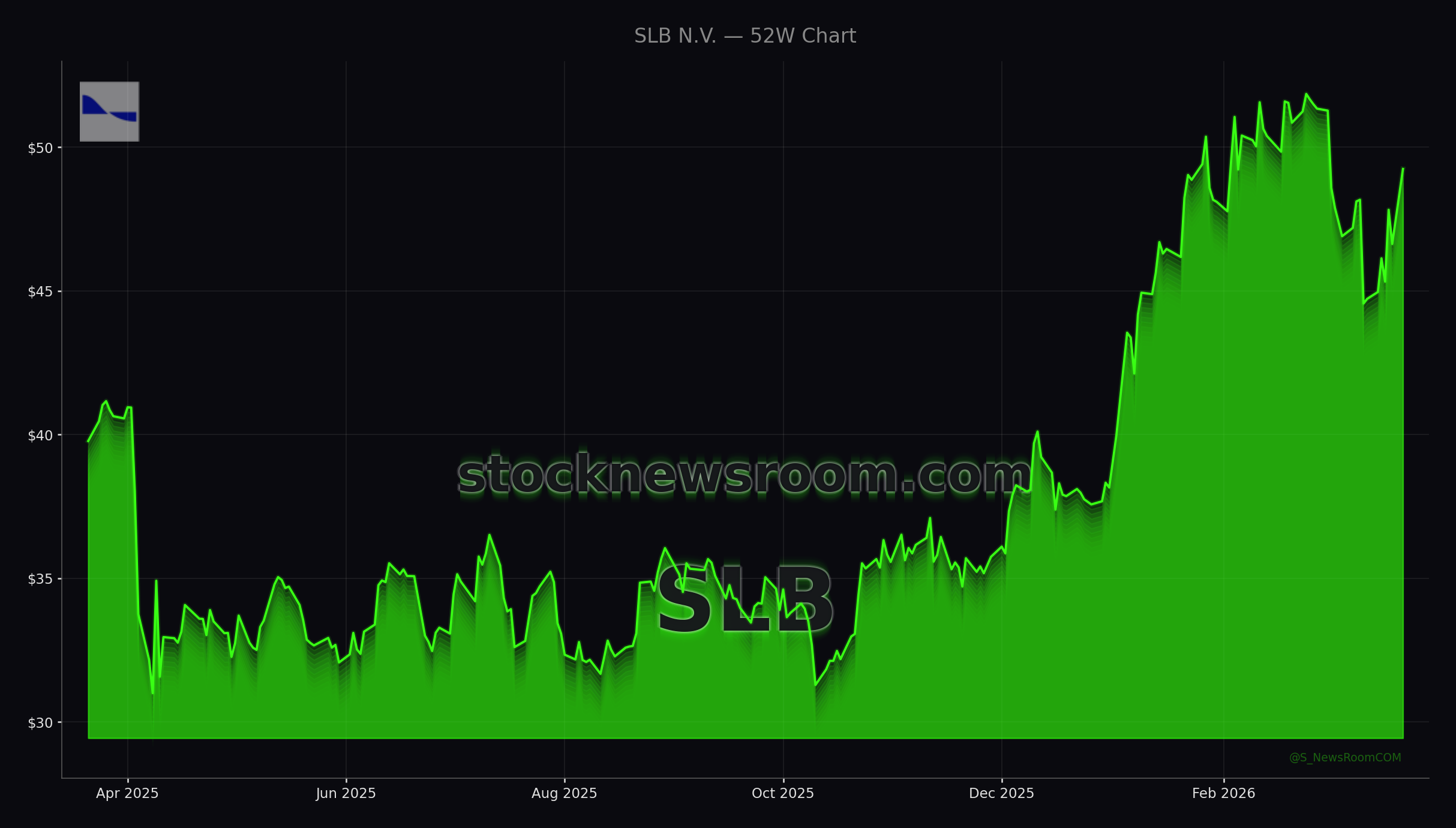
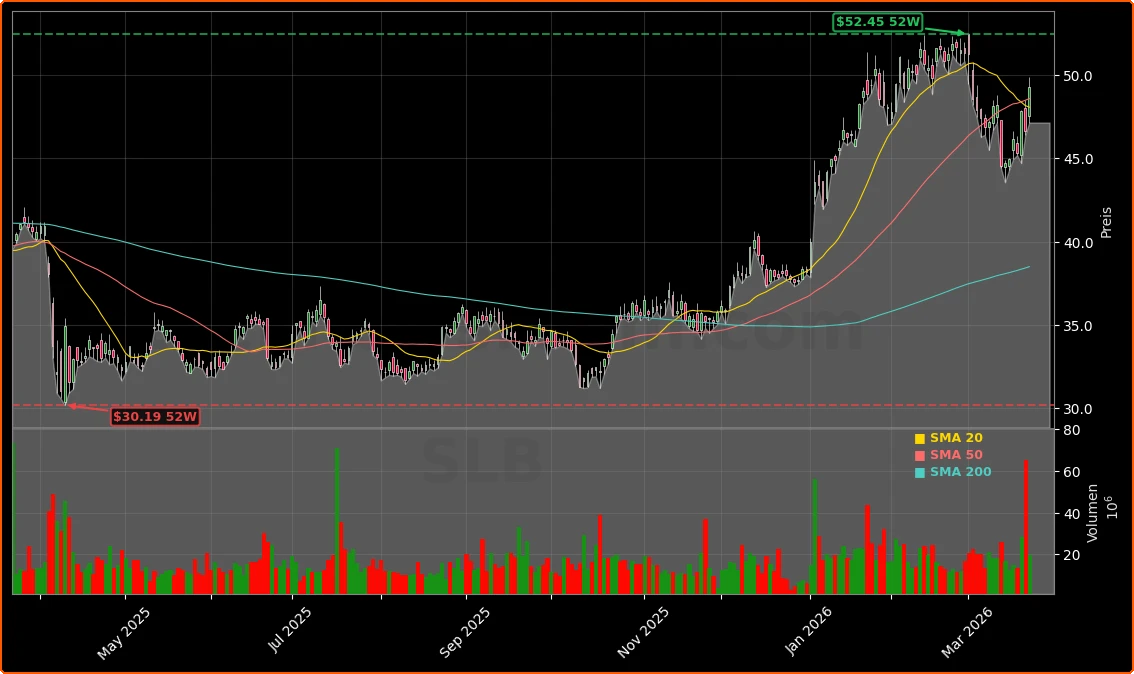
SLB shares traded around $49.25 on Monday, up roughly 5.6% from the prior close of $47.04, recovering part of the drop that followed the company’s Q1 guidance cut earlier in March. The stock still sits below its 52‑week high near $52.45 reached on March 2, underscoring how recent volatility around the Iran conflict has weighed on sentiment even as broader benchmarks like the S&P 500 and Dow Jones Industrial Average have held up relatively better.
The immediate catalyst for Monday’s move was a buy recommendation from Citigroup, which urged clients to accumulate SLB “on weakness.” The call comes after the stock had fallen about 9% from pre‑conflict levels, despite SLB’s strong free cash flow profile and diversified global exposure. Wall Street appears increasingly willing to look through the near‑term earnings drag embedded in the latest SLB Forecast and focus instead on the multiyear demand for repair, maintenance, and new projects that may follow the current disruption.
At roughly under 20 times trailing earnings, SLB continues to trade at a discount to many high‑quality industrial and technology names in the S&P 500, even though its portfolio increasingly blends traditional oilfield services with digital and software‑driven solutions. That valuation backdrop is a core part of the bullish narrative around the updated SLB Forecast.
What changed in the SLB Forecast for Q1 2026?
On March 11, SLB revised its Q1 2026 outlook, warning that it expects to incur additional costs tied mainly to the Iran conflict and related operational disruptions in the Middle East. Management now anticipates a negative earnings per share impact of approximately $0.06 to $0.09 for the quarter, alongside revenue that will come in lower than previously expected.
The company emphasized that the pressure is largely near term and operational rather than structural. SLB highlighted its long experience operating through geopolitical shocks in the Middle East and pointed to the underlying resilience of its global franchise. With four major divisions — Digital & Integration, Reservoir Performance, Well Construction, and Production Systems — SLB is positioned across the full life cycle of oil and gas development, from subsurface modeling to production infrastructure.
For U.S. investors, the updated SLB Forecast underlines how quickly Middle East risk can filter into earnings, even for a diversified global player. Yet it also frames a potential setup where a few cents of near‑term EPS pressure could translate into higher long‑term activity as customers allocate capital to repair damaged assets and harden critical infrastructure.
Does the Iran conflict create a longer-term opportunity for SLB?
Recent attacks have damaged key oil and gas infrastructure in the Persian Gulf, hitting facilities owned by majors such as Shell, Exxon Mobil, and Occidental Petroleum. When wells, gas‑to‑liquids plants, and processing hubs go offline, service providers like SLB initially feel the pain in volumes and project delays. However, restoring and upgrading those assets over the next several years could generate significant high‑margin work.
That is the core argument behind Citigroup’s constructive stance and other bullish commentary on SLB’s long‑term setup. Elevated oil prices driven by supply risk may give upstream producers and national oil companies larger budgets to deploy on both new projects and recovery operations. SLB’s deep domain expertise and high‑end technology — from reservoir modeling to advanced subsea systems — should position it as a key beneficiary once the immediate disruption passes.
Competitively, SLB operates in a field that includes TechnipFMC, Oceaneering, and integrated majors like Exxon Mobil and Chevron that increasingly build in‑house digital capabilities. While some rivals have recently outperformed — TechnipFMC’s subsea backlog, for example, has surged — SLB still commands the broadest global footprint and service mix. That breadth is central to the positive long‑term SLB Forecast many analysts are now articulating.
How do deepwater wins and analyst targets support the SLB Forecast?
Beyond the Middle East headlines, SLB continues to add high‑quality international work that supports a more constructive multi‑year outlook. The company recently secured a major deepwater contract from CNOOC for 20 wells in the Kaiping 18‑1 field in the South China Sea, acting as the main contractor for the entire subsea architecture. The deal underscores SLB’s strength in integrated subsea solutions and aligns with its strategy of focusing on production‑oriented, internationally weighted growth.
Analysts have started to reflect both the Q1 guidance cut and these contract wins in their models. Bernstein’s Guillaume Delaby lifted his price target on SLB from $52.30 to $56.10 while reiterating an “Outperform” rating, explicitly adjusting the firm’s valuation approach after the company flagged lower Q1 revenue. Other bullish research argues that current enterprise value implies only minimal long‑term free cash flow growth, leaving room for upside if SLB executes on its digital, deepwater, and international expansion plans.
Against this backdrop, SLB has been highlighted alongside global energy names such as Exxon Mobil and Occidental as one of the smarter ways to gain leveraged exposure to both conventional oil and gas demand and the growing digitalization of the energy system. While mega‑cap techs like NVIDIA and Apple still dominate the NASDAQ narrative, the refreshed SLB Forecast suggests that select energy technology plays may offer more attractive risk‑reward for investors seeking diversification within U.S.‑listed equities.