
Is the Snowflake Class Action turning a routine tech pullback into a deeper crisis of confidence for this high‑growth data‑cloud stock?

How is Snowflake trading on Wall Street?
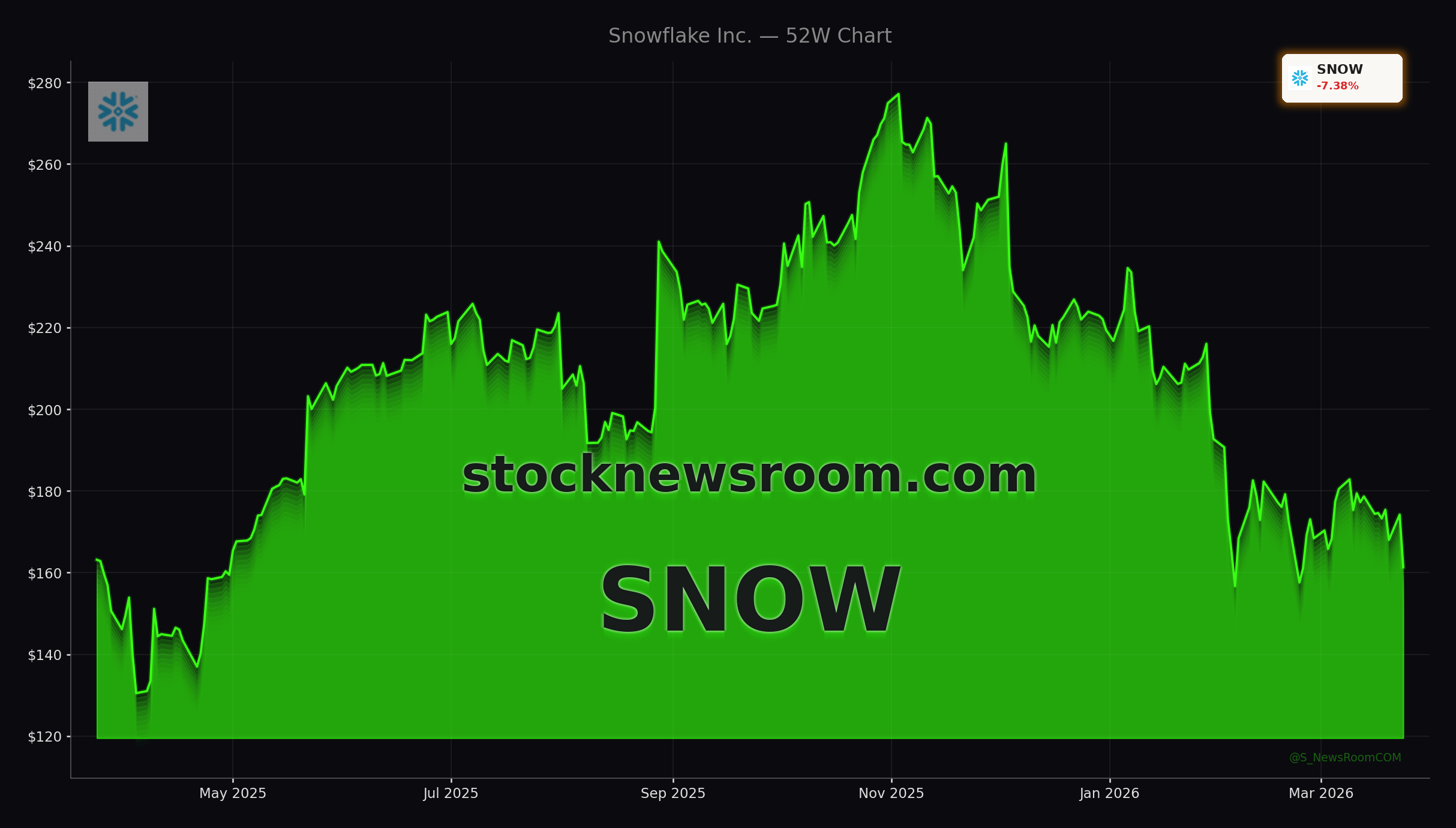
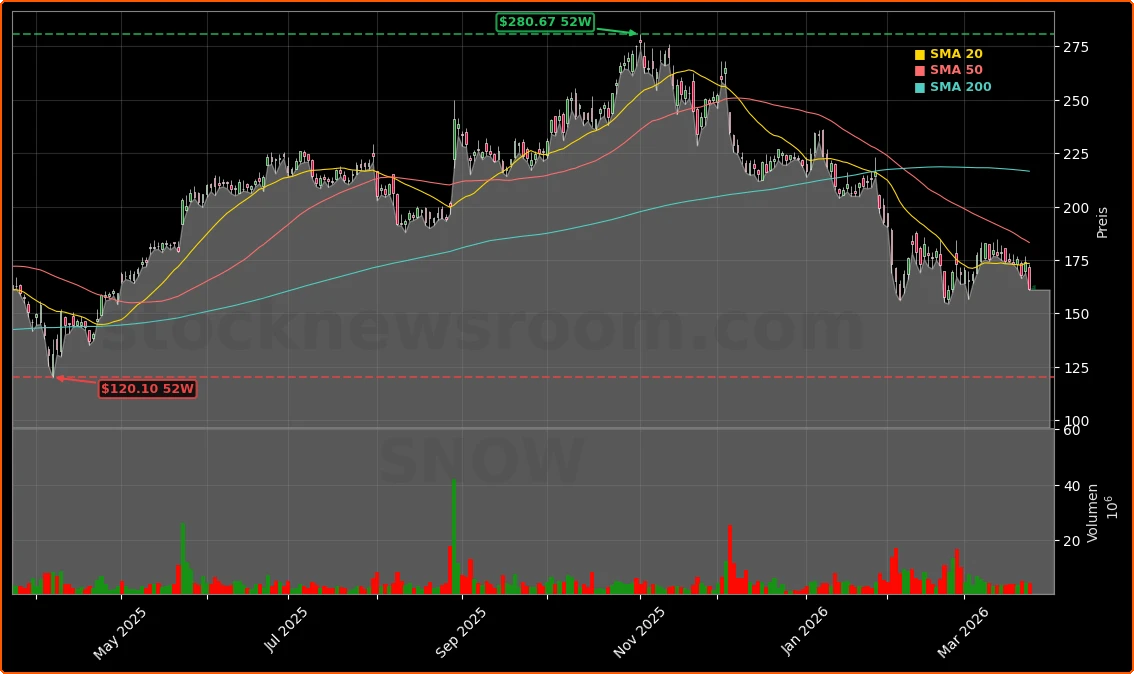
Snowflake Inc. closed regular Tuesday trading on the NYSE at $161.34, down 7.38% from the previous close of $174.38, before ticking slightly higher to $163.00 (+1.03%) in after-hours trading (all prices in USD, ET). The pullback follows renewed attention on the Snowflake Class Action filings and continues a broader downtrend since the stock’s sharp drop on February 28, 2024, when the company disclosed revenue headwinds tied to product-efficiency gains and storage-pricing changes.
Snowflake, a prominent data-cloud and AI infrastructure player often mentioned alongside NVIDIA and other high‑growth tech names, has been a key beneficiary of enterprise AI and cloud data trends. Yet the growing legal overhang underscores that even fast-growing software names can face significant headline risk. On a volatile NASDAQ session, Snowflake’s move stood out, underperforming many large-cap software peers, including Apple and Tesla, as investors rotated defensively within the technology sector.
What is at the core of the Snowflake Class Action?
Multiple investor-rights law firms have now filed securities complaints against Snowflake Inc., all focused on a common class period: June 27, 2023 through the market close on February 28, 2024. The Snowflake Class Action cases generally allege that Snowflake and certain senior executives made materially positive statements about customer usage, consumption trends, and product developments, while failing to adequately warn that new product efficiencies and pricing models were expected to materially pressure consumption and revenue.
Specifically, complaints highlight product initiatives such as Iceberg Tables and tiered storage pricing. These changes are alleged to have improved efficiency for customers but reduced the volume-based consumption that underpins Snowflake’s revenue model. When Snowflake disclosed the impact of these headwinds on February 28, 2024, the stock reportedly fell by more than 18% in a single session, erasing billions in market value and triggering the wave of litigation.
Several law firms—including Rosen Law Firm, Pomerantz LLP, Bernstein Liebhard, Faruqi & Faruqi, Bronstein Gewirtz & Grossman, Levi & Korsinsky, and The Gross Law Firm—are vying to represent shareholders. The current key date across the Snowflake Class Action landscape is April 27, 2026, the deadline for investors to seek appointment as lead plaintiff in the consolidated case.
Are insider transactions adding pressure on Snowflake?
Against this legal backdrop, insider activity at Snowflake Inc. is drawing additional scrutiny. Fresh Form 4 filings show a string of recent share surrenders and sales by top executives. On March 20, 2026, CEO Sridhar Ramaswamy surrendered 4,427 shares at a reference price of $175.40, valued at roughly $776,500, primarily to cover tax obligations linked to equity vesting. Vice President Vivek Raghunathan surrendered 3,603 shares on the same date at the same price, while officer Emily Ho likewise surrendered 765 shares before selling 2,141 shares on March 23 at an average of $173.97.
Co‑founder and director Benoit Dageville sold 874 shares on March 23 at $170.01 under a Rule 10b5‑1 trading plan, after surrendering 885 shares days earlier to cover taxes. Vice President Christian Kleinerman sold 2,621 shares at $170.01 on March 23, also under a 10b5‑1 plan, following a 2,653‑share surrender at $175.40 on March 20. These come on top of a long-running pattern of scheduled sales by former chairman Frank Slootman and other directors throughout late 2025 and early 2026.
While share surrenders tied to vesting and pre‑planned 10b5‑1 sales are common in Silicon Valley and do not in themselves prove any wrongdoing, the timing—so close to the eruption of the Snowflake Class Action narrative and amid a falling stock—could weigh on investor sentiment. Portfolio managers already nervous about legal risk may interpret continued insider selling as a signal that management is less confident in near‑term share performance.
How are analysts and peers reacting?
Snowflake remains widely covered on Wall Street, with major firms such as Goldman Sachs, Morgan Stanley, Citigroup, and RBC Capital Markets previously highlighting the company as a structural winner in cloud data and AI workloads. Several of these banks had set aggressive price targets based on long‑term expansion in data consumption and Snowflake’s ability to monetize enterprise AI. That bullish thesis is now being tested as the market weighs whether product-driven efficiency gains structurally cap consumption growth.
Relative to large‑cap software and AI bellwethers such as NVIDIA and platform players like Apple, Snowflake’s legal uncertainty stands out. While many mega‑cap tech names have faced regulatory or antitrust questions, the Snowflake Class Action directly challenges the company’s disclosure practices and the credibility of its growth guidance. For institutional investors benchmarked to the S&P 500 and NASDAQ, this introduces a distinct governance and litigation dimension on top of the usual execution risk.
So far, there has been no broad-based analyst downgrade wave centered solely on the lawsuits, but legal risks are increasingly mentioned in research notes as a factor that could compress Snowflake’s valuation multiple relative to high‑growth peers. Any future revisions to revenue guidance, or additional disclosures around product economics, will likely be dissected for consistency with allegations raised in the litigation.
For U.S. investors, the next key milestones are the April 27, 2026 lead‑plaintiff deadline and any court decisions on motions to dismiss. Until there is more clarity on the scope and strength of the Snowflake Class Action claims, many portfolio managers may choose to size positions more cautiously, treating Snowflake as a higher‑beta, higher‑headline‑risk play within the broader AI and cloud‑software trade.