Will the SoFi Short Seller Report derail the fintech’s growth story, or does Muddy Waters simply hand bulls another buying dip?

How is SoFi stock reacting on Wall Street?
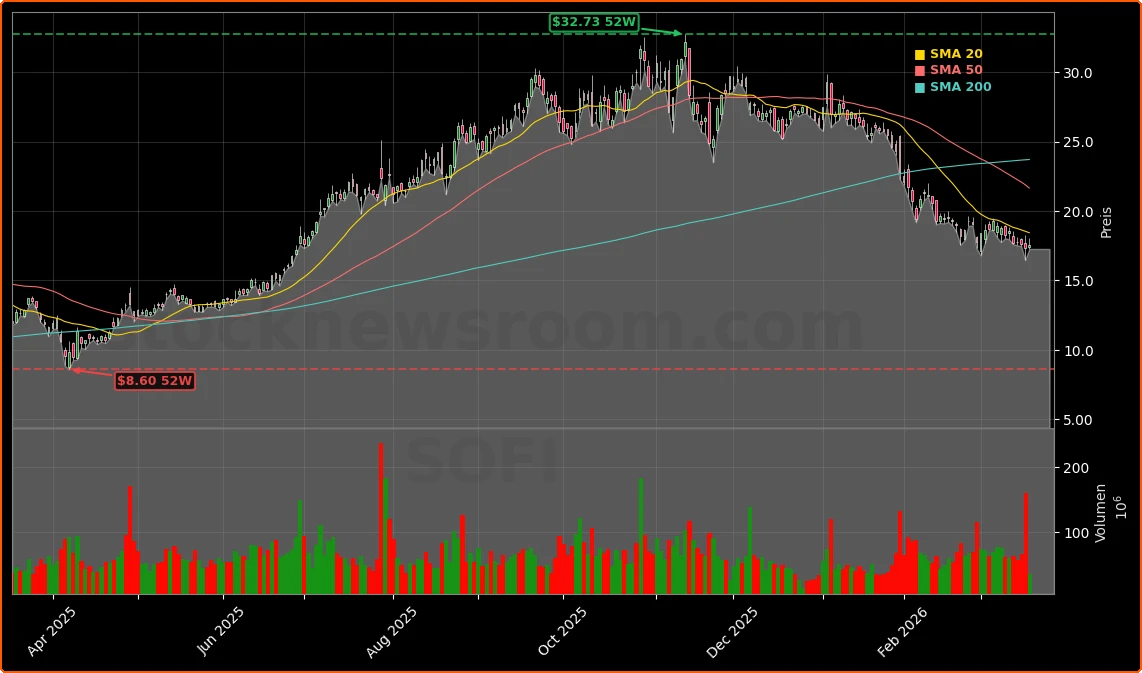
SoFi Technologies (SOFI) traded around $17.57 on Wednesday, up about 1% from the prior close of $17.49, even as the Nasdaq Composite slipped. That resilience comes just a day after Muddy Waters released the SoFi Short Seller Report, which briefly pushed the shares lower by roughly 1.5% in heavy volume. The stock is still down about 36% year to date after a roughly 70% surge in 2025, leaving it volatile but far below its recent 52‑week highs, not in record territory.
The move higher suggests many traders saw the report as an opportunity to buy the dip rather than the start of a sustained collapse. The backdrop is a fintech space that has lagged broader market leaders like NVIDIA and Apple, with rising rates and tighter credit standards pressuring high‑growth lenders. Against that macro setting, any credibility hit from a short thesis can quickly shift sentiment, especially for a stock with a high retail investor following.
What does the SoFi Short Seller Report claim?
The 28‑page SoFi Short Seller Report characterizes the company as a “financial engineering treadmill” instead of a durable growth business. Muddy Waters alleges that SoFi understates debt, manipulates loan metrics and dilutes shareholders to enrich insiders, even asserting that accounting decisions may be tied to CEO performance bonuses. It also questions personal loan charge‑off disclosures and the sustainability of SoFi’s rapid expansion into new products.
For portfolio managers, the core accusation is that SoFi’s earnings quality may be weaker than headline numbers suggest. If the claims were ultimately validated, it could force a re‑rating similar to past high‑profile short campaigns that hit other growth names, though there is no evidence of regulatory action at this stage. SoFi, a licensed bank holding company, stresses that it follows GAAP and SEC rules under tight supervisory oversight.
How is SoFi responding to Muddy Waters?
Management has mounted an unusually aggressive counterattack. In a formal statement, SoFi said the Muddy Waters publication “demonstrates a fundamental lack of understanding” of its financial statements and business model, and called the document “factually inaccurate and misleading.” The company added that Muddy Waters “stand to profit from their own misleading report,” highlighting the firm’s short position.
SoFi announced it will explore potential legal action against Muddy Waters, an escalation that could keep the dispute in headlines for months. Muddy Waters, which has a long track record of activist short campaigns, responded that it has been sued multiple times and remains “undefeated.” That public back‑and‑forth means U.S. investors should expect continued volatility, even if fundamentals remain unchanged in the near term.
What signals are insiders and fundamentals sending?
CEO Anthony Noto has tried to send a clear counter‑signal to the SoFi Short Seller Report by buying stock in the open market. Regulatory filings show he purchased 28,900 shares on Tuesday at a weighted average price of about $17.32, an investment of just over $500,000 and his second open‑market buy in 2026. Combined with a prior March purchase, Noto has committed roughly $1.5 million of his own capital to SoFi shares this year, reinforcing his reputation for “buying the dip.”
Fundamentally, SoFi reported Q4 2025 adjusted earnings of $0.13 per share, up 160% year over year, on net adjusted revenue of about $1.03 billion, a 40% increase. The company added a record 1 million members in the quarter, bringing total membership to 13.7 million and underscoring traction across personal loans, credit cards, mortgages, investing and its digital bank. Still, technicals are mixed: SoFi’s Composite Rating around the mid‑40s and an Accumulation/Distribution Rating of E indicate significant institutional selling pressure despite improving profits.
What does this mean for U.S. investors now?
For diversified U.S. portfolios, the clash over the SoFi Short Seller Report is less about immediate bankruptcy‑type risk and more about valuation, governance and trust. The stock’s sharp swings, heavy short interest and emotionally charged debate make it a higher‑beta satellite position rather than a core holding for most investors, especially compared with mega‑caps like Tesla or Apple that anchor many growth portfolios.
We intend to explore potential legal action against Muddy Waters for the factually inaccurate and misleading report they shared about our business.— SoFi Technologies statement
Without fresh analyst rating changes from major banks such as Goldman Sachs, Morgan Stanley, Citigroup or RBC Capital in direct response to the report, Wall Street’s institutional verdict is still forming. Many professionals will likely wait for the next quarterly update or any regulatory commentary before materially adjusting models. Until then, SoFi’s legal posture, insider activity and loan performance data will be critical signposts.