
Can Solana shake off the latest DeFi hack at Drift, or is this the moment leveraged traders finally hit the brakes?

How is Solana trading after the Drift attack?
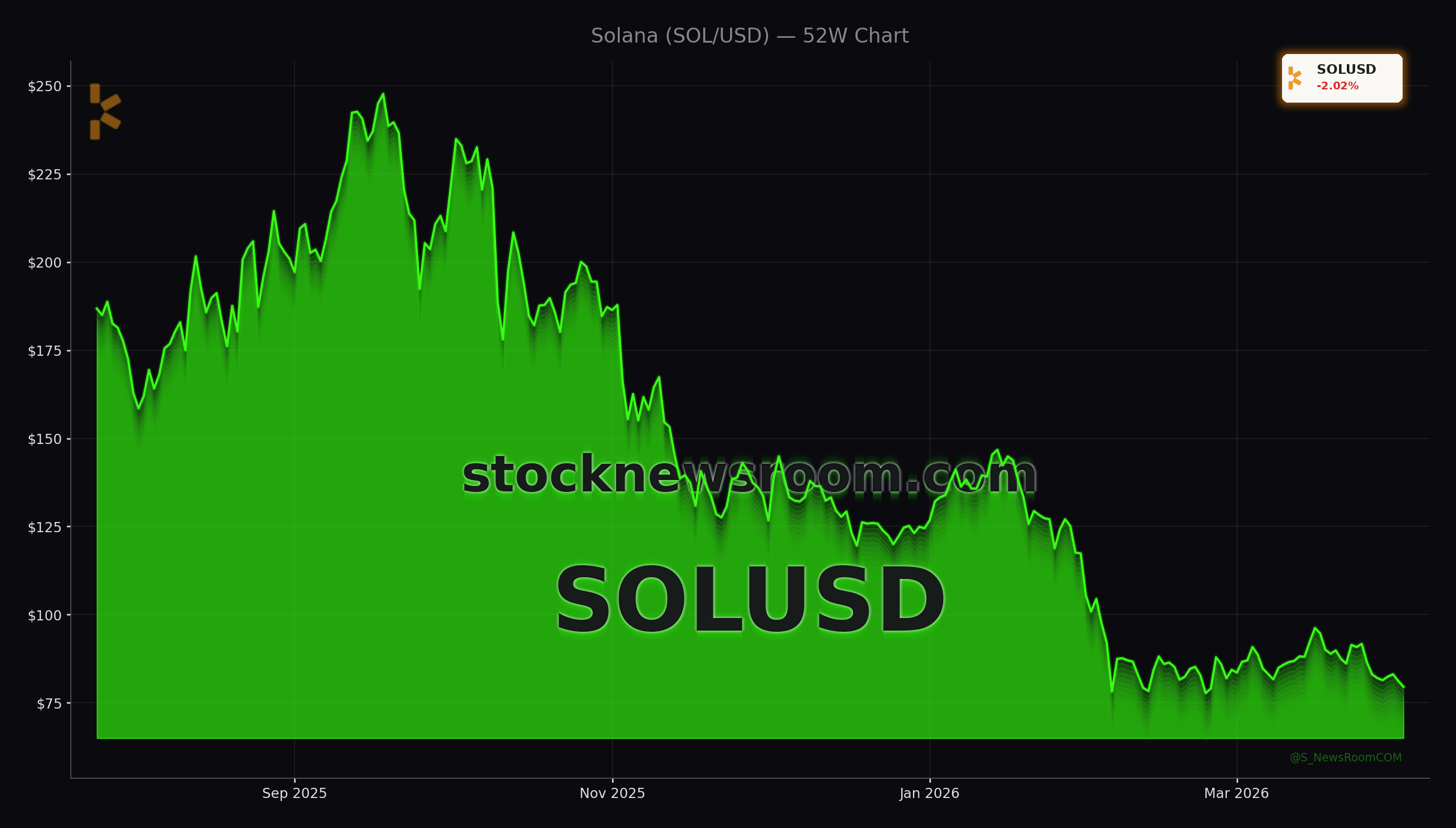
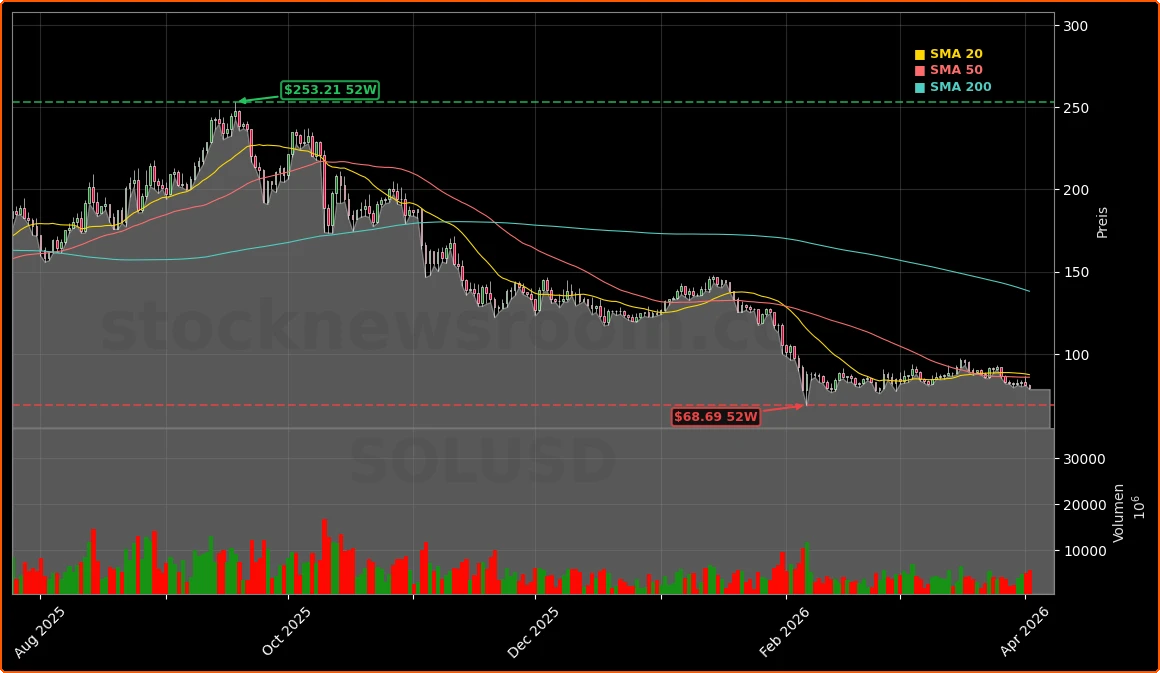
On Thursday morning in Europe, **Solana (SOLUSD)** changed hands around $79.33, down roughly 5.24% from the previous close of $81.19 and extending this week’s losses. The token has now fallen about 6% over the last 24 hours and more than 12% over the past seven days, underperforming large-cap peers even as Bitcoin hovers near $66,000. From a technical perspective, SOL has clearly lost momentum after failing to sustain levels above $85 earlier in the week.
Traders watched a break below $82–$84 support with growing concern, as SOL slid through $80 and briefly tested the $78 area. On the hourly chart, the pair dropped below a prior bullish trend line around $81.50 and now trades under the 100-hour simple moving average, signaling short-term control by sellers. Immediate resistance is seen near $80.25, followed by $82.50 and then $85. A decisive daily close back above $85 would be the first indication that bulls are regaining their footing.
For now, support levels to watch cluster at $78 and $75. A failure to hold $75 could open the door to a deeper retracement toward $70, a key psychological line where dip buyers may attempt to step in. With SOL still far below its all‑time high near $293 set in early 2025, the current correction is painful but not unprecedented in the context of prior crypto cycles.
What happened in the Solana DeFi Hack at Drift?
The immediate catalyst for the latest leg lower was a new Solana DeFi Hack targeting Drift, one of the largest derivatives and margin trading platforms in the Solana ecosystem. Within a short window, attackers allegedly siphoned off digital assets worth at least $200 million, making it one of the most severe DeFi breaches on Solana in recent months. Part of the haul was reportedly swapped into stablecoins and moved across multiple networks, a tactic commonly used to obscure on-chain traces.
The incident has frozen many users’ funds after Drift halted deposits and withdrawals while it investigates and attempts to secure the protocol. The DRIFT governance token has seen heavy selling, but the reputational damage may be even more significant: the attack struck a core venue for leveraged trading on Solana, amplifying doubts about the maturity of its DeFi tooling and audits. For U.S. investors accustomed to stricter rules in listed products on the NYSE and NASDAQ, the episode underscores the gap between decentralized platforms and traditional market infrastructure.
This Solana DeFi Hack also arrives at a time when regulators in Washington and other major jurisdictions are already scrutinizing DeFi. Large hacks often become case studies for policymakers arguing for tighter oversight, and they can weigh on the willingness of institutional desks—whether at NVIDIA-adjacent AI funds seeking on-chain exposure, or crypto-facing hedge funds—to allocate capital to experimental protocols running on newer blockchains like Solana.
How are macro and crypto sector trends interacting?
Beyond protocol-specific risk, SOL’s slide reflects a broader risk-off tone across digital assets. The crypto market has struggled to regain sustained upside in 2026 after a downturn that began in October last year. Bitcoin’s inability to hold above $69,000, combined with weaker sentiment in high-beta tech on the NASDAQ, has made investors more cautious on altcoins, including **Solana (SOLUSD)**. Heightened geopolitical tension, including talk from the U.S. administration about potential ground operations in the Middle East, has added to the uncertainty and reduced appetite for speculative trades.
For multi-asset managers on Wall Street, Solana now trades as a high-volatility satellite position rather than a core holding, similar to how some handle concentrated exposures in names like Tesla or fast-moving chip leaders adjacent to NVIDIA. Many portfolios use Bitcoin or large-cap equities such as Apple as benchmark risk assets, with Solana occupying a smaller allocation that can be trimmed during macro shocks or protocol-specific scares like the current Solana DeFi Hack.
While on-chain metrics and developer activity on Solana remain areas of interest for long-term bulls, short-term flows tend to be dominated by derivatives positioning and cross-asset correlations. With the hourly MACD in a bearish configuration and the RSI holding below the neutral 50 line, technical traders see room for further downside unless SOL quickly reclaims the $82.50–$85 band.
What are analysts and investors watching next?
Despite the pullback to the high‑$70 range, some research outlets still project a rebound later in the second quarter if risk sentiment stabilizes. One widely followed price model sees **Solana (SOLUSD)** rallying toward roughly $135 by late May, which would imply more than 70% upside from current levels. Major Wall Street banks such as Goldman Sachs, Citigroup, and Morgan Stanley have not issued fresh public rating changes on Solana this week, but digital-asset desks are focusing on three key factors: the Drift team’s incident response, the speed of any on-chain upgrades to strengthen security, and Bitcoin’s ability to avoid a deeper break below current levels.
For U.S. retail traders using regulated exchanges, the immediate takeaway is that smart-contract and DeFi risks are additive to the typical volatility of a non-yielding asset. Position sizing, diversification across layer‑1 platforms, and attention to custody solutions remain central. Institutional players, meanwhile, may use the pullback after the Solana DeFi Hack to reassess whether Solana can maintain its niche as a fast, low‑fee chain for trading and gaming, or whether security concerns will drive more volume back toward Ethereum and other established ecosystems.
The Drift exploit is a stark reminder that in DeFi, speed and innovation mean little without battle-tested security and robust risk controls.— Jane Miller, digital asset strategist at Hudson Ridge Capital
In sum, the Solana DeFi Hack at Drift has accelerated an ongoing correction in SOL, but it has not yet broken the longer-term narrative around scalable alternative chains. The coming weeks will show whether improved security practices and a steadier macro backdrop can help restore confidence, or whether another leg down toward $70 will be needed before long-term buyers return in force.