Will the S&P 500 Middle East Conflict scare fade like past shocks, or could an oil spike finally break this rally?
How fragile is the S&P 500 in the Middle East conflict?
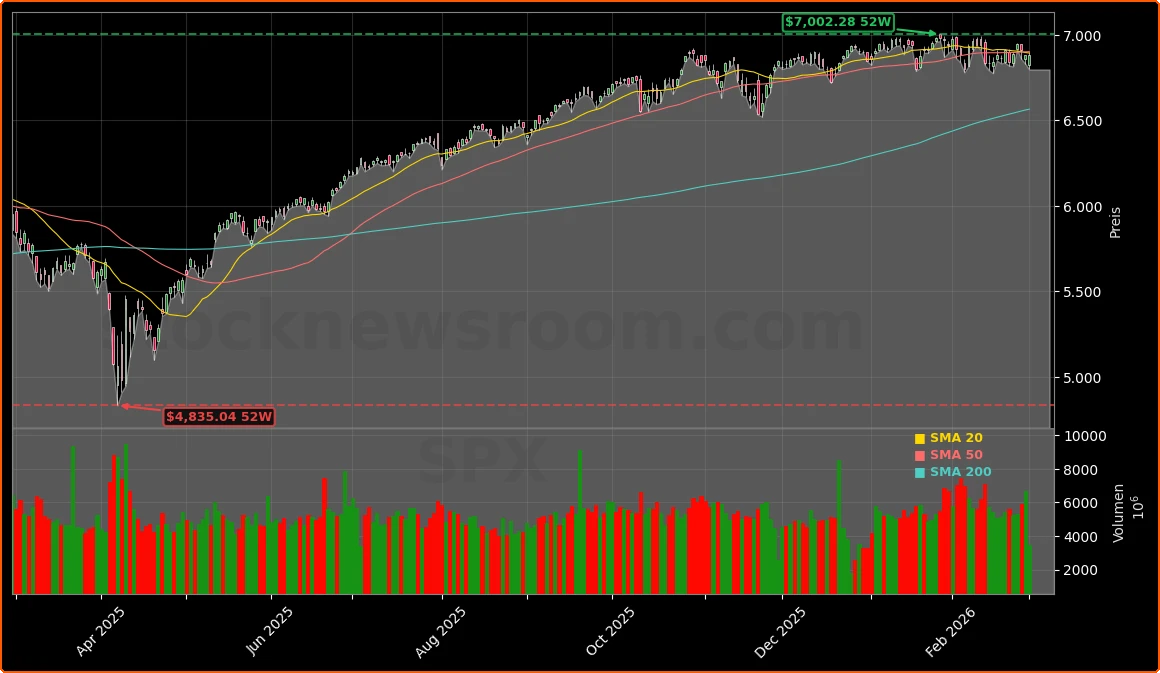
At first glance, the **S&P 500 Middle East Conflict** shock looked serious. Futures were down, Treasury yields slipped as investors sought safety, gold rallied and energy prices spiked after coordinated attacks on Iranian targets and subsequent reprisals. Early in Monday’s session, the S&P 500 fell close to 1%, before steady dip-buying erased losses by midday ET. The index remains less than 2% below its recent record highs and continues to trade in a tight range between roughly 6,775 support and 7,002 resistance, signaling an ongoing tug-of-war between bulls and bears.
Strategists at Morgan Stanley, led by Mike Wilson, argue that most geopolitical shocks historically generate only brief volatility for U.S. stocks unless they trigger a sustained and severe oil-price spike. Their 12‑month S&P 500 target of 7,800 implies moderate upside from current levels, even as they warn of near-term choppiness. Price targets from other major houses such as Deutsche Bank (8,000 year-end 2026), J.P. Morgan (7,500) and BofA Global Research (7,100) show that, for now, Wall Street still expects the index to grind higher despite regional conflict.
Will higher oil prices derail the rally?
The most immediate transmission channel from the Middle East to the S&P 500 is energy. Traffic through the Strait of Hormuz, a critical chokepoint for global crude and LNG, is estimated to be down about 70%, while insurance rates for tankers have surged as much as 50%. That combination is feeding through to higher fuel costs for sectors from airlines and cruise operators to heavy industry, and it risks reigniting inflation pressures that had been slowly easing.
For investors, the **S&P 500 Middle East Conflict** debate is really about where oil settles. If crude stabilizes after the initial shock, most strategists expect broader equities to absorb the hit. Energy and defense stocks, including names like Lockheed Martin, have already started to outperform, while energy-heavy ETFs have recently beaten the index. But if oil continues to climb sharply and stays elevated, margin pressure for transport, consumer and manufacturing names could force earnings downgrades and push the S&P 500 out of its current sideways pattern toward a deeper correction near the 6,550 area.
What does this mean for Apple, NVIDIA and other leaders?
Under the surface, Mike Wilson warns that a “stealth correction” is already underway, with the performance gap between the top 50 and bottom 50 S&P 500 constituents this year widening to its largest level in two decades. Mega-cap tech and communication services stocks such as Apple and NVIDIA continue to anchor the index, while many smaller and cyclical components lag badly. That leaves U.S. equities more vulnerable if risk sentiment sours and investors decide to lock in profits in the narrow group of winners that has driven most of the gains since 2023.
So far in 2026, U.S. markets have underperformed international peers, with non-U.S. developed stocks outperforming the S&P 500 by several percentage points after a similar gap in 2025. Concerns range from domestic political uncertainty and trade frictions to questions about whether artificial intelligence disruptions are fully priced in. In that backdrop, the **S&P 500 Middle East Conflict** acts as one more layer of uncertainty, rather than the single dominant driver of prices.
How are strategists positioning portfolios now?
Despite the headlines, major banks are not calling for wholesale de-risking. Morgan Stanley and J.P. Morgan both characterize the latest pullbacks as buying opportunities for long-term investors rather than the start of a bear market, provided oil does not spiral far higher. Many portfolio managers are rotating selectively: adding to energy, defense and high-quality dividend payers while trimming richly valued growth names that trade at steep premiums to the S&P 500 multiple, which still stands above 20 times forward earnings.
Dividend strategies are drawing renewed interest as a buffer against volatility. Historically, S&P 500 members that pay and grow dividends have outperformed non-payers by a wide margin, and funds focused on dividend growers currently yield roughly three times the broader index’s 1.1%. For retail investors, that offers a way to stay invested in U.S. equities while softening the blow if the **S&P 500 Middle East Conflict** or renewed inflation spark a deeper correction later in 2026.
Geopolitical shocks rarely derail U.S. equities for long unless they ignite a lasting surge in oil prices and inflation expectations.
— Mike Wilson, Chief U.S. Equity Strategist, Morgan Stanley
Conclusion
In the end, the **S&P 500 Middle East Conflict** has so far been a volatility event, not a trend change. The index’s modest 0.04% gain on Monday, after an early slide, underlines how conditioned investors have become to buy geopolitical dips unless corporate earnings or credit conditions clearly deteriorate.
Further Reading
- Stocks pare losses after U.S.-Israeli strikes as oil jumps (Reuters)
- Wall Street strategists update S&P 500 targets for 2026 (Bloomberg)
- Historical performance of U.S. stocks around geopolitical shocks (Morningstar)
- S&P 500 und Nahost-Konflikt bei Yahoo Finance (Yahoo Finance)