
Can Taiwan Semiconductor Earnings keep setting records as the AI supercycle accelerates, or is Wall Street’s optimism running too hot?

How critical are Taiwan Semiconductor Earnings for Wall Street?
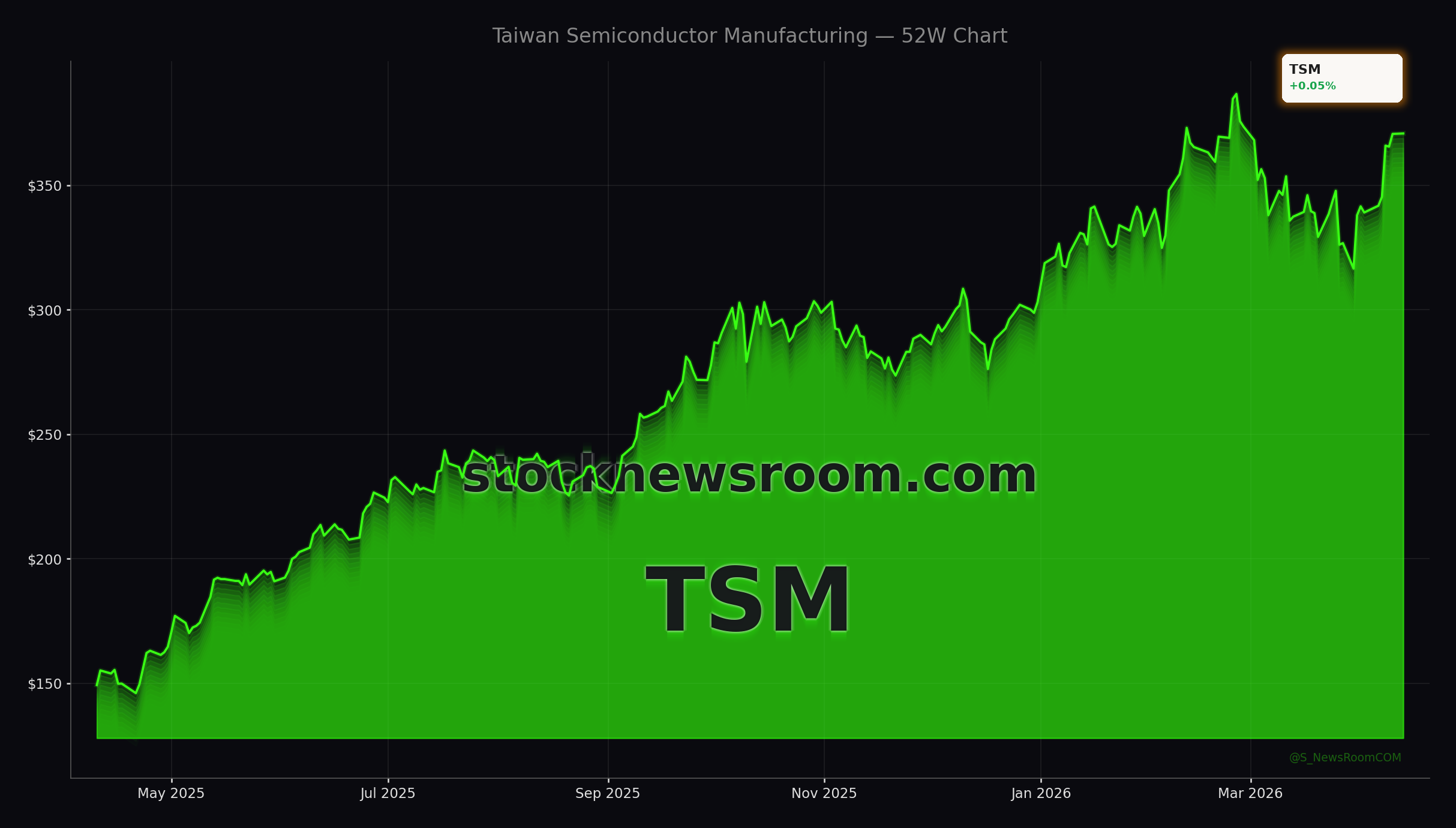
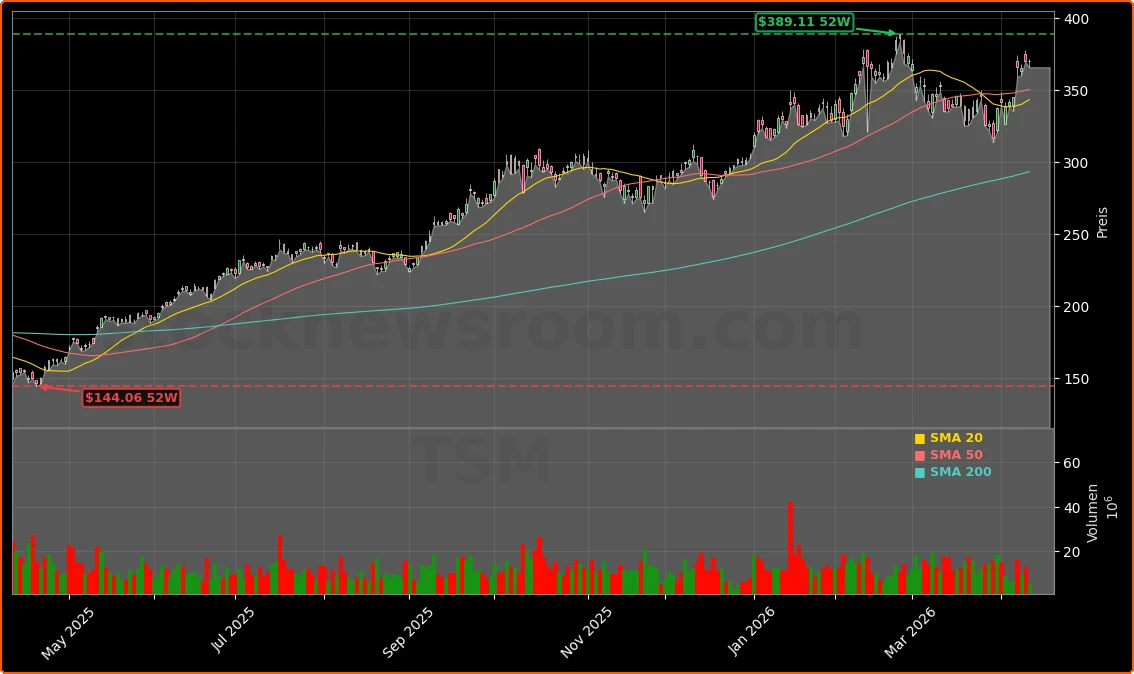
Taiwan Semiconductor Manufacturing Co. (TSM) has quietly become one of the most important swing factors for the S&P 500 and NASDAQ. The ADR last traded around $370.67, up more than 20% year to date, and its market cap near $1.9 trillion makes it one of the most valuable companies listed on the NYSE. With hyperscalers pouring more than $200 billion into AI infrastructure, the foundry’s results and outlook are now a proxy for the durability of the AI spending boom.
For Q1 2026, the company has already reported record revenue of roughly $35.6 billion, a 35% year‑over‑year jump in U.S. dollar terms. That figure landed at the high end of management’s own guidance range and comfortably ahead of Wall Street estimates, signaling that demand for advanced AI chips and 3‑nanometer process technology remains red‑hot. Thursday’s full Taiwan Semiconductor Earnings release will fill in the missing pieces: net income, margins and updated guidance for Q2 and the full year.
Consensus forecasts point to another record quarter on the bottom line as well, with several models pointing to net income growth of around 50% versus the prior year. If confirmed, it would mark a fourth consecutive record profit and the ninth straight quarter of earnings growth.
What are analysts expecting from TSMC’s guidance?
Analysts see Taiwan Semiconductor Earnings as less about what just happened and more about what management says next. Multiple firms have raised their targets into the print. Bank of America Securities reiterated its “Buy” rating and lifted its price target, citing extremely tight capacity in high‑performance computing and 3‑nanometer nodes. Davidson also rates the stock “Buy” with a $450 target, while Barclays has an “Overweight” rating and a $450 target as well. TD Cowen remains more cautious with a “Hold” rating and a $370 target, close to the current price.
On the call, investors will focus on three datapoints: Q2 revenue guidance, gross margin guidance (with some models pointing toward the mid‑60% range), and any update on TSMC’s long‑term growth framework. Management has previously indicated it is targeting around 25% compound annual growth from 2024 to 2029, a pace that would outstrip even many leading U.S. mega‑caps. Confirmation — or revision — of that trajectory will heavily influence whether the market continues to pay a premium earnings multiple for the stock.
Monthly revenue releases already suggest that 3‑nanometer and advanced packaging demand exceeds current capacity, giving the company some pricing power even as it ramps costly fabs in the U.S. and Japan. Any hint that orders from key clients such as NVIDIA and Apple are accelerating into the second half could keep sentiment firmly bullish.
How dependent is TSMC on the AI buildout?
AI has rapidly become the company’s main growth engine. TSMC manufactures the most advanced GPUs and accelerators for fabless leaders, including NVIDIA, AMD, Broadcom and Qualcomm, as well as core processors and custom silicon for Apple and other consumer electronics giants. Nvidia alone is targeting an eye‑catching $1 trillion in cumulative AI data center chip sales across 2026 and 2027, up sharply from the roughly $193.7 billion it generated in data center revenue in its fiscal 2026 year.
That wave of spending runs directly through TSMC’s fabs. The company controls roughly 70% of the global leading‑edge foundry market, giving it a de‑facto monopoly on the most complex AI and high‑performance computing chips. Recent export data out of Taiwan show that AI‑related chip shipments are now a major driver of the country’s trade surplus, underlining how central TSMC has become to the global tech supply chain.
At the same time, the AI supercycle brings execution and risk‑management challenges. TSMC is investing about $165 billion in new manufacturing capacity in Arizona and expanding its footprint in Japan to produce 3‑nanometer chips there as well. These multi‑year projects raise capital intensity and add cost pressure just as the company navigates geopolitics around Taiwan and disruptions from conflicts that could affect supplies of gases like helium and neon. So far, TSMC’s diversified sourcing and inventories appear sufficient to handle near‑term shocks.
Are Taiwan Semiconductor Earnings already priced in?
The stock’s strong run raises the question of whether Taiwan Semiconductor Earnings can still surprise to the upside. The ADR trades around 27–35 times forward earnings estimates, depending on the model, a clear premium to the broader semiconductor group and the S&P 500. Some valuation frameworks suggest the shares are above estimated fair value, with risks flagged around non‑cash earnings items and the sheer scale of the capex program.
Nonetheless, many institutional investors remain committed, seeing TSMC as a foundational holding for long‑term exposure to AI and advanced computing. Several recent 13F filings show active position trimming from some managers alongside increased stakes from others, typical behavior after a large price move but not indicative of a wholesale shift in sentiment. For U.S. investors, the key question is whether the April 16 report will confirm that earnings power is compounding fast enough to outrun valuation concerns.
Related Coverage
For a deeper dive into how record AI demand is shaping recent Taiwan Semiconductor Earnings and what that has meant for chip valuations, see TSMC Earnings Record as AI Boom Powers Chip Surge. Investors focused on downstream beneficiaries of TSMC’s technology, especially in consumer devices, may also want to read Apple Foldable Warning: Delay Risks, AI Pivot and Upside, which examines how Apple’s product roadmap and AI strategy could influence demand for advanced processors over the next cycle.
Overall, Taiwan Semiconductor Earnings this week are set to be a major checkpoint for the entire AI trade. The company has already delivered record revenue growth, and now investors want confirmation that profits and margins are keeping pace with expectations. The next quarters will show whether TSMC’s massive capex bets and dominant foundry position can translate into sustained outperformance for long‑term shareholders.