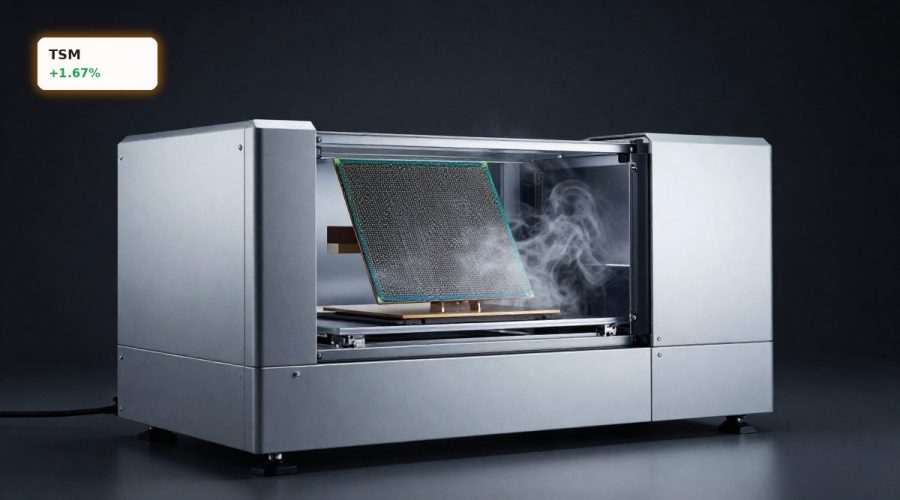
Could a sudden Taiwan Semiconductor Helium Shortage quietly derail the AI chip boom just as demand hits overdrive?
How exposed is TSMC to the Taiwan Semiconductor Helium Shortage?
Taiwan Semiconductor Manufacturing Co. und Helium-Engpass are suddenly at the center of the AI trade’s risk map. TSMC relies on ultra‑pure helium to cool wafers during etching steps, especially at 5‑nanometer and below where tolerances are microscopic. There is no true substitute at scale, and helium is only produced as a by‑product of natural gas processing, which makes supply both concentrated and inflexible in the short term.
The Ras Laffan LNG complex in Qatar is one of the world’s largest sources of both LNG and helium. After the early‑March drone attack linked to Iranian forces, production there has been effectively halted, taking around a third of global helium supply out of the market. Helium flows from the Middle East to East Asia underpin the gas ecosystems serving TSMC, Samsung and SK Hynix, all of which are linchpins of AI and memory production.
For now, TSMC and Korean peers say operations are continuing normally and that they have secured inventories for several months. Industry estimates suggest TSMC’s internal buffer could cover roughly three months of consumption, which means the Taiwan Semiconductor Helium Shortage is a tail risk rather than an immediate shutdown threat. But as every foundry operator knows, gas supply is binary: once buffers are drawn down, there is no partial workaround for missing helium in cutting‑edge process nodes.
What does this mean for AI chips from NVIDIA and Apple?
The most direct implication of a worsening Taiwan Semiconductor Helium Shortage would be forced prioritization inside TSMC’s fabs. Management has already indicated that in a constrained scenario, lower‑margin and legacy product lines would be deprioritized in favor of strategic high‑performance products such as high‑bandwidth memory (HBM) and advanced accelerators. That dynamic would tighten supply for some consumer and industrial chips while ring‑fencing output for AI data center silicon.
This matters greatly for customers like NVIDIA and Apple. NVIDIA’s GPUs and AI accelerators dominate the current capex cycle for hyperscale data centers run by Microsoft, Amazon and Meta Platforms, and TSMC is the primary manufacturing partner behind those chips. Any reduction in TSMC’s effective capacity at 5‑nanometer and below, whether from helium constraints or energy disruptions in Taiwan’s gas‑dependent power grid, could push lead times higher and support continued pricing power for NVIDIA hardware.
For Apple, which relies heavily on TSMC for its A‑series and M‑series processors, a prolonged squeeze could force a trade‑off between smartphone, PC and AI‑focused silicon roadmaps. In a worst‑case scenario where the Taiwan Semiconductor Helium Shortage persists well beyond the three‑month buffer, investors should expect TSMC to favor its highest‑value contracts and critical nodes, potentially delaying some lower‑margin consumer chips.
How are markets and analysts pricing this new risk?
TSMC’s U.S.‑listed shares (TSM) traded at $342.45 in the latest session, up 1.67% from the prior close, extending an already strong 2026 performance. The stock is up around 11% year to date and more than 100% over the past 12 months, fueled by insatiable demand for AI compute and a 36% jump in 2025 revenue to about $122.4 billion. High‑performance computing – which includes AI‑related chips – now accounts for the majority of sales and is growing at nearly 50% year over year.
On valuation, TSMC changes hands at roughly 25 times forward earnings, a premium to many traditional chipmakers but still seen as reasonable by bullish houses on Wall Street. MarketBeat data show a consensus “Buy” rating with an average price target near $391 and some targets stretching as high as $450, underlining confidence that AI demand can offset cyclical and geopolitical risks. Fund managers like Shannon River Fund Management and Douglass Winthrop Advisors have recently added or maintained sizable positions, signaling ongoing institutional conviction.
More cautious voices are starting to flag the Taiwan Semiconductor Helium Shortage as a new layer in an already complex risk stack that includes cross‑Strait tensions and supply chain concentration in Taiwan and South Korea. Research from Simply Wall Street notes that TSMC trades almost 30% above its modeled fair value and warns that conflict‑driven disruptions to key inputs and logistics could test that premium. For U.S. investors, the message is not to abandon the AI hardware theme, but to recognize that supply shocks can quickly change the margin and volume outlook.
Taiwan Semiconductor Helium Shortage: what’s the path forward?
Looking beyond the next few weeks, the severity of the Taiwan Semiconductor Helium Shortage will hinge on three variables: the duration of outages in Qatar, the ability of North American producers to redirect exports, and how efficiently Asian fabs can stretch existing inventories. North America accounts for close to half of global helium output and could, in theory, fill part of the gap, but those flows also serve domestic medical, industrial and aerospace demand. Re‑routing cargoes is possible, not trivial, and likely to come with higher prices.
At the same time, Taiwan faces its own energy challenges. Having shut down nuclear power, the island is heavily dependent on LNG‑fired generation and has storage capacity measured in days, not months. Any simultaneous stress on LNG supply – from the same Middle East conflict now driving helium shortages – would increase the risk of power volatility that can trip TSMC’s ultra‑sensitive lithography tools, adding another operational headache to an already tight environment.
Helium may seem like a niche commodity, but for advanced chipmakers it is as strategic as oil was for the industrial age.
— Senior Asia Technology Strategist at a global investment bank
Conclusion
For investors in TSMC, NVIDIA, Apple and even AI beneficiaries like Tesla that rely indirectly on the same chip ecosystem, the coming quarter will be critical. If Helium production in Qatar gradually resumes and alternative supply chains scale up, the Taiwan Semiconductor Helium Shortage may fade into the background as a 2026 scare. If not, the next leg of the AI capex boom could be constrained more by chemistry and geopolitics than by demand, pushing hardware prices higher and reinforcing the strategic value of leading‑edge capacity.
Further Reading
- Taiwan Semiconductor Manufacturing Company Ltd. (TSM) Stock Price, News, Quote & History (Yahoo Finance)
- Up Over 100% in 1 Year, Should You Buy Taiwan Semiconductor Manufacturing Company Right Now? (The Motley Fool)
- TSMC Supply Chain Risks Rise As Valuation Premium Faces New Test (Simply Wall Street)
- 8,701 Shares in Taiwan Semiconductor Manufacturing Company Ltd. Bought by Shannon River Fund Management LLC (MarketBeat)