Does the massive Taiwan Semiconductor investment plan in AI fabs justify the current stock record – or does it increase the risk for investors?
How Aggressive is the Taiwan Semiconductor Investment Plan?
The current Taiwan Semiconductor investment plan for 2026 outlines a massive budget of $52 to $56 billion. A significant portion will be allocated to new manufacturing capacities for cutting-edge process technologies such as 2-nanometer, A16, and A14. With this, Taiwan Semiconductor Manufacturing Co. aims to secure its technological leadership in the semiconductor industry, particularly in the AI sector.
Currently, up to ten new factories are being built in Taiwan, many focused on high-performance chips for data centers. Particularly important is the so-called Advanced Packaging: The specialized facilities AP5B and AP7 P1 are set to be completed in 2026 and will enable complex chip stacking, as required by companies like NVIDIA and major hyperscalers for AI accelerators.
While the capital requirements put short-term pressure on margins, management signals that high utilization from AI and high-performance computing should amortize the investments in the medium term. Zacks Investment Research points out that despite global expansion, Taiwan Semiconductor is projecting a gross margin of 63 to 65%, even though new overseas factories may cost 2 to 4 percentage points in the short term.
What Does the AI Boom Mean for Taiwan Semiconductor?
The demand for AI chips is the central driver behind the Taiwan Semiconductor investment plan. NVIDIA has raised its production plans for the second quarter of 2026 and is urging Taiwan Semiconductor to increase capacity for high-end GPUs, as demand from China currently exceeds supply. At the same time, Chinese tech giants are massively ordering H200 GPUs and their own AI chips, such as those from Alibaba’s T-Head unit.
In the most recent quarter, revenues in the high-performance computing segment rose by 48% and now account for 58% of total revenue. Other areas are also providing tailwinds: automotive chips increased by 34%, IoT applications by 15%, and the important smartphone business, which makes up nearly 30% of revenues, grew by 11% year-over-year. This broad positioning reduces the risk of a one-sided dependence on AI.
The Motley Fool highlights that the consistent expansion of efficiency and scaling has driven the gross margin from below 49% ten years ago to nearly 60% today. Operating margins of over 50% and a return on equity of more than 35% underscore that the high investments have so far resulted in significantly rising profits.
How is the Stock Market Reacting to Taiwan Semiconductor?
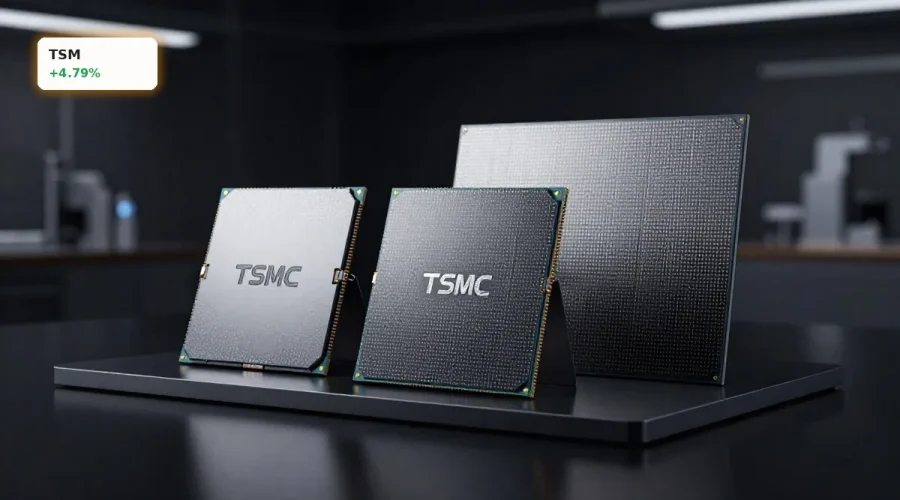
On Wall Street, Taiwan Semiconductor’s stock continues its rally. In New York, the stock gained 4.79% on Tuesday to $387.83, up from $370.04 the previous day. In Taiwan, the stock recently hit a record high of 1,965.00 TWD, approximately 85% above the level from twelve months ago. Technical indicators do not appear overheated: The Relative Strength Index (RSI) around 53 signals neutral momentum, while the price is clearly above the 200-day average of 1,340.24 TWD.
Analysts remain predominantly positive. Zacks Investment Research lists Taiwan Semiconductor in several analyses as one of the most exciting beneficiaries of the AI boom and points to the persistently bullish sentiment on Wall Street. The Globe and Mail also ranks the stock among the “smartest” growth stocks for long-term investors, emphasizing its effective quasi-monopoly position in advanced manufacturing processes.
Many strategists point out that Taiwan Semiconductor is systemically important for numerous US tech giants and hyperscalers. Without the company’s manufacturing capacities, the ambitious AI plans of cloud providers, software companies, and platform operators could hardly be realized. This explains why the stock market interprets the billion-dollar scope of the Taiwan Semiconductor investment plan more as an opportunity than a risk.
What Should Investors Consider Now?
The next valuation-relevant date is April 16, 2026, when Taiwan Semiconductor Manufacturing Co. will present its next quarterly figures. Then it will become clear whether the Taiwan Semiconductor investment plan has already led to further acceleration in revenue and profit. Key metrics will include growth in the AI and HPC segments, as well as the development of gross margin and the utilization of new capacities.
With a price increase of around 24% since the beginning of the year, investors are left wondering whether an entry is still attractive. The strong margin profile, dominant market position in cutting-edge technology, and full order books suggest that growth could continue in 2026 and beyond. At the same time, geopolitical risks in the Taiwan conflict and high dependence on major customers like NVIDIA are factors that should be considered in risk management.
Bottom Line
Overall, many indicators suggest that the Taiwan Semiconductor investment plan is setting the stage for the next growth phase, and the stock remains interesting for the long term, even if short-term pullbacks after the strong rally are always possible.
Related Sources
- Taiwan Semiconductor Manufacturing Co. (TSM) on Yahoo Finance (Yahoo Finance)
- This AI Stock Is a Money-Making Machine (The Motley Fool)
- Investors Heavily Search Taiwan Semiconductor Manufacturing Company Ltd. (TSM) (Zacks Investment Research)
- Can TSM Sustain 60%+ Gross Margin Amid Overseas Fab Expansion? (Zacks Investment Research)