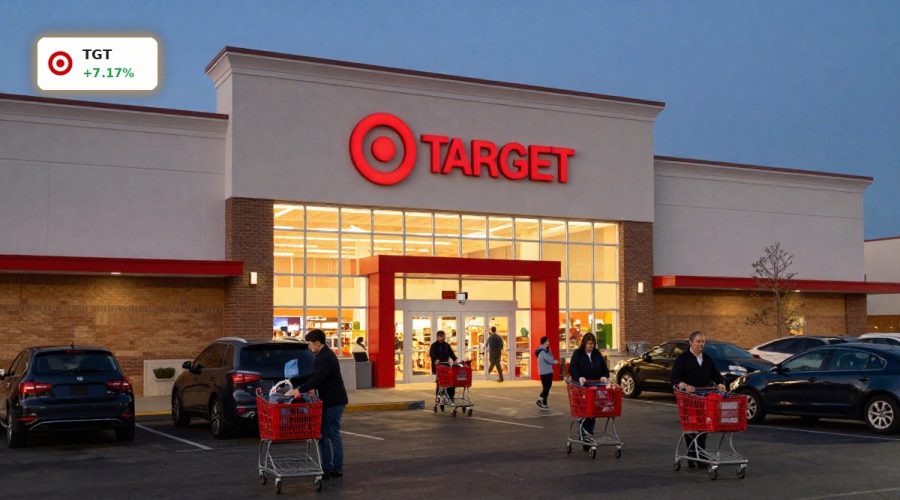
Is the Target Turnaround finally for real, or just another short-lived retail rally that fades with the next earnings season?
Target Corporation: Why The Stock Is Suddenly Back On Wall Street’s Radar
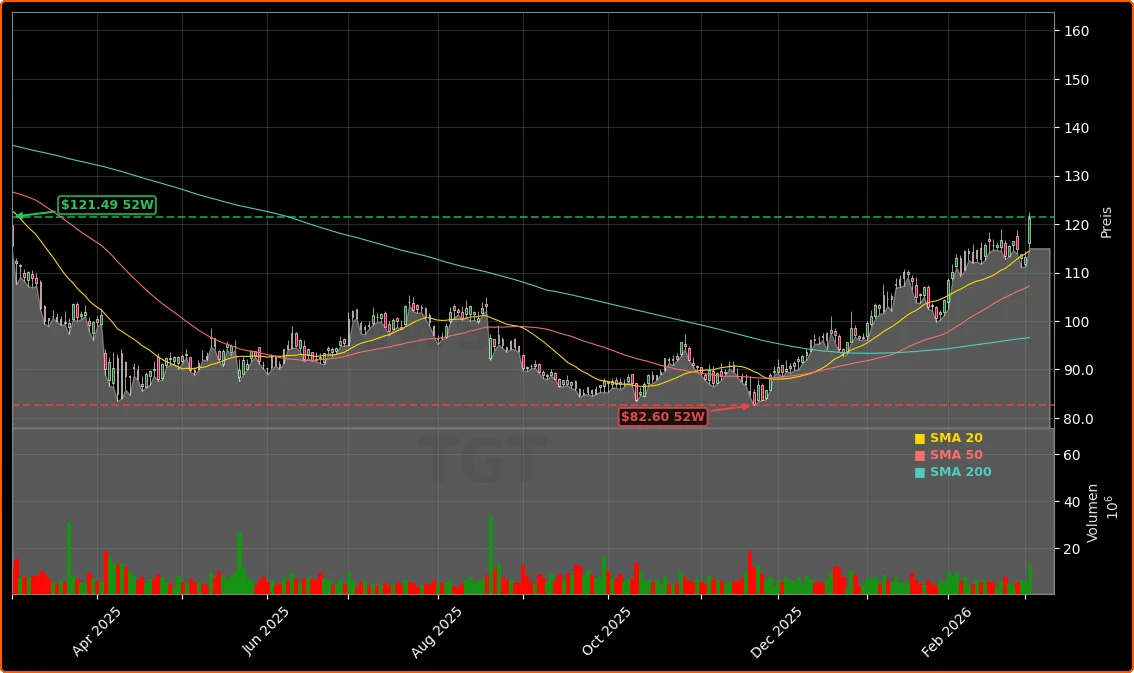
On a deep selling day for the broader market, Target Corporation stood out as one of the few large consumer names trading firmly in the green. TGT closed around $121.29, up more than 7% from the prior close of $113.17, after the company beat expectations on fourth-quarter earnings and issued guidance that topped consensus estimates. That move comes on top of a roughly mid-teens year-to-date gain, as investors have rotated out of richly valued AI beneficiaries like NVIDIA and back into more defensive consumer names.
Target’s latest quarter underscores that the market is willing to look past soft top-line trends if management can deliver margin repair and a credible forward path to earnings growth. Comparable sales declined about 2.5% in Q4, continuing a three-and-a-half-year pattern of revenue sluggishness. Yet earnings per share exceeded Wall Street’s forecasts, supported by better cost control and improving merchandise margins. In a market where the S&P 500 is heavily driven by a narrow cohort of mega-cap tech leaders like Apple, any sign that a beaten-down retailer can self-help its way to higher profitability is getting attention.
For portfolio managers balancing cyclical growth and defensives, the Target Turnaround narrative is emerging as a potential counterweight to high-duration tech risk. The question now is whether the new leadership team can turn one good print and upbeat guidance into a durable multi-quarter trend.
Target Turnaround: Is The New Strategy Finally Gaining Traction?
The core of the Target Turnaround hinges on a strategic reset away from being an “everything store” and toward a clearer focus on its strongest customer base: time-pressed, higher-income families. Management has outlined a plan to refresh core categories such as home, baby and apparel, improve the food offering, and lean harder into omnichannel convenience. That includes modernizing stores, decluttering layouts, and putting more staff back on the sales floor after years in which shoppers complained about messy aisles and inconsistent in-stock levels.
New CEO Michael Fiddelke, who took the top job on February 1 after a long tenure in finance and operations roles inside Target, is positioning the first quarter under his leadership as the start of a healthier sales phase. He highlighted that February saw a “healthy, positive” uptick in sales – a key psychological milestone for investors who have watched comparable revenues drift lower for years. At the same time, he has been clear that this will not be a smooth or linear earnings journey, as Target steps up capital expenditures by roughly 20% to fund store remodels, supply-chain upgrades and technology investments.
Wall Street is rewarding the willingness to invest through the cycle, especially given management’s guidance for 2026 earnings per share in a range of $7.50 to $8.50. That outlook implies an expectation of renewed growth following a 2025 in which company filings show net sales slipped about 1.7% and GAAP EPS fell to $8.13. Analysts and active managers see that guidance range as the first quantitative anchor for the Target Turnaround, but they also caution that management will need to string together several quarters of execution to fully rebuild credibility.
Target Versus Walmart: Can The Retailer Win Back Higher-Income Shoppers?
Behind the Target Turnaround story lies a market-share problem that has been building in plain sight. Over the last several years, Target has lost meaningful share of higher-income consumers to Walmart. The gap is especially evident in food, where Walmart generates roughly half of its revenue, versus only about a quarter for Target. That difference matters because grocery drives trip frequency and positions a retailer as a default weekly stop rather than an occasional discretionary visit.
Target’s comparable sales decline of about 2.5% in the fourth quarter contrasts with significantly stronger growth at Walmart over similar periods, with some analysts estimating a performance gap of as much as 700 basis points. In practical terms, this means that the consumer who once bundled apparel, home and discretionary purchases with their Target grocery run may now be making more of those trips to Walmart or to club formats like Costco instead. That erosion at the top of the income spectrum is particularly dangerous because those customers are the most profitable and the most likely to buy higher-margin discretionary categories.
To reverse this shift, Target is putting fresh emphasis on staples and frequency drivers: better grocery assortments, more competitive pricing in key value baskets, and improved inventory availability. There is also a renewed focus on “Retail 101” – clean stores, clear signage, and enough staffed lanes to avoid chronic checkout bottlenecks. While these basics sound mundane compared with headline-grabbing AI initiatives at tech names like Tesla, they are precisely the operational foundations that determine whether a mass-merchant retailer can consistently translate traffic into profitable transactions.
What The Latest Earnings Say About Profitability And Efficiency
The latest quarter suggests that Target is making some progress on the earnings side even as sales remain under pressure. Adjusted earnings per share for the key holiday quarter modestly exceeded the prior year and came in well ahead of consensus estimates, helped by margin expansion and tighter cost discipline. Some of that upside came from lower markdowns and a more disciplined approach to inventory, which reduced the need for clearance activity that had weighed on results in prior years.
However, not all profitability metrics are flashing green. At least one detailed earnings review on Wall Street has flagged that while the stock screens attractively on a simple price-to-earnings basis – trading around a mid-teens multiple on forward EPS – the company’s return on invested capital (ROIC) has drifted lower as profits fell and capital intensity rose. Full-year ROIC reportedly declined to the mid-teens, around 13–14%, raising the question of whether the current level represents a cyclical trough ahead of a rebound or a structural reset that would justify a lower valuation multiple versus the past.
If the 20% increase in capital expenditures generates clear payback in the form of better traffic, higher conversion and improved margins, ROIC can stabilize and eventually move higher, supporting multiple expansion. If, instead, the spend merely keeps Target running in place against tougher competitors, investors may conclude that earnings quality is deteriorating. That ROIC-versus-growth trade-off is one of the most critical lenses through which institutional investors are now evaluating the Target Turnaround.
How Are Analysts On Wall Street Positioning Around Target?
On the sell side, sentiment toward Target has been gradually improving from the deeply pessimistic stance of the past two years, but it is far from euphoric. Major U.S. brokerages such as Citigroup, JPMorgan and Bank of America have highlighted that the stock’s valuation – roughly 14 times forward earnings based on current guidance – looks reasonable to attractive if management hits the mid-point of its EPS range. Some, including Citigroup, have framed Target as a relative value play within large-cap U.S. retail versus higher-multiple growth stories in e-commerce and specialty retail.
At the same time, more cautious voices like those at RBC Capital Markets and other research shops emphasize that Target still needs to prove that its operational execution can match peers. They point in particular to the company’s historical underperformance in fresh food and grocery relative to Walmart and to the risk that higher-income consumers have permanently diversified their shopping routines among multiple retailers and digital platforms. Strategists also note that the broader defensive consumer-staples sector has benefited from a flight to safety as investors seek havens from volatility in high-beta tech stocks, which may already be partially priced into Target’s recent rally.
Options markets appear to agree that a big directional breakout is not imminent. Some derivatives strategists have recommended range-bound strategies such as iron condors on TGT, noting that the stock has traded in a relatively tight band for months and may remain constrained below the $125 mark in the near term. That positioning reflects a view that while the Target Turnaround is real enough to put a floor under the stock, it may take several quarters of confirmed progress before the equity can sustain a move into a higher valuation zone.
Where Does Target Fit In A Modern, Tech-Driven Retail Landscape?
One of the more underappreciated elements of the Target Turnaround is how it intersects with the broader evolution of retail technology. While Target is not a software or AI company in the way that NVIDIA or other NASDAQ names are, its future competitiveness will depend heavily on how well it integrates digital tools into the in-store and online shopping experience. The company is already leveraging technology for inventory management, dynamic pricing, and fulfillment of digital orders through its store network.
At the same time, new AI-powered consumer tools are beginning to sit on top of retailer websites as independent layers. For example, smart shopping agents can plug into a shopper’s browser as they browse Target or other brands, providing instant guidance on price fairness, quality and fit. That means Target’s site and product data are increasingly being consumed not just by human eyes but by algorithms that will nudge purchasing decisions in real time. To win in that environment, Target needs product pages, assortment depth and pricing logic that score well not only with human consumers but also with AI recommendation engines.
From an investor’s perspective, this sets up Target as something of a hybrid play: operationally a brick-and-mortar retailer with a large physical footprint, but strategically part of the digital commerce ecosystem that increasingly shapes consumer demand. That hybrid profile may make Target an appealing diversifier for portfolios heavily concentrated in pure-play tech or in traditional defensive staples.
Valuation, Risk/Reward And What To Watch Next
With the stock near $121, Target trades at a discount to the broader S&P 500 on a forward P/E basis, and at a noticeable discount to high-growth retailers and e-commerce specialists. If management delivers EPS toward the high end of the $7.50–$8.50 guidance range in 2026 and restores mid-teens or better ROIC, that valuation could prove too pessimistic. In that upside scenario, investors could see both earnings growth and modest multiple expansion, supporting a constructive risk/reward profile over a multi-year horizon.
Key risks, however, are non-trivial. First, the macro backdrop remains uncertain, with higher-for-longer interest rates and uneven consumer confidence that could weigh on discretionary categories such as home, apparel and seasonal goods where Target has historically excelled. Second, competitive intensity remains fierce, not only from Walmart and club stores but also from online-first players and fast-fashion platforms that are increasingly capturing younger demographics. Third, execution risk around the store refresh program and expanded capital budget is real; cost overruns or poor returns on investment could pressure free cash flow and constrain shareholder returns.
Investors monitoring the Target Turnaround over the next several quarters should focus on a handful of metrics: the trajectory of comparable sales (especially in stores versus digital), gross margin trends, inventory turns, and ROIC. Commentary from management on higher-income customer traffic versus value-oriented segments will also be critical, as will any signs that Target is regaining share in grocery and other frequency-driving categories. Finally, how the stock behaves during broader risk-off episodes will tell investors whether Target has truly reclaimed its status as a defensive anchor within U.S. consumer portfolios.
Conclusion
In sum, the latest earnings report and guidance shift the Target Turnaround from theory to early reality. The market has rewarded the improved outlook with a sharp re-rating, but long-term investors will demand consistent execution to keep the story intact. For now, Target looks like a reasonably valued, operationally improving retailer that can add diversification and defensive ballast to U.S.-focused equity strategies. Whether it can graduate from turnaround story to durable compounder will depend on what the next few holiday seasons – and the next few earnings calls – reveal.
Further Reading
- Target Corporation (TGT) stock quote and key data (Yahoo Finance)
- Target CEO on the company’s turnaround plan (CNBC Television)
- Target shifts away from being an ‘everything store’ in new strategy focused on ‘busy families’ (Business Insider)
- Target stock is up even though sales were down. Why the retailer is getting a surprise bump today (Fast Company)
- Target (NYSE: TGT) 2025 sales slip 1.7% but plans growth in 2026 (Stock Titan)