Can a sharp rebound in Tesla China Deliveries offset rising competition, legal risks and a sliding TSLA share price?
How strong were Tesla China Deliveries in February?
Tesla, Inc. posted a sharp rebound in China last month, with February retail sales jumping roughly 91% year over year to about 58,600 vehicles, even as the broader Chinese auto market slumped. Industry data show that overall passenger-car sales in China fell around 25% in February, while sales of new energy vehicles, including battery EVs and plug-in hybrids, dropped more than 30% compared with a year earlier.
The strength in Tesla China Deliveries contrasts starkly with the 45% plunge in January, when volumes slid to their lowest level since late 2022 amid the impact of the Lunar New Year holiday and changing tax rules. The February comeback was driven by aggressive financing offers, including extended payment terms with zero or low interest rates, and strong demand for the refreshed Model Y, which remains the company’s workhorse in the region.
China is strategically critical for Tesla: roughly 42% of its global vehicle sales, or about 685,000 of 1.6 million units last year, were delivered there. That concentration means that every swing in Tesla China Deliveries has outsized implications for margins, factory utilization and ultimately for how investors value the stock on the NASDAQ and in the broader S&P 500 context.
What challenges does Tesla face in China now?
Despite the impressive February figures, the backdrop in China remains difficult. Domestic rivals such as BYD and Xiaomi are pushing hard with aggressively priced models and rapid technology cycles. BYD recently unveiled fast-charging technology it says can bring an EV close to a full charge in around nine minutes, raising the bar for performance in a market where charging speed is becoming a key differentiator.
For Tesla, holding share in this environment has required price cuts and incentives that pressure automotive gross margins, a key metric closely watched on Wall Street. Analysts at firms like Goldman Sachs and Morgan Stanley have argued that Tesla needs to balance volume growth against profitability, especially as the era of hypergrowth in EV adoption gives way to a more mature, competitive market. Consensus expectations see Tesla’s global deliveries growing at mid-single to low double-digit rates over the next several years, far below the explosive trajectory of the last decade.
Some bearish voices, including high-profile short sellers, highlight that Tesla now relies heavily on just two mass-market models, the Model 3 and Model Y, and increasingly on discounting to defend share. They argue that competition from Chinese manufacturers at home and abroad could cap both the volume growth and the premium valuation that Tesla currently enjoys versus legacy automakers such as Ford and General Motors.
How does this affect the Tesla stock story for U.S. investors?
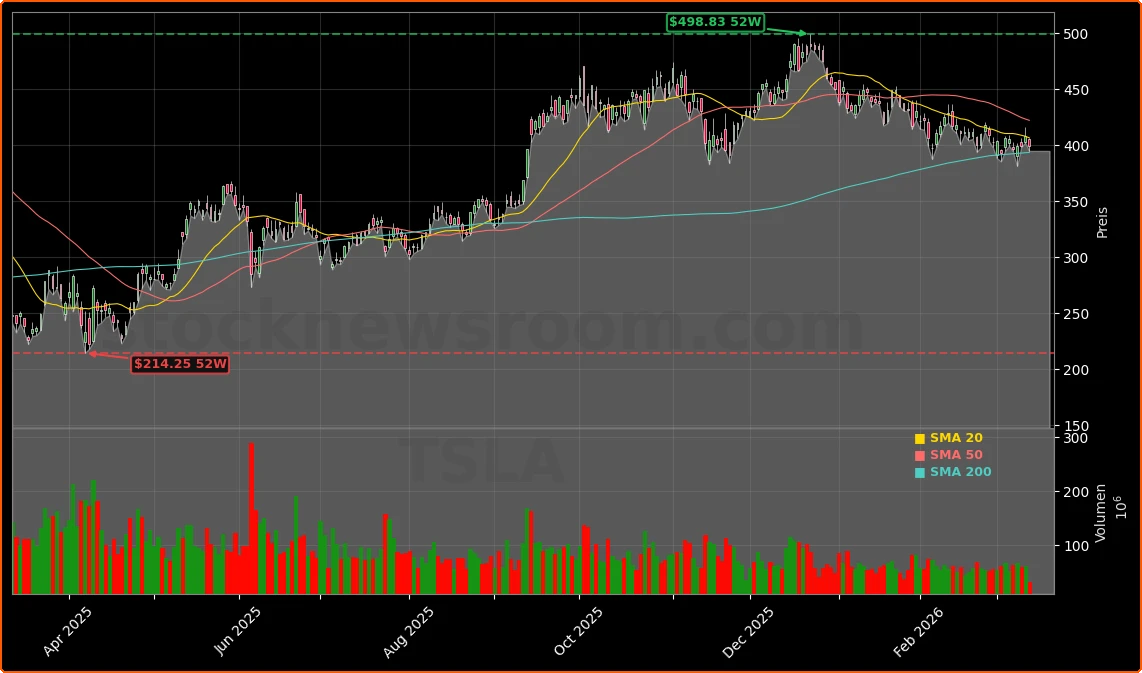
Tesla shares have been volatile in 2026, recently rallying on hopes for robotaxis and robotics before pulling back about 17% from recent highs. At around $399.33, the stock remains well below its 52-week peak but has recovered meaningfully from last year’s lows. High trading volumes keep TSLA a favorite among day traders, with intraday swings regularly outpacing those of mega-cap peers like NVIDIA and Apple.
For long-term investors, Tesla China Deliveries serve as a near-term barometer for the health of the EV franchise, which still funds most of the company’s ambitious bets on autonomy and humanoid robots. A base-case outlook for the next three years sees Tesla evolving into a mature EV leader with stabilizing margins, growing though still modest robotaxi revenue, and early internal deployment of its Optimus robots, particularly in its Austin Gigafactory.
Analyst opinions remain split. Some bullish houses, such as Wedbush Securities, emphasize the optionality in software, Full Self-Driving and robotics, arguing that these could justify a premium multiple if execution continues. More cautious firms like JPMorgan and Barclays focus on slowing core auto growth and the risk that regulatory or safety setbacks could delay monetization of autonomy, justifying more conservative price targets.
What about FSD risks and the new lawsuit?
Legal and regulatory risk around driver-assistance technology remains a key overhang. In Texas, a Tesla Cybertruck owner has filed a $1 million lawsuit alleging that her vehicle, operating with Full Self-Driving engaged, attempted to drive off an overpass in Houston and ultimately crashed into a concrete barrier. The suit names both the company and Elon Musk personally, claiming that internal safety concerns from engineers were ignored.
This case adds to broader scrutiny over Tesla’s marketing of Autopilot and FSD in the United States and abroad, including investigations in California and reports of incidents in China. While FSD is currently classified as a Level 2 driver-assistance system, which still requires active driver supervision, many regulators and consumer advocates are pressing for clearer labeling, stricter testing and stronger safeguards before higher levels of autonomy are approved.
If regulators impose tighter rules or if courts find Tesla liable in high-profile accidents, the timeline and economics for robotaxi services could be affected. That would matter not only for future revenue streams but also for the narrative premium embedded in the stock price, which assumes that autonomy will become a meaningful profit driver after 2028.
Is Tesla’s energy and robotics pivot enough?
Beyond Tesla China Deliveries and FSD, the company is steadily broadening its business mix. In the UK, Tesla Energy Ventures has just secured a license from Ofgem to supply electricity to homes and businesses across Great Britain, enabling the company to bundle solar, battery storage and power supply into integrated offerings. That move brings Tesla into direct competition with established European utilities and could open a recurring-revenue stream less tied to vehicle cycles.
On the robotics front, Tesla is ramping internal testing of its Optimus humanoid robots, with plans to deploy them for repetitive tasks in its own factories before selling them to external customers later in the decade. Some investors see this as a potential game changer; others caution that meaningful revenue impact is unlikely before the 2030s.
China will likely remain the single most important swing factor for Tesla’s auto profitability, even as the company pushes into energy, software and robotics.
— StockNewsroom.com analysis
Conclusion
For now, the core investment thesis still hinges on EVs, and within that, China remains the swing factor. Sustained strength in Tesla China Deliveries would support the case that the company can navigate a more crowded market, generate free cash flow and self-fund its riskier bets in autonomy, energy and robotics.
Further Reading
- Tesla, Inc. (TSLA) on Yahoo Finance (Yahoo Finance)
- Tesla China Sales Show It Isn’t Struggling As Much As Its Rivals (Investors Business Daily)
- Tesla’s Energy Division Gets UK License to Supply Electricity (Bloomberg)
- Where Could Tesla Be in 3 Years? The Base Case. (The Motley Fool)