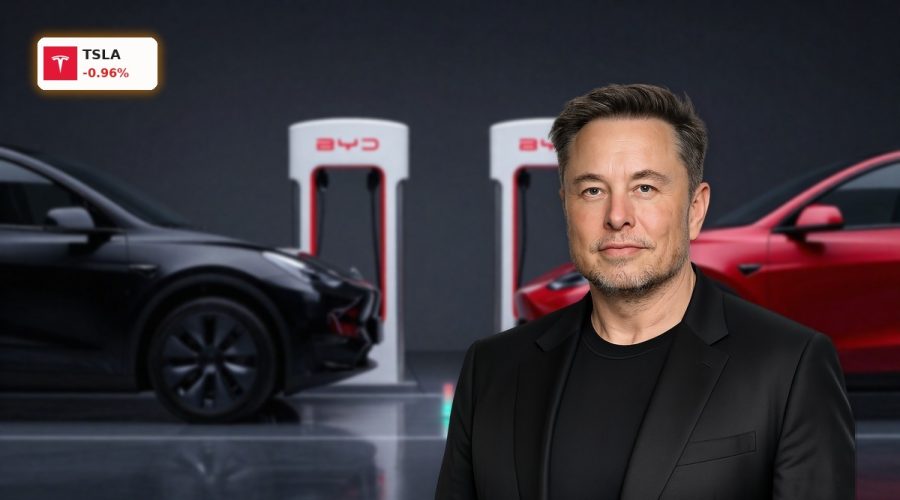
Is Tesla’s soaring valuation ready for a real stress test as global Tesla Competition accelerates in batteries, AI and robotaxis?
How is Tesla trading as Wall Street reassesses risk?
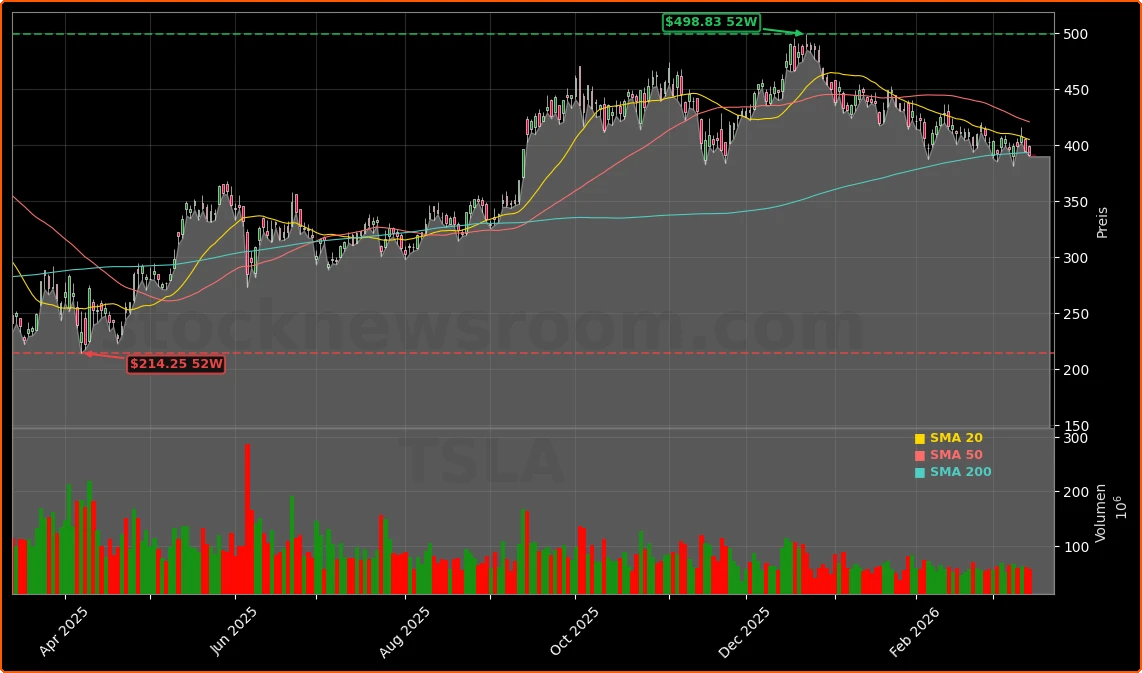
Tesla, Inc. (TSLA) ended the latest session at $391.20, down about 1% on the day from a prior close of $395.48, with after-hours trading dipping further to $389.80. The move puts the stock just below the $400 line that has become a psychological reference point for many retail and institutional traders. While the stock remains well below its all‑time peak and under typical 52‑week highs seen in earlier momentum phases, it still reflects a rich multiple versus most global automakers.
Since its 3‑for‑1 stock split in August 2022, when shares traded just under $300, the stock has climbed roughly 37%. That translates into an annualized return of around 9%—respectable, but trailing the roughly 16.5% compound annual growth rate of the S&P 500 over the same period. In other words, investors who bought around the split have underperformed a simple index fund, despite Tesla’s powerful brand and first‑mover advantage.
This underperformance is increasingly being framed through the lens of Tesla Competition. Tesla now has to justify its valuation not only against legacy carmakers but also against high‑growth technology names in the NASDAQ and megacap AI stocks that have delivered stronger returns. As volatility in the broader “Magnificent Seven” cohort picked up—Meta, Apple, Microsoft and NVIDIA all finished lower in the same session—positioning in Tesla has become more tactical, with short‑term options strategies and intraday trading volume influencing price action more than long‑only, fundamentals‑driven flows.
The stock’s current dip below $400 has reignited debate among U.S. investors about whether this is a buy‑the‑dip opportunity ahead of the next product and AI catalyst, or a warning sign that rising Tesla Competition could compress margins and growth expectations faster than the market currently discounts.
Is BYD’s new battery a real threat to Tesla Competition?
The sharpest new competitive headline comes from Chinese EV powerhouse BYD, which claims its latest Blade Battery 2.0 can charge from roughly 10% to 97% in about 12 minutes under optimal conditions. Some marketing has even referenced five‑minute top‑ups to a highly usable charge level, suggesting a dramatically reduced downtime at fast chargers. If this performance is validated at scale, it has the potential to reset consumer expectations for what an EV experience should feel like.
By comparison, Tesla’s latest in‑house 4680 cells, which power select models, are known for solid reliability and strong range, but they typically require about 20 to 25 minutes to charge from a low state to a high usable level on the company’s Supercharger network. That difference may not sound huge on paper, but behaviorally it could be significant if drivers begin to view sub‑15‑minute charging as the new standard. This is where Tesla Competition becomes tangible: range, cost, and now charging speed are all levers competitors can pull to erode Tesla’s perceived technological lead.
For now, BYD and Tesla do not battle head‑to‑head in the U.S. market. Aggressive U.S. tariffs—currently around 100% on Chinese‑built EVs—have effectively kept BYD out of American dealerships. In Europe, Latin America and parts of Asia, however, the two brands already collide, and BYD’s combination of low manufacturing cost and innovative batteries is putting pressure on price points and margins. The reputational threat is just as real as the product threat: if global consumers come to associate BYD with leading‑edge charging technology, Tesla’s long‑standing image as the default “cutting‑edge” EV brand faces erosion.
There is an important nuance, however. Tesla already sources some battery cells from external suppliers, including BYD, alongside its in‑house production. That gives Tesla a degree of strategic flexibility. If Blade Battery 2.0 or a successor proves unequivocally superior on cost, safety and performance, Tesla could, in theory, integrate such packs into certain vehicles. This would be a hit to the narrative around proprietary Tesla batteries and the tight coupling between cells and the Supercharger ecosystem, but it would also reduce the risk that Tesla is permanently outclassed on charging speed.
Investors trying to weigh Tesla Competition in batteries need to separate near‑term hype from longer‑term structural risk. Over the next couple of years, Tesla’s existing fleet, software ecosystem and charging network offer a strong moat. Over the longer term, if rapidly charging, lower‑cost packs become the industry norm outside the U.S., Tesla may be compelled either to accelerate its own battery R&D or lean more heavily into suppliers in order to maintain its premium pricing power.
How is Tesla repositioning against global EV rivals?
Tesla’s strategic response to intensifying Tesla Competition is not just about batteries. The company is shifting its center of gravity from being primarily an EV manufacturer toward becoming a vertically integrated robotics, autonomy and AI company. This includes stopping production of its higher‑end Model S and Model X vehicles—a notable pivot away from flagship sedans that helped build the brand—and reallocating capital and engineering talent toward autonomy, robotaxis, and its humanoid robot program, Optimus.
Rivian, another U.S. EV maker, has taken a different path. Rather than pivot away from cars, Rivian is pushing forward with its mass‑market R2 platform, while working to improve manufacturing efficiency and cash flow. That contrast matters for investors: Rivian is still seen as a pure EV growth story with a relatively clean narrative, whereas Tesla’s narrative is increasingly diversified. Bulls see this as an evolution into a broader AI mobility platform; bears see it as a potential dilution of focus at a time when direct EV competition from China and legacy OEMs is intensifying.
In Europe, Tesla recently posted its first meaningful increase in vehicle registrations in about a year, a rare dose of good news after a stretch of lackluster performance. However, this bounce came against an unusually weak comparison period, and year‑to‑date volumes remain roughly flat. That dynamic underscores how quickly Tesla’s growth story has normalized in key markets where subsidies are shrinking and local rivals—such as Volkswagen, Stellantis and numerous Chinese brands—are forcing price competition.
Within the U.S., Tesla continues to benefit from brand strength, software‑heavy vehicles, and its nationwide Supercharger footprint. But mainstream automakers like Ford and General Motors are improving their own EV offerings, while Hyundai, Kia and others push aggressively into the American market with attractive designs and competitive pricing. The result is that Tesla Competition is no longer a theoretical future concern; it is embedded in pricing power, production planning and investor expectations today.
What does Musk’s AI chip fab mean for Tesla’s edge?
One of the most significant recent announcements for Tesla’s long‑term strategy is Elon Musk’s confirmation that a “gigantic” in‑house chip fab, dubbed “Terafab,” is slated to begin operations in about a week. The facility is designed to manufacture AI chips that Tesla needs for its full self‑driving (FSD) and autonomous driving ambitions. Musk has argued that existing chip suppliers like Intel, TSMC and Samsung may not be able to provide enough capacity to meet Tesla’s future needs, particularly if robotaxis and AI inference workloads scale as expected.
Bringing chip production closer to home could, if executed well, give Tesla more control over its core AI hardware stack, reduce dependency on constrained third‑party supply and potentially lower long‑term costs. This would put Tesla in a more similar strategic position to leading AI infrastructure players such as NVIDIA, which designs its own GPUs and has deep relationships with foundry partners. It could also support Musk’s broader vision of Tesla as both a robotics company and a provider of AI inference capacity via its Dojo supercomputer.
However, building and running an advanced chip fab is capital‑intensive and operationally complex. Fabrication requires world‑class process technology, long lead times for equipment, strict quality control and constant iteration. Even if Tesla ultimately relies on foundry partners like TSMC or Samsung for some stages of production, coordinating such a “Terafab” ecosystem will demand sustained managerial focus at a time when Tesla Competition in its core EV market is already rising. Missteps could delay FSD progress or inflate costs exactly when investors are hoping for margin stabilization.
For Wall Street, the chip fab is a double‑edged sword. On the one hand, it deepens Tesla’s AI moat, helping it stand apart from traditional automakers that rely heavily on off‑the‑shelf silicon and third‑party software. On the other, it raises execution risk and pushes even more of Tesla’s valuation onto future autonomy revenues and robotaxi deployment—areas still subject to regulatory approvals, technological uncertainty and competitive responses from Alphabet’s Waymo, General Motors’ Cruise and others.
How central are robotaxis and Optimus to the story?
Tesla’s latest public relations push has spotlighted two products that do not yet generate meaningful revenue: the Cybercab robotaxi and the Optimus humanoid robot. During the South by Southwest (SXSW) festival in Austin, the company set up a free pop‑up exhibit that allowed the public to get an up‑close look at both. The Cybercab’s steering‑wheel‑free cabin and minimalist interior are designed for a world in which human drivers are optional, not mandatory.
Production of Cybercab is expected to begin around April, but widespread commercial deployment will depend heavily on regulatory approval and the demonstrated safety of Tesla’s FSD software. Recent departures among Tesla’s autonomy and safety teams have raised fresh questions about how quickly the company can deliver fully driverless service at scale. Nevertheless, Musk continues to frame robotaxis as a central pillar of Tesla’s long‑term valuation, arguing that an autonomous ride‑hailing network could transform the company into a high‑margin software and services platform.
Optimus, meanwhile, embodies Tesla’s ambition to extend its AI and actuator expertise beyond vehicles. Musk has repeatedly suggested that the potential market for humanoid robots—ranging from factory work and logistics to household tasks—could one day eclipse that of cars. For now, Optimus remains in a prototype and limited pilot phase, and revenues are negligible. But showcasing the robot alongside the Cybercab at SXSW is a clear signal that Tesla wants investors to think of it as an AI and robotics leader rather than a pure EV manufacturer facing intensifying Tesla Competition.
Whether these bets pay off will likely determine how investors value Tesla over the next decade. If robotaxis and robots become large, profitable businesses, today’s valuation may prove justified or even conservative. If they stall due to technical or regulatory hurdles, Tesla will be judged more directly against other EV makers, where its advantage is narrower and competition is already fierce.
Are stock-split rumors returning as shares near $400?
Tesla last executed a 3‑for‑1 stock split on August 25, 2022, when the post‑split share price briefly traded just under $300. Since then, the stock has appreciated to about $400 before the latest pullback, sparking fresh chatter on trading desks and social media about whether another split could be on the horizon. Historically, Tesla’s splits have been associated with spikes in retail participation and short‑term price strength, as lower nominal share prices make the stock feel more accessible to smaller investors, even though fractional shares already address that mechanically.
From a fundamentals perspective, a new split would not change Tesla’s market capitalization, earnings power or competitive positioning against other automakers and AI companies. However, it could influence liquidity dynamics, options pricing and investor psychology. A lower post‑split share price typically leads to more granular options strikes and potentially higher retail options trading volumes, which in turn can affect short‑term volatility and gamma positioning.
Some analysts caution that using stock splits as a signal of underlying strength can be misleading. Since the 2022 split, Tesla’s 9.3% annualized return has lagged the S&P 500, and the stock has experienced multiple drawdowns tied to macro concerns, EV demand fluctuations, and changing sentiment around Musk’s leadership and side ventures. In that sense, a new split would more likely be an optics and accessibility move than a reflection of an accelerating business.
Still, in an environment where Tesla Competition is elevating uncertainty about long‑term growth, management may welcome any tool that can widen the shareholder base, refresh bullish sentiment and create new entry points for investors who have been waiting on the sidelines. A split announcement, especially if paired with strong guidance or a major AI/robotaxi update, could be used to reframe the narrative.
How are options traders positioning around Tesla?
At around $400 per share, Tesla remains an expensive underlying for options traders, particularly those looking to construct multi‑leg strategies that require numerous contracts. Nonetheless, interest in bullish positioning persists, as many traders view the stock as a high‑beta way to express views on both the EV cycle and the broader AI and autonomy theme.
One options strategist recently highlighted that, given the current implied volatility profile, running advanced diagonal spreads in Tesla is challenging, and selling put spreads is less attractive because the implied volatility rank is not particularly elevated. Instead, the strategist pointed to a straightforward calendar call spread as a potentially simpler way to express a directional view—specifically, buying and selling calls at or around the $420 strike, which sits about $20 out of the money relative to recent spot prices.
The logic is that a calendar spread can benefit if Tesla drifts or grinds higher toward $420 while implied volatility behavior and time decay work in the trader’s favor. For investors who believe Tesla Competition will increase short‑term volatility but that Tesla retains meaningful upside over a longer horizon, such structures can be appealing. They limit outright capital at risk compared with buying deep‑in‑the‑money calls, while still offering exposure to a potential upside surprise—such as a positive FSD regulatory development, stronger‑than‑expected European demand, or a more detailed roadmap for the chip fab and Optimus.
However, options are not a free lunch. If the stock chops sideways or sells off on disappointing news—such as slower robotaxi progress or more aggressive price cuts to counter Chinese competition—calendar spreads can lose value on both legs. Long‑only investors should be careful not to confuse tactical derivatives trades with long‑term allocation decisions in retirement or core equity portfolios.
How does Tesla Competition compare with other tech giants?
Tesla’s share price decline of about 1% in the latest session occurred alongside a broader pullback in the so‑called Magnificent Seven. Meta dropped more than 3% after concerns about delays and underperformance in its latest AI model, Apple slipped more than 2%, and Microsoft and NVIDIA were each down more than 1%. Amazon and Alphabet also finished in the red. Against this backdrop, Tesla’s modest dip looks less like a company‑specific capitulation and more like part of a general de‑risking in premium tech and AI‑linked names.
However, Tesla Competition is structurally different from what these software and platform companies face. While Apple and Microsoft contend with rival ecosystems and regulatory scrutiny, Tesla must defend both a hardware manufacturing business and a software/AI stack. When the market is bullish on AI, Tesla can trade more like a high‑growth tech name; when investors focus on cyclical car demand, it trades more like a volatile automaker with margin risk and large capital requirements.
Post‑split performance reinforces this dual identity. Tesla has underperformed Alphabet, which has gained about 167% since its own stock split, but has outpaced certain other names—Netflix, for example, has struggled as it absorbs higher content costs and engages in expensive M&A activity. That positioning underscores the importance of Tesla’s next phase: if its AI and autonomy initiatives begin to deliver tangible, monetizable products—such as commercial robotaxis or widely adopted robotics—Tesla could reclaim a narrative closer to the high‑growth winners in the NASDAQ 100.
For now, investors should recognize that Tesla Competition is coming from multiple vectors: Chinese EV manufacturers on cost and speed, legacy automakers on scale, and large tech platforms on software ecosystems and AI talent. Holding Tesla in a diversified portfolio alongside other AI, semiconductor and EV plays can help balance the idiosyncratic risks attached to Musk’s ambitious multi‑front strategy.
What are analysts and institutions watching next?
Sell‑side analysts continue to frame Tesla as a high‑conviction but controversial name. Firms such as Morgan Stanley, Goldman Sachs and Citigroup have historically toggled between bullish and more cautious stances as new data emerges on deliveries, pricing, FSD progress and capital allocation. When price targets are updated, these banks often explicitly reference rising Chinese competition, slowing EV adoption curves in Europe, and uncertainty around the timing and economics of robotaxi deployment as key variables in their models.
RBC Capital Markets, which has at times rated Tesla as “Sector Perform,” has highlighted both the potential of software‑driven margins and the risks of over‑reliance on unproven future revenue streams. Citigroup, for its part, has in past notes emphasized valuation sensitivity to long‑term FSD attach rates and regulatory acceptance, implying that small changes in those assumptions can justify large moves in either direction.
Institutional investors are also paying attention to Tesla’s corporate governance and jurisdictional choices. The company’s decision to align more closely with Texas—following the broader trend of major corporations, including Exxon Mobil and digital asset firms like Coinbase, shifting or considering shifts toward the state—reflects an effort to capitalize on what is perceived as a more business‑friendly legal environment. For Tesla, which often finds itself at the center of regulatory debates around labor, safety and environmental standards, jurisdiction can have a meaningful impact on operational flexibility.
Over the coming quarters, analysts and large investors will likely focus on three main themes: whether Tesla can stabilize automotive margins in the face of aggressive discounting by Chinese brands; how quickly the company can turn its AI and robotics projects into scalable, revenue‑generating businesses; and whether capital‑intensive efforts like the Terafab chip initiative can be funded without overly diluting shareholders or stressing the balance sheet. Each of these themes is intertwined with the evolving landscape of Tesla Competition.
What does all this mean for U.S. investors now?
For U.S.-based investors, Tesla sits at the intersection of several secular trends: electrification of transportation, AI‑driven automation, and the migration of corporate influence toward business‑friendly states like Texas. The stock’s position just below $400 offers a clear reference point: it is well above past panic lows but below highs reached during periods of peak optimism. Investors must decide whether they believe Tesla’s long‑term optionality in AI and robotics offsets near‑term pressures from a more crowded EV market.
Those who view Tesla primarily as a car company might see today’s valuation as stretched, especially when direct EV competitors are willing to sacrifice margins to gain share. Those who believe TeslaCompetition will eventually narrow its automotive margins but that the company can reopen a large valuation gap via software, autonomy and robotics may see the current consolidation below $400 as an attractive entry or add point in a multi‑year thesis.
Portfolio construction is critical. Concentrated bets on Tesla can deliver outsized gains or losses depending on news flow around FSD approvals, battery innovations and macro conditions. Holding Tesla alongside diversified exposure to the S&P 500, semiconductor leaders, and select global EV makers can provide participation in upside scenarios while dampening the impact of company‑specific setbacks. For options‑savvy investors, structured strategies like calendar spreads at strikes around $420 may offer risk‑defined ways to express a view on future volatility and direction.
Ultimately, the significance of growing Tesla Competition is less about an imminent collapse of Tesla’s business and more about a gradual normalization of its lead. Where Tesla was once the only serious EV and software‑centric automaker in many markets, it is increasingly one of many ambitious players. The company’s response—building a chip fab, doubling down on robotaxis and robots, and leveraging its brand and network effects—will determine whether it remains the benchmark for the sector or merely one strong competitor among several.
“Tesla is trying to leapfrog traditional automakers by turning itself into an AI and robotics platform just as global EV competition intensifies.”
— StockNewsroom.com Analysis Desk
Conclusion
For now, Tesla remains a pivotal, high‑beta component of many U.S. and global growth portfolios. The next phases of its strategy will test whether its transformation into an AI‑powered mobility and robotics platform can outpace the rise of Tesla Competition in batteries, vehicles and autonomous services.
Further Reading
- Tesla, Inc. (TSLA) on Yahoo Finance (Yahoo Finance)
- BYD Just Announced 5-Minute EV Charging. Should Tesla Investors Be Concerned? (The Motley Fool)
- Musk says Tesla’s ‘gigantic’ chip fab project to launch in seven days (Reuters)
- Better EV Stock: Rivian vs. Tesla (The Motley Fool)
- Finally, a Little Good News for Tesla Investors — or Is It? (The Motley Fool)