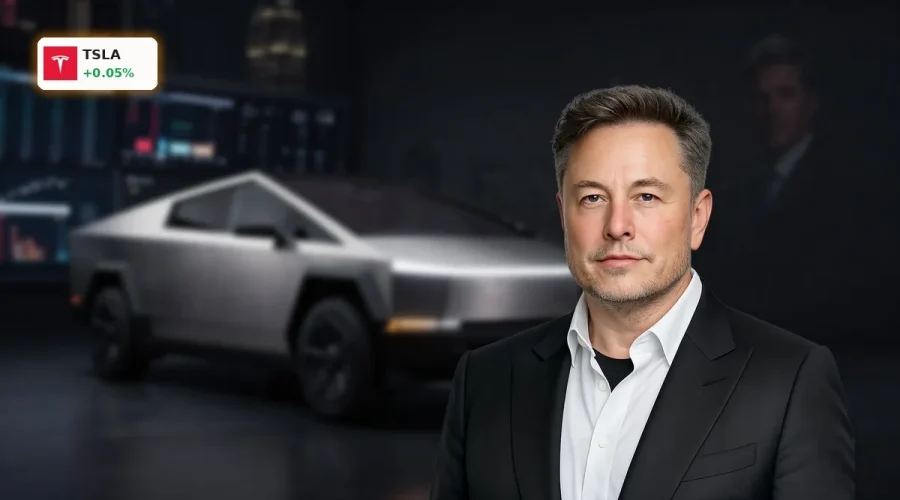
Will the Tesla Cybertruck, with its price shock and Cybercab launch, become a game changer or a margin risk for investors?
How is Tesla repositioning the Tesla Cybertruck?
Tesla, Inc. is intensifying the price competition in the U.S. pickup market, placing the Tesla Cybertruck at the center of its pricing offensive. A new dual-motor all-wheel-drive model has been introduced in the U.S. for $59,990, making it the most affordable Cybertruck variant to date. At the same time, the price of the top model, Cyberbeast, is dropping from $114,990 to $99,990. This indicates that Tesla is forgoing the previously offered Luxe Package, which included features such as Supervised Full Self-Driving (FSD) and free access to the Supercharger network.
The price reduction for the Tesla Cybertruck is part of a broader strategy: instead of quickly launching a completely new mass-market model, Tesla aims to attract additional buyers through lower entry prices. This move comes in response to a noticeable decline in demand in the U.S. electric vehicle market following the expiration of government incentives in the fall of 2025. At the same time, competition is intensifying from Chinese manufacturers and traditional automakers who continue to push their electric portfolios.
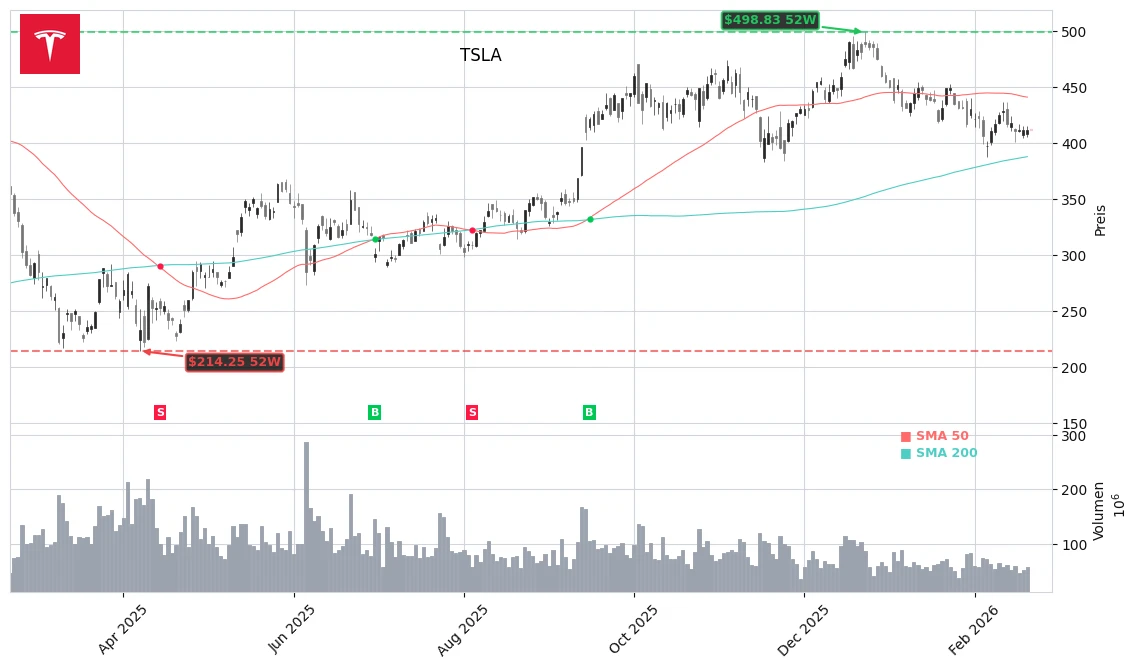
For investors, the question of margins is paramount: lower selling prices must be compensated either by decreasing production costs or by generating higher revenues from software, Autopilot/FSD options, and services. The current stock price of $412.08 is only slightly above the previous day (+0.05%) and signals caution, even though the narrative surrounding robotaxis and robotics continues to offer potential.
What does the Cybercab mean for Tesla?
Alongside the Tesla Cybertruck, Tesla is accelerating its efforts in autonomous mobility. The first so-called Cybercab, a two-seat coupe designed as a robotaxi without a steering wheel and pedals, has been produced at Gigafactory Texas. Series production is set to begin in April. Technologically, Tesla remains committed to its approach: instead of using lidar like competitors in the robotaxi space, the company relies on a purely camera-based system combined with FSD software.
In Austin, several Model Y vehicles are already operating as robotaxis with safety drivers. These pilot runs are intended to pave the way for the Cybercab to operate without safety drivers in the medium term. Elon Musk emphasizes that Tesla is evolving from a traditional automaker to a company focused on robotaxis and humanoid robots. At the same time, he tempers excessive expectations: the production of the Cybercab will initially ramp up “painfully slowly,” indicating that scaling and regulatory processes will remain significant bottlenecks.
This strategic shift is also evident in the product portfolio. Production of the premium sedan Model S and the SUV Model X is being halted to free up capacity in California for humanoid robots. This shift moves Tesla’s value drivers away from established models toward new growth areas such as robotics, robotaxis, and energy business—offering higher opportunities but also significantly greater regulatory and technological risks.
” alt=”Tesla, Inc. Stock Chart – 252 Days Price Performance – February 2026″ loading=”lazy” style=”width:100%;height:auto;border-radius:8px;”>
How is the Autopilot dispute affecting Tesla?
While the Cybercab and Tesla Cybertruck embody the vision for the future, a court case highlights the downside of the autonomy strategy. A U.S. federal judge in Miami has denied Tesla’s request to overturn a jury verdict of $243 million. The verdict is related to a 2019 accident in Florida that resulted in the death of a young woman and serious injuries to her partner. The jury found Tesla 33% liable because a Model S equipped with Autopilot crashed into a vehicle parked on the roadside.
This ruling is the first known federal jury verdict involving a fatality centered on Autopilot and underscores the legal risks stemming from Tesla’s aggressive marketing of driver assistance and FSD features. Tesla argued that the driver was solely responsible and that the manufacturer could not be held liable for reckless behavior behind the wheel—without success. The company plans to appeal, but the signal to regulators, courts, and investors is clear: the leeway for bold autonomy promises is narrowing.
This also increases the pressure on Tesla to communicate the actual performance and safety of Autopilot and FSD more clearly. For the robotaxi business—from the Cybercab to autonomous versions of the Model Y—software credibility is central. Any further lawsuits or accidents could lead to not only financial but also significant reputational damage.
How are investors reacting to Tesla Cybertruck, Cybercab, and more?
The stock market presents a mixed picture. Institutional investors have recently significantly reduced their positions: UBS cut its stake by around 60 million shares, Nomura divested about 80% of its holdings, and Goldman Sachs and Morgan Stanley also reduced their engagements—though Morgan Stanley remains one of the larger Tesla shareholders. On the other hand, retail investors are increasingly pouring money into the stock. Between February 12 and 18, approximately $326 million was net invested in Tesla by retail investors, making it one of the most purchased stocks in the retail segment this year, just behind Microsoft.
Analysts remain divided on Tesla. While firms like Goldman Sachs and Morgan Stanley emphasize the long-term prospects in robotaxis, energy, and software, more skeptical voices—such as those from banks like Citigroup or RBC Capital Markets in earlier assessments—point to valuation risks, cyclical weaknesses in the EV market, and legal uncertainties surrounding Autopilot. For the moment, the market seems to be soberly evaluating the recent pricing measures for the Tesla Cybertruck and the production start of the Cybercab: the stock is hovering near the current level of $412, without setting new upward or downward impulses.
Bottom Line
The Tesla Cybertruck, the new Cybercab, and the focus on robotics demonstrate that Tesla is consistently shifting its narrative toward software and autonomous mobility. For investors, this means more growth potential but also higher volatility due to price competition, margin pressure, and legal risks in the Autopilot business. Those investing should closely monitor how quickly Tesla scales robotaxis and whether it can balance cheaper vehicles with profitable software.
Related Sources
- Tesla unveils cheaper Cybertruck variant, cuts Cyberbeast price to drive demand (Yahoo Finance)
- Tesla unveils cheaper Cybertruck variant, but there’s a catch (The Detroit News)
- Tesla Stock Shrugs as Musk Launches Cheaper Cybertruck. There’s a Concern. (Barron’s)
- US judge upholds $243 million verdict against Tesla over fatal Autopilot crash (Reuters)