Can Tesla’s $4.3 billion LG battery pact really pivot its story from slowing EV sales to a booming energy storage powerhouse?
[fxmag_hero_image]
How does the LG deal reshape Tesla Energy Storage?
The new pact will see LG Energy Solution manufacture tariff-free LFP cells in Michigan for Tesla Energy Storage products, notably the Megapack 3 systems assembled in Houston. The facility, once planned as a joint venture to supply General Motors’ EVs, has been repurposed after GM exited the project and sold its stake, allowing LG to dedicate new lines specifically to Tesla’s stationary storage demand.
With Chinese producers like CATL dominating advanced LFP technology but facing steep U.S. import tariffs, the Michigan plant gives Tesla a domestic alternative at scale. Tesla has historically sourced much of its large battery capacity from China, so this deal helps mitigate both geopolitical risk and cost volatility tied to trade policy.
Strategically, the shift reflects where Tesla’s growth is coming from. While vehicle deliveries have now declined for two consecutive years, the company’s energy generation and storage segment grew revenue about 27% last year to roughly $12.8 billion, accounting for around 13% of company sales. That divergence is forcing investors to reassess Tesla less as a pure-play EV maker and more as a vertically integrated energy and AI platform.
Why are utilities and AI centers driving demand?
Large, stationary batteries are rapidly becoming critical infrastructure. U.S. utilities are using Megapacks and similar systems to balance grids, store surplus solar and wind power, and avoid costly peaker plants. At the same time, hyperscale and AI data centers being built by firms like NVIDIA’s customers are creating enormous, round-the-clock electricity needs that grid operators must buffer.
This is where Tesla Energy Storage aims to expand its footprint. Products such as Powerwall for homes and Megapack and Megablock for utility and commercial projects give Tesla exposure to structural electrification trends that are less cyclical than car sales. Ford and other automakers are now refitting EV battery plants to chase the same stationary storage opportunity, highlighting how the sector is shifting capital toward batteries that don’t move at all.
For investors tracking the S&P 500 and NASDAQ leaders, that shift matters. U.S. energy storage deployments are expected to rise sharply over the next few years as intermittent renewables gain share, providing a multi-year demand tailwind that could help offset slowing EV growth for Tesla.
What’s the read-through for TSLA stock?
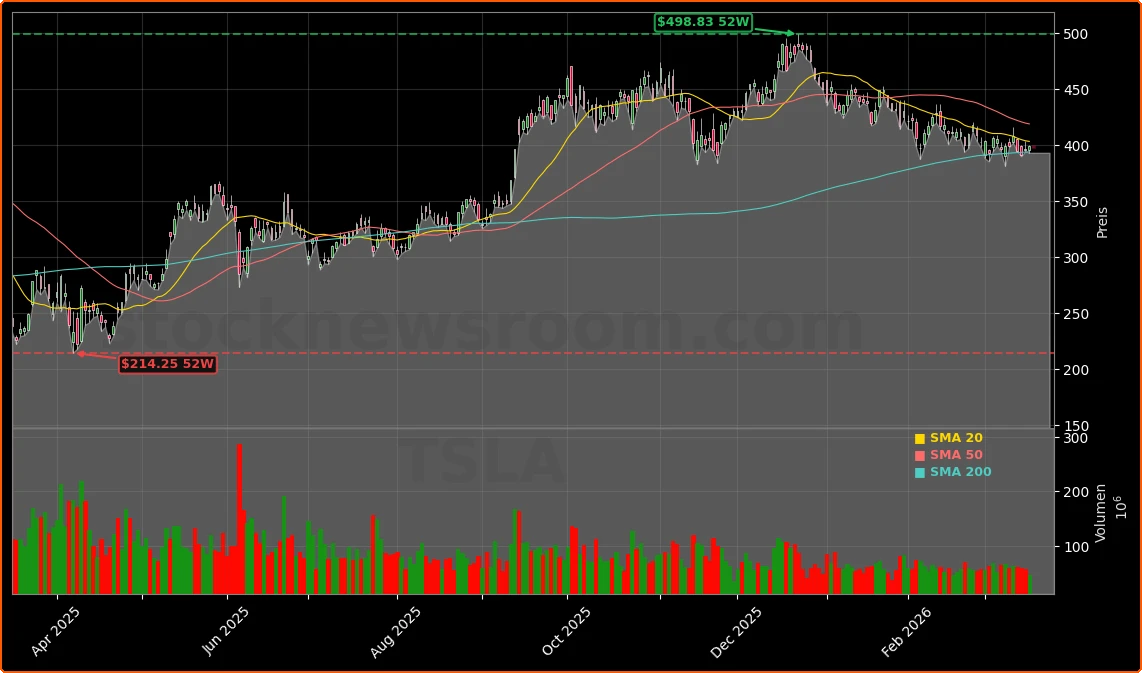
Tesla (TSLA) shares closed the last session at $399.27, up about 0.94% on the day, with pre-market indications near $396.99 on Wednesday morning ET. The stock remains roughly 77% higher year over year, even after an 8–9% pullback year-to-date, as expectations swing from pure EV momentum toward AI, robotics and energy storage optionality.
Wall Street remains split. Benzinga data shows a consensus Buy rating with an average price target near $387.79, implying modest downside from current levels. The range is extremely wide: Wedbush sits on the bullish end with a $600 target, while GLJ Research has flagged a deeply bearish $25.28 target and a series of recent negative calls that imply over 50% downside risk from here.
At a market cap around $1.2–1.25 trillion and a trailing P/E close to 370, valuation leaves little room for execution missteps. Bears highlight margin pressure, intensifying competition from Chinese EV makers overseas, and ongoing controversy around Tesla’s Full Self-Driving (FSD) system, which some Wall Street voices now openly question as a near-term revenue driver. Bulls counter that expanding software, AI, and Tesla Energy Storage earnings could eventually justify a premium multiple more typical of high-growth tech than autos.
How do chips, insurance and rivals fit into the picture?
Tesla is also shoring up other parts of its ecosystem. Samsung Electronics has outlined plans to begin volume production of Tesla chips at its Texas foundry from late 2027, a move that could support both FSD compute and future Optimus humanoid robots. In parallel, Lemonade’s stock jumped after Morgan Stanley upgraded it to Overweight with an $85 price target, citing its data-sharing partnership with Tesla for autonomous driving insurance as a strategic edge, underscoring how Tesla’s software and telemetry are creating second-order winners across the market.
Competition remains fierce. Rivian’s newly unveiled R2 is directly targeting the Model Y, while Chinese brands and legacy OEMs push aggressive EV and autonomy roadmaps. Yet none of these players currently match Tesla’s combination of AI data scale, integrated power electronics and a rapidly scaling grid battery business.
For diversified U.S. investors, the question is whether the emerging pillars of AI, robotics and Tesla Energy Storage can grow fast enough to offset EV volatility and regulatory overhangs in autonomy. The Michigan LG deal suggests Tesla is betting heavily that long-duration demand for U.S.-made batteries will do exactly that.