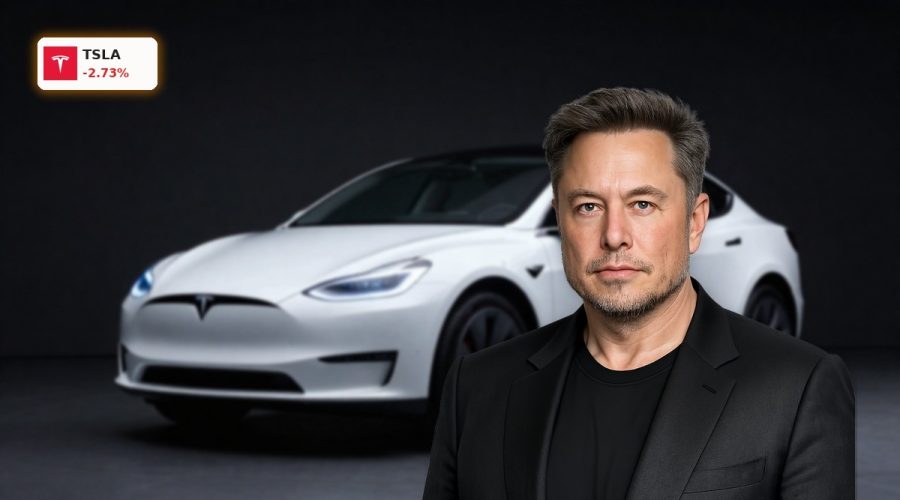
Can the Tesla Robotaxi vision survive intensifying U.S. safety scrutiny just as Musk doubles down on in-house AI chips?

Is safety scrutiny now Tesla’s main overhang?
Federal regulators at the National Highway Traffic Safety Administration (NHTSA) have moved their review of Tesla’s Full Self-Driving (Supervised) system into an engineering analysis, a significant escalation that puts the company one step closer to a potential recall. The probe, which now covers roughly 3.2 million vehicles, focuses on collisions in low-visibility conditions such as sun glare, fog and airborne dust, where FSD allegedly failed to warn drivers in time and in some cases lost track of lead vehicles.
NHTSA is zeroing in on Tesla’s camera-only “Tesla Vision” architecture and its so‑called degradation detection system, designed to recognize when visibility drops below safe thresholds. Incident data suggests the system has not consistently detected common roadway obstructions, raising questions about whether FSD can safely underpin a commercial autonomous service. A forced software recall would not only be costly; it would undercut the technological foundation on which the Tesla Robotaxi thesis rests.
The latest step extends years of regulatory scrutiny of Tesla’s driver-assistance stack, including Autopilot, and lands just as the company prepares to build a purpose-built driverless Cybercab with no steering wheel or pedals. For U.S. investors, the message is clear: near-term stock moves are now far more tied to FSD outcomes than to quarterly delivery beats or misses.
How exposed is the Tesla Robotaxi story?
Wall Street analysts increasingly view Tesla less as an automaker and more as an AI and robotics platform. UBS recently noted that most investor conversations now revolve around the Tesla Robotaxi and Optimus humanoid robot, not Model 3 or Model Y margins. Yet the same software that powers Tesla’s limited robotaxi service in Austin, Texas, is at the center of NHTSA’s probe, and bears argue this creates an existential mismatch between narrative and risk.
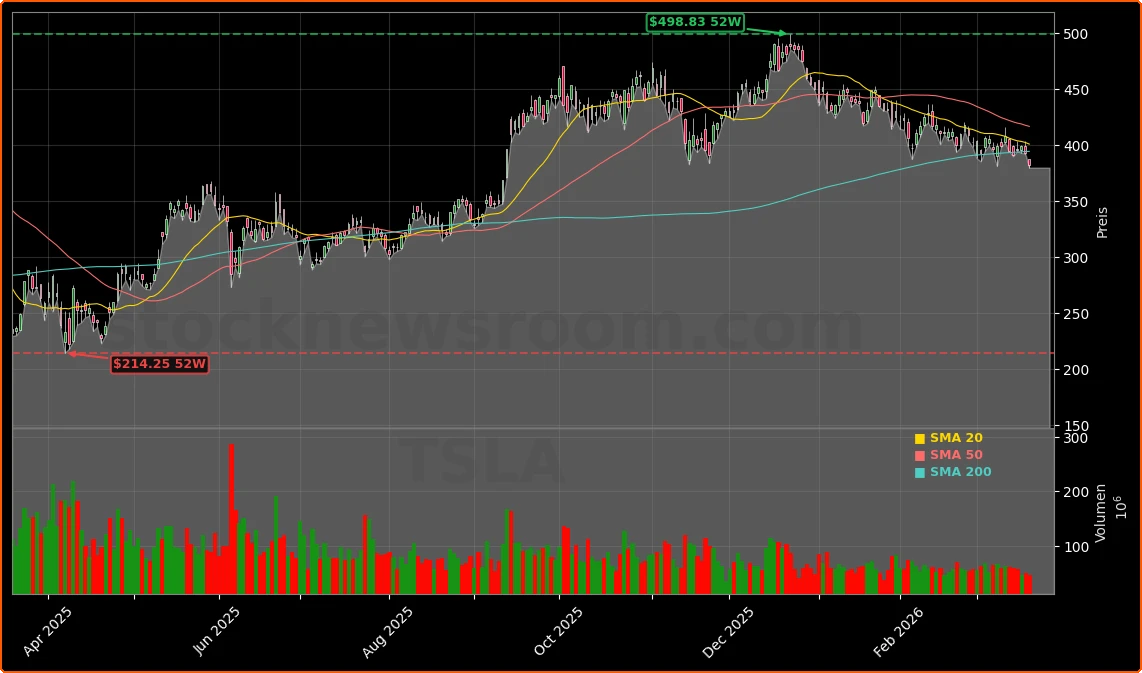
GLJ Research’s Gordon Johnson warned that an engineering analysis is “one step from a mandatory recall,” arguing that investors “cannot build a $1.2 trillion robotaxi company on software the federal government is one determination away from forcing off the road.” That stark framing helps explain why TSLA, despite being up roughly 74% over the past 12 months, has slid back into a technical bear market and now trades well below recent highs even as broader AI enthusiasm remains intense.
On the ground, safety performance is under fresh scrutiny. In Austin, fewer than 40 Tesla robotaxis have reportedly logged about 15 crashes since June, versus roughly 60 incidents for Waymo’s 200‑vehicle driverless fleet. While incident rates are tricky to compare without mileage data, the figures feed a broader debate over whether Tesla’s camera-only strategy can match or exceed lidar- and radar-heavy rivals such as Waymo and Cruise.
Can Tesla’s AI chip push change the game?
Against this backdrop, Elon Musk is doubling down on vertical integration with a new Terafab semiconductor project aimed at bringing high-performance AI chip production in-house. The initiative, backed by tens of billions in planned capital expenditure, is designed to alleviate dependence on external foundries and secure capacity for Tesla’s fifth‑generation AI5 and future AI6 chips that will power both Tesla Robotaxi fleets and Optimus robots.
Musk has said the AI5 chip will “punch far above its weight,” while internal timelines target an AI6 tape‑out by December 2026. Proponents argue that if Tesla can reliably manufacture custom silicon optimized for real‑world vision and robotics, it could gain a structural advantage over both automakers and pure-play chip buyers, much as NVIDIA has dominated data-center AI. Skeptics counter that semiconductor fabrication is capital-intensive, technologically unforgiving and far from Tesla’s historical core competencies.
This strategic shift also reinforces why traditional auto metrics matter less for the stock in the short term. UBS expects Tesla to deliver roughly 345,000 vehicles in Q1 2026, up modestly year-over-year but below the roughly 380,000 broader Street consensus. Yet even back-to-back annual declines in total deliveries haven’t stopped investors from treating TSLA as a high-beta AI proxy rather than a cyclical consumer discretionary name alongside Apple and Amazon in the S&P 500.
What does this mean for charging, rivals and S&P 500 exposure?
Even as the Tesla Robotaxi strategy and FSD safety dominate headlines, the company continues to expand its influence through infrastructure. Stellantis has joined more than 20 global automakers in tapping into Tesla’s Supercharger network, giving Dodge, Jeep, Ram, Fiat and Maserati EV drivers access to over 27,500 V3 and V4 stalls across North America via NACS‑to‑CCS1 adapters and Magic Dock stations. For U.S. portfolios with broad EV exposure, this cements Tesla’s charging standard as a de facto industry backbone, benefiting TSLA beyond vehicle unit sales.
At the index level, Tesla remains a key constituent of both the S&P 500 and NASDAQ, helping anchor the consumer discretionary sector alongside Amazon and Home Depot. The stock’s volatility continues to make it a favorite for day traders, with average three‑month daily volume above 90 million shares and recent sessions trading nearly double that. However, with TSLA now roughly 2.7% lower on the day and well off its 52‑week high, options markets are increasingly pricing binary outcomes around regulatory milestones and AI execution.
Related coverage: Tesla’s pivot away from a pure EV growth story has also been visible in its energy business, where, as we detailed in our analysis of the $4.3B LG battery deal, a new supply pact aims to accelerate utility‑scale storage and stabilize cash flows beyond cars. More broadly across the autonomous EV space, investors are comparing Tesla’s approach with rivals like Rivian, which as covered in our Rivian Robotaxi report just secured a $1.25 billion Uber deal, highlighting multiple parallel bets on how autonomous ride-hailing will scale.
For investors, the bottom line is that the Tesla Robotaxi dream, FSD safety risk and Terafab chip gambit are now tightly intertwined drivers of TSLA’s valuation. A favorable NHTSA outcome and steady progress on in‑house AI silicon could re‑energize the stock and validate the longer-term AI and robotics thesis. The next few quarters of regulatory decisions and technical milestones will show whether Tesla’s high‑risk, high‑reward strategy can keep it at the center of Wall Street’s AI trade.