Will Tesla’s bold Robotaxi and AI chip push justify its premium valuation, or will regulators and rivals puncture the story?

Is Wall Street Buying the Tesla Robotaxi Story?
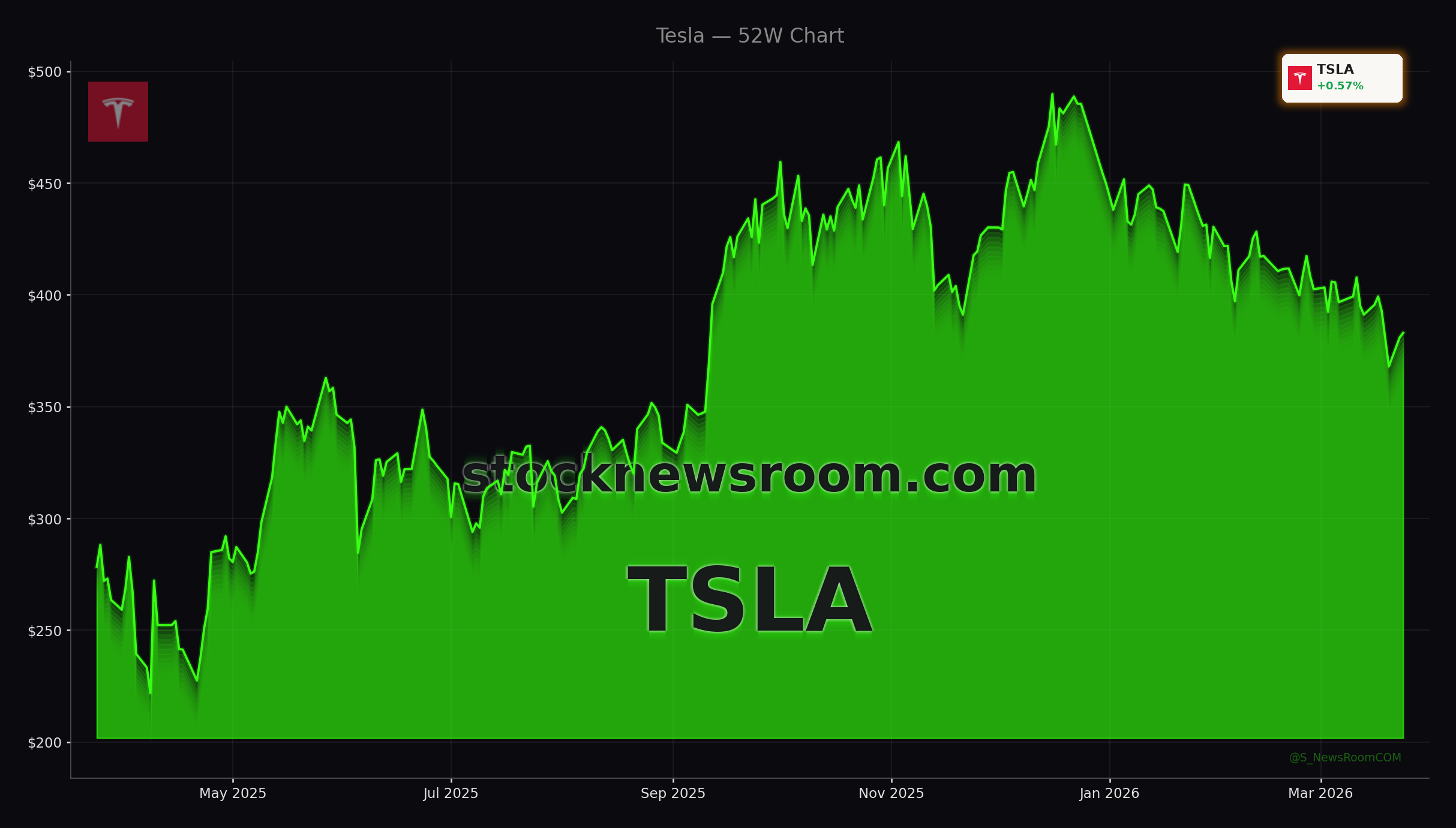
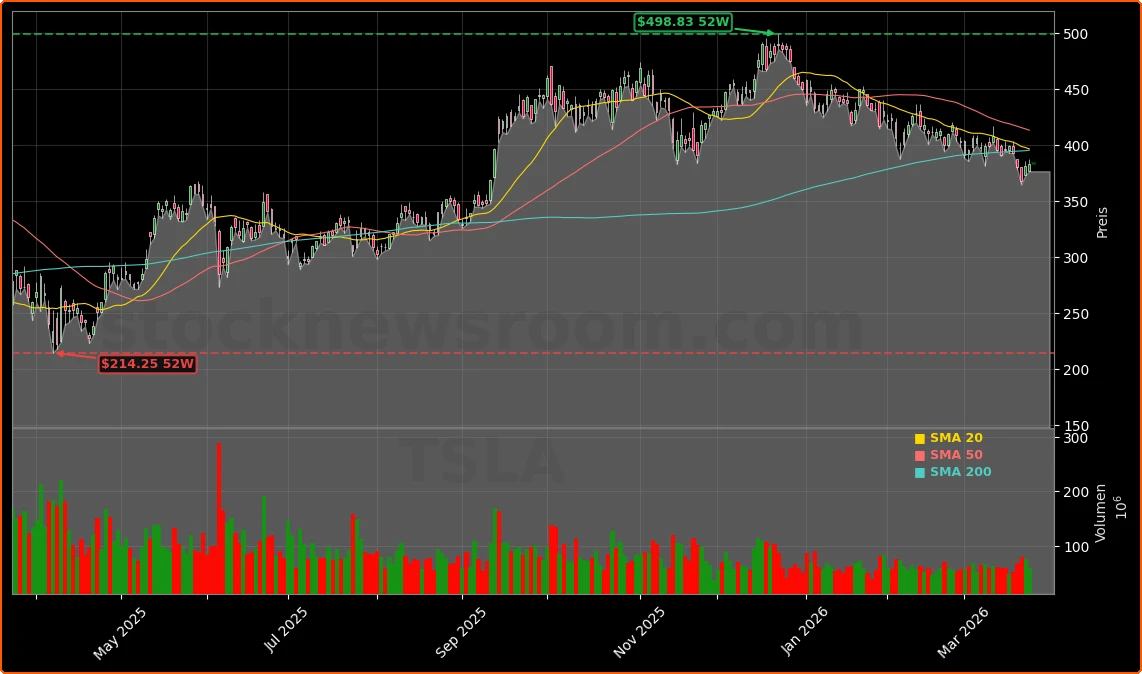
Tesla, Inc. shares finished regular trading at $383.03 on Tuesday, up 0.57% and modestly higher after hours, outpacing a softer S&P 500 and Nasdaq. The move extends a short‑term upswing that has pushed Tesla above its 200‑day moving average, making it one of only two so‑called “Mag 7” stocks still trading above that key technical line. Yet the stock remains well below its 52‑week high, and year‑to‑date performance is still negative, underscoring how much of the bull case rests on autonomy and AI rather than near‑term EV profits.
Wedbush has reiterated its bullish stance on Tesla, emphasizing the value of FSD, the Optimus humanoid robot and the company’s expanding AI stack as key drivers for a multi‑trillion‑dollar narrative. At the same time, prediction markets assign barely mid‑teens odds to Tesla launching commercial robotaxis in California by mid‑2026, highlighting a growing gap between optimism and execution risk. For portfolio managers benchmarked to the S&P 500, the Tesla Robotaxi Strategy is less about today’s deliveries and more about whether these long‑dated AI bets eventually convert into cash flow.
Can Tesla’s European Rebound Stick?
After more than a year of declining volumes, Tesla reported its first year‑over‑year sales increase in Europe, with February registrations up roughly 12% and separate data showing a 29% jump to around 13,700 units across the EU. That rebound comes as overall European EV registrations rose sharply while internal‑combustion models fell more than 20%, signaling that the region’s powertrain mix is still shifting in favor of battery vehicles despite political noise and subsidy uncertainty.
The recovery is not without caveats. Chinese rival BYD posted an estimated 185% surge in February EU sales to about 15,400 units, overtaking Tesla by volume in the region and reinforcing the pressure on margins as more low‑cost competitors arrive. In China, Tesla continues to battle dozens of local EV brands in an intense price war, while in the U.S. demand has been dampened by the expiration of the $7,500 federal EV tax credit on September 30. Legacy players such as Ford and General Motors have already pulled back on their most aggressive EV expansion plans and taken large write‑downs, but a growing pool of used Teslas in the U.S. could weigh on new‑car pricing through 2026.
How Crucial Is EU FSD Approval for Tesla?
Beyond raw unit sales, European regulators may soon have a bigger say in the Tesla Robotaxi Strategy. A third key meeting on FSD approval in the eurozone is scheduled for April 10, with the Netherlands expected to be the first pilot market. Tesla has already logged roughly 1.6 million autonomous kilometers on European roads, a data trove management cites as evidence of a lead over other systems.
If regulators grant even a phased approval, Tesla would gain a powerful proof point for its claim that autonomy is a software‑defined, data‑driven moat. That could set the stage for subscription‑based FSD revenue across the EU and support longer‑term plans for a robotaxi network. Failure or significant delay, however, would undermine one of the most important pillars of the Tesla Robotaxi Strategy and strengthen the case that investors should value the company more like a premium automaker than an AI platform.
Will Terafab and AI Chips Reinvent Tesla’s Economics?
Elon Musk is moving to vertically integrate one of Tesla’s biggest bottlenecks: AI compute. Under the “Terafab” initiative, Tesla and SpaceX plan to build two advanced chip fabrication plants in Austin, Texas—one aimed at AI processors for vehicles and Optimus robots and the other for space‑based data‑center infrastructure. Musk has argued that the combined AI demand from Tesla and SpaceX will soon exceed the capacity of the global semiconductor industry, making internal fabs a strategic necessity rather than a luxury.
Wedbush analysts see Terafab as a potential game‑changer for scaling FSD training, Optimus and future robotaxi operations. The move also reduces reliance on external suppliers such as NVIDIA, even as Tesla remains a major buyer of GPUs in the near term. Still, the capital requirements are enormous—early estimates point to at least $20 billion—and execution risk is high in an industry where Intel and others have struggled to hit yield and cost targets. For equity holders, Terafab raises the stakes: if it works, it could turbocharge the Tesla Robotaxi Strategy by lowering per‑mile autonomy costs; if it stumbles, it becomes another drain on a business still dominated by car sales.
Does Tesla Risk Being Valued Like a Car Company?
Today Tesla commands roughly a $1.4 trillion market cap, dwarfing BYD at about $144 billion and Toyota near $274 billion, even though the vast majority of its revenue still comes from selling cars and related services. The implicit bet is that high‑margin software, robotaxis and humanoid robots will eventually justify a tech‑style multiple. If the robotaxi rollout in the U.S. and Europe stalls, or if the Optimus robot fails to find mass‑market use cases, that thesis could unravel quickly.
Competition is already fierce. Alphabet’s Waymo is the clear operational leader in current robotaxi deployments, while Chinese player WeRide and several U.S. startups are racing to secure city permits and partnerships. Safety remains a persistent overhang for Tesla, with multiple accidents tied to both legacy vehicles and FSD features drawing regulator scrutiny and lawsuits. A fresh regulatory probe into FSD could force software changes that slow down the Tesla Robotaxi Strategy and push back any large‑scale commercial launch into the late 2020s.
Related Coverage
For a deeper dive into regulatory headwinds, see how the latest FSD investigation is reshaping sentiment in “Tesla FSD Probe -3.2% Warning as Regulators Turn Up Heat”, which explores whether scrutiny will merely tweak the software stack or challenge the entire robotaxi vision. Investors tracking the broader EV space and brand positioning should also read “Ford MLB partnership +2.1%: Can Baseball Fuel a Brand Rally?”, where Ford’s new sports marketing push offers a sharp contrast to Tesla’s near‑zero traditional advertising strategy.
In the end, the Tesla Robotaxi Strategy is the fulcrum on which a $1.4 trillion valuation balances, amplifying both upside and downside for TSLA in U.S. portfolios. A European sales rebound, potential EU FSD approval and the Terafab chip buildout all point toward a company determined to be viewed as an AI and autonomy leader rather than just a carmaker. The next 12–24 months—when regulators rule, chips get built and real‑world robotaxi rollouts either accelerate or stall—will determine whether that vision sticks and how Wall Street ultimately prices Tesla.