Is Tesla’s robotaxi vision powerful enough to justify today’s rally and shift the market’s focus away from slowing EV growth?
Tesla and the market: autonomy story back in the driver’s seat?
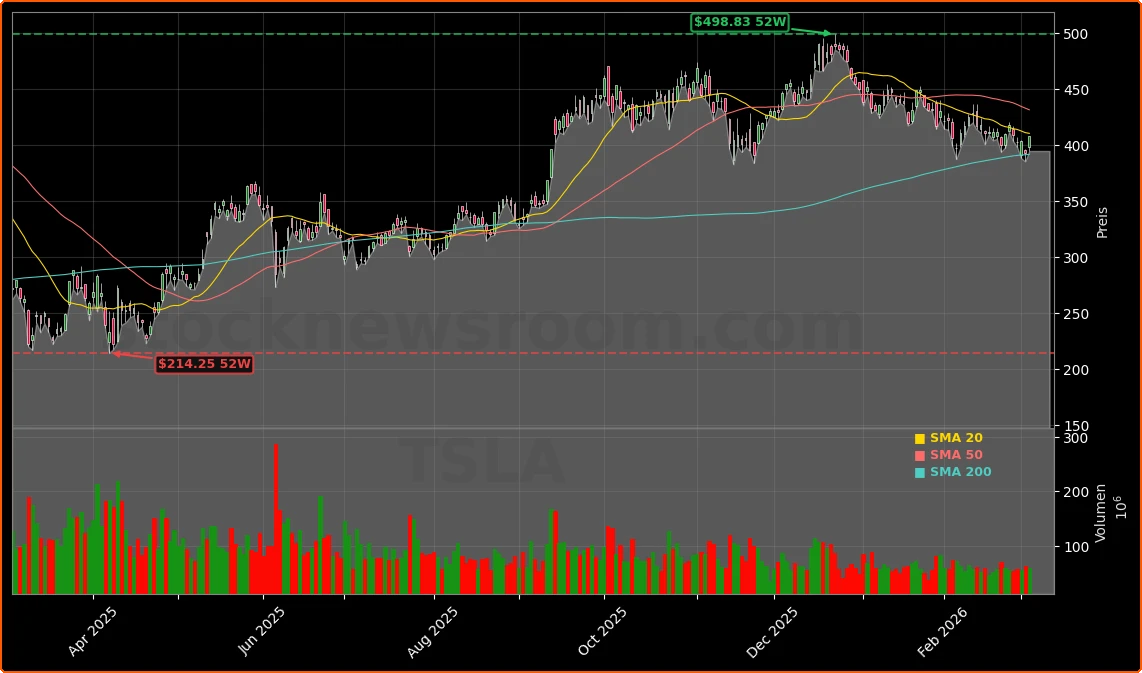
At about $408.16 in Wednesday’s session, Tesla shares are up roughly 4% on the day and sit less than 20% below their recent all‑time high, according to recent trading data. The move comes as growth stocks rebound broadly on Wall Street, with the so‑called Magnificent Seven, including Tesla and Apple, helping lift the major indices. MarketWatch notes that Tesla and Amazon led gains in the group, supporting a wider bounce in the S&P 500 and Nasdaq after a volatile stretch for growth names.
The narrative behind this latest leg higher has shifted decisively away from pure EV volume. Tesla’s global deliveries have plateaued: around 1.81 million vehicles in 2023, 1.79 million in 2024 and an estimated 1.22 million in 2025, marking the first meaningful step down after years of rapid expansion. Subsidy roll‑offs in key markets and intensifying competition from both legacy OEMs and Chinese manufacturers are pressuring unit growth and margins. Against this backdrop, the market is again focusing on the high‑margin promise of autonomy, software and robotics as the next growth engines.
This is where the Tesla Robotaxi Strategy becomes central: if robotaxis and advanced driver assistance software can become recurring‑revenue platforms, investors may tolerate cyclical or even shrinking EV volumes as long as the software stack scales. That shift, however, places far more weight on execution in an area where regulation, technology readiness and public perception all remain uncertain.
Tesla Robotaxi Strategy: what exactly is Wall Street betting on?
The clearest near‑term catalyst behind the stock’s recent move is Bank of America’s decision to reinstate Tesla with a Buy rating and a $460 price target. Analyst Alexander Perry characterizes Tesla as the current leader in consumer autonomy and argues the company is well positioned to become a dominant provider of robotaxi services, with the ability to scale more profitably than rivals. In a separate note on the broader auto sector, Bank of America frames Tesla as the spearhead of an “Auto 2.0” revolution driven by autonomous technology and new mobility services.
For investors, the Tesla Robotaxi Strategy rests on several pillars. First, the company has a large, globally distributed fleet equipped with the necessary sensor suite, generating billions of real‑world miles of driving data. That dataset is critical for training the neural networks behind its Full Self‑Driving (FSD) system. Second, Tesla sells FSD (now branded as Full Self‑Driving Supervised) as a high‑margin software add‑on, creating the potential for substantial operating leverage if adoption rises. Third, management envisions a future in which Tesla can flip a software switch to enable a robotaxi network, allowing owners to deploy their vehicles as autonomous ride‑hailing assets when not in use.
Market consensus is starting to model autonomy as a distinct value driver. A recent MarketWatch analysis argued that Tesla’s self‑driving efforts could ultimately be worth more than double its EV manufacturing division if the robotaxi opportunity materializes at scale. In that scenario, hardware margins might compress, but total enterprise value could expand as the market re‑rates Tesla more like a software and mobility platform than a traditional automaker. That is the core upside case for the Tesla Robotaxi Strategy — but it is far from guaranteed.
Tesla and autonomy: technology progress vs. regulatory drag
One of the biggest disconnects U.S. investors must grapple with is the gap between the long‑term vision of the Tesla Robotaxi Strategy and the current reality of Tesla’s driver‑assistance technology. After years of promising fully autonomous capabilities, Tesla in 2024 appended “Supervised” to the Full Self‑Driving brand, acknowledging what regulators and independent researchers have long maintained: the system remains a Level 2 driver‑assistance suite under SAE definitions, not a Level 4 autonomous system. Drivers must stay fully attentive and ready to take over at any time.
Regulatory tensions underscore the risks. The California Department of Motor Vehicles previously accused Tesla of misleading marketing around Autopilot and FSD, threatening its dealer and manufacturing licenses in the state. In February, Tesla responded with a lawsuit seeking to overturn the agency’s ruling that the company engaged in false advertising. Viral footage of a Tesla driver apparently asleep while FSD is engaged on a California freeway has further inflamed public debate and political pressure. At the same time, Elon Musk continues to publicly suggest that Tesla owners will eventually be able to fall asleep and wake up at their destination, a vision that regulators are far from endorsing.
From a risk‑reward standpoint, this tension cuts both ways. On one hand, if regulators clamp down aggressively on Autopilot and FSD marketing, the rollout of the Tesla Robotaxi Strategy could be delayed, and Tesla may face fines, retrofit costs or reputational damage. On the other, if Tesla can demonstrate a strong safety record and work constructively with regulators to define standards, the company could lock in a powerful first‑mover advantage. That is the scenario underpinning bullish calls from Bank of America and from high‑conviction shareholders like Cathie Wood’s Ark Invest, which continues to hold more than $1 billion worth of Tesla stock and has been buying on dips.
Tesla and Optimus: can humanoid robots be the next multi‑billion‑dollar segment?
Beyond the Tesla Robotaxi Strategy, another key narrative supporting the stock is the push into humanoid robotics through the Optimus program. Elon Musk has argued that Tesla will be one of the companies to achieve artificial general intelligence (AGI), and probably the first to do so in a humanoid, “matter‑shaping” form. He has outlined plans to repurpose the company’s Fremont facility for Optimus production, with a long‑term goal of reaching one million humanoid robots per year.
On recent public forums, Musk has gone even further, speculating that Optimus could evolve into a kind of self‑replicating von Neumann probe for future space exploration — a vision that, while speculative, illustrates the scale of his ambition. More concretely for investors, Tesla is pushing hard on in‑house AI chip development, targeting a 2‑nanometer chip roadmap to support both autonomous driving and robotics workloads. Progress on proprietary chips could reduce the company’s dependence on external suppliers like NVIDIA over time and improve vertical integration economics.
Wall Street has not yet fully capitalized the Optimus opportunity into most models, largely because there is no meaningful commercial revenue today. However, the company has started reallocating resources in that direction, discontinuing its two oldest and most expensive car lines to free up capacity for Optimus and its future Cybercab offering. If even a fraction of Musk’s production targets prove realistic over the next decade, Optimus could rival or surpass the economics of the core EV business, especially if units are deployed first inside Tesla factories to reduce labor costs and then sold into broader industrial and consumer markets.
Tesla competitive positioning: EVs, autonomy and global demand
Operationally, Tesla’s global footprint remains a strength but is no longer unchallenged. In the United Kingdom, for example, Tesla’s sales in February dropped sharply year over year, even though the company still outsold Chinese rival BYD in battery‑electric vehicles, as highlighted by new registration data. Within continental Europe, recent data from Germany show that Tesla’s deliveries rebounded strongly after a weak 2025, with monthly registrations up nearly 60% versus the prior-year period. That sort of regional volatility is now the norm as incentives, consumer sentiment and competitive dynamics shift market by market.
The product lineup is in flux as well. Tesla recently tested demand sensitivity with a lower‑priced Cybertruck all‑wheel‑drive variant around $59,000, roughly $20,000 below the high‑end trim. The offer quickly pushed order books out toward 2027, suggesting significant price elasticity. However, the discount was explicitly temporary; after ten days, Tesla rolled prices back up by $10,000. That experiment suggests management is still probing the optimal balance between volume and margin in a higher‑rate environment. Betting markets such as Polymarket are even speculating on whether Tesla will launch its Cybercab — the physical backbone of the Tesla Robotaxi Strategy — under $30,000 this year, with implied probabilities around one‑third.
In the U.S. and China, Tesla faces intensifying competition from legacy automakers like General Motors, Ford and Apple’s emerging automotive ambitions, as well as pure EV players. Bank of America has taken a barbell approach, pairing a bullish call on Tesla’s autonomy leadership with a positive view on GM’s internal combustion truck and SUV dominance. That split underscores how divergent auto strategies have become: some players are leaning into high‑margin ICE vehicles while keeping EV and autonomy options open, whereas Tesla is effectively doubling down on autonomy and robotics at the potential expense of near‑term volume growth.
Tesla governance, labor and inequality: headline risk for investors
Investors also need to consider non‑operational risks, especially around governance, labor relations and public perception. A recent analysis from Oxfam, covered by the Austin American-Statesman, argues that Tesla’s pay structure, tax strategies and political influence have significantly contributed to Elon Musk’s outsized wealth and rising U.S. inequality. The report points to the vast gap between Musk’s compensation packages and average employee pay, use of tax havens and what it characterizes as insufficient corporate oversight.
At the manufacturing level, tensions are visible in Europe. In Germany’s Grünheide gigafactory, powerful metalworkers’ union IG Metall suffered a setback in recent works‑council elections, failing to secure a majority after an intense campaign. A new factional landscape emerged, including a Polish workers’ list that became the third‑largest group, reflecting the factory’s multinational workforce. Shortly before the vote, Musk addressed employees by video, warning that expansion would be “realistically” harder if external organizations tried to push Tesla in what he sees as the wrong direction, though he said the plant would not be closed. Such statements highlight the company’s resistance to traditional union frameworks, which may continue to generate friction in heavily unionized regions.
While these issues do not directly alter the financial calculus of the Tesla Robotaxi Strategy, they matter for ESG‑oriented funds, European investors and regulators who may view Tesla as a test case for how aggressively tech‑style governance can coexist with heavy manufacturing. Any adverse rulings on Autopilot, tax practices or labor standards could, at the margin, affect Tesla’s cost of capital and license to operate in key markets.
Valuation, sentiment and positioning: how much of the future is priced in?
From a valuation standpoint, Tesla still commands a premium multiple versus both global automakers and many high‑growth tech names. One recent snapshot put the company at roughly 15 times sales, a level more typical of high‑margin software leaders than of cyclical manufacturers. The Wall Street analyst community is deeply divided: around 31 Buy ratings, 19 Hold ratings and 14 Sell ratings reflect a wide range of views on execution risk and intrinsic value. Bank of America’s $460 price target implies meaningful upside from current levels, underpinned primarily by its conviction in Tesla’s leadership in autonomous driving software and its early edge in the robotaxi race.
Short‑term traders are watching key technical levels. Some active market participants flag $360 on the downside as an important support zone that, if broken, could trigger a sharper correction, while a sustained move above the $417 area would signal a fresh breakout attempt toward the $460 region and potentially new highs. With Tesla still only about 20% off its peak despite a punishing stretch for many growth stocks, positioning is far from washed out, leaving room for both upside surprises and painful drawdowns.
On the fundamental side, consensus expects modest revenue growth around the high single digits in 2026 despite the loss of some U.S. EV tax credits and the discontinuation of older models. Profitability is expected to expand, driven by mix shift toward software, improvements in the FSD platform and early contributions from robotics. Those forecasts, however, assume no major regulatory roadblocks to the Tesla Robotaxi Strategy and continued progress on Optimus and in‑house AI chips.
Tesla’s investment case has shifted from being primarily about electric vehicles to being a leveraged bet on autonomy and humanoid robotics, with the Tesla Robotaxi Strategy at its core.
— StockNewsRoom Analysis
Conclusion
For diversified U.S. investors, the decision is ultimately about portfolio role. Tesla today is less a pure EV cyclical and more a high‑beta, high‑optionality play on autonomy and robotics. That makes it particularly sensitive to macro risk appetite, AI sentiment and regulatory newsflow, but it also offers exposure to secular themes that many broad indices may underweight.
Further Reading
- Tesla, Inc. (TSLA) stock quote and profile (Yahoo Finance)
- Tesla Stock Is Rising as It Gets a New Vote of Confidence From Wall Street (Investopedia)
- Tesla and General Motors: BofA Bets Big on Autonomy and ICE Dominance With Bold Price Targets (24/7 Wall St.)
- Tesla’s self-driving effort could be worth more than double its EV division (MarketWatch)
- Elon Musk Says Tesla Will Be One Of The Companies To Develop AGI, Reaffirms Humanoid Robot Ambitions (Benzinga)