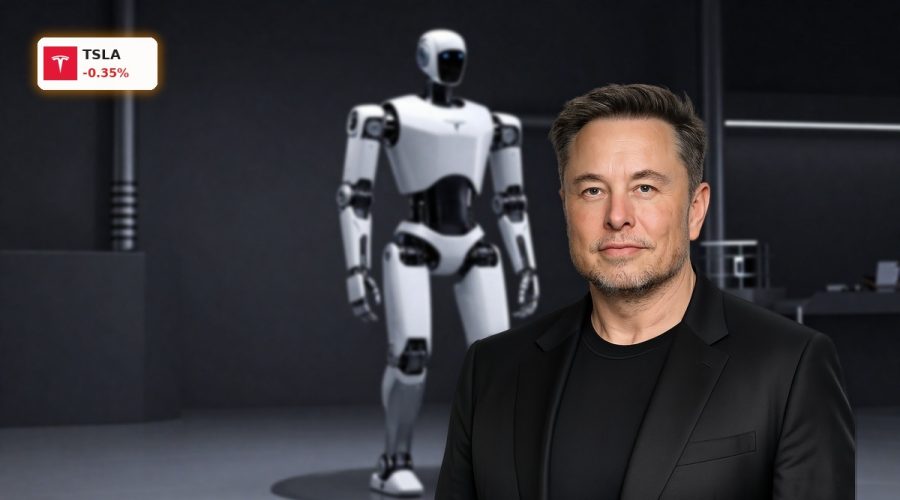
Is Tesla Robotics and the Optimus humanoid bet powerful enough to overshadow a cooling EV market and reprice TSLA?
Is Wall Street shifting from EVs to Tesla Robotics?
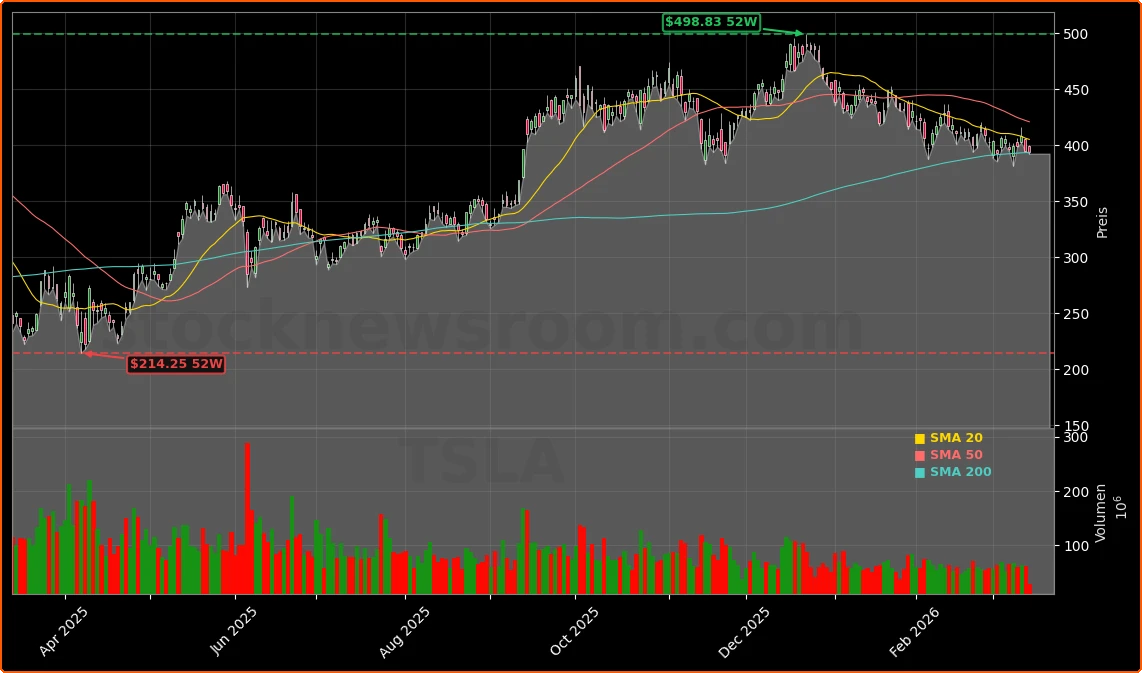
For a growing group of institutional investors, the story is no longer primarily about cars. Some portfolio managers now explicitly say they own Tesla for its emerging Tesla Robotics business, not for the traditional EV franchise that drove the stock’s first decade of gains. The stock is down roughly mid‑teens year to date and about 0.35% on Friday, underperforming a weak tape for the S&P 500 and Nasdaq, where most of the “Magnificent Seven” also traded lower in recent sessions.
The new narrative hinges on CEO Elon Musk’s plan to deploy at least 10,000 Optimus humanoid robots across Tesla factories in the coming months as an internal proof‑of‑concept. The strategic pitch: if Optimus can automate repetitive, labor‑intensive tasks in manufacturing, logistics, and eventually other industries, Tesla Robotics could become a high‑margin platform business largely decoupled from cyclical car demand.
How big could Optimus be for Tesla?
Musk has outlined an aggressive roadmap for Optimus under the broader Tesla Robotics umbrella. His goal is to reach production of 1 million humanoid robots per year by 2028 at a selling price around $50,000 per unit. On his math, each robot could generate roughly $20,000 in profit, implying a potential annual profit pool of $20 billion once scale is achieved – more than Tesla has earned in any year from its auto operations alone.
That kind of incremental profit would meaningfully reshape valuation models on Wall Street. It effectively introduces a second growth S‑curve on top of EVs, similar to how cloud computing transformed Amazon beyond its retail roots or how AI accelerators changed the narrative for NVIDIA. Quant frameworks that score S&P 500 consumer‑discretionary names on growth now frequently rank Tesla near the top, in part because of those Robotics assumptions.
However, the execution risk is enormous. Humanoid robotics at industrial scale has yet to be proven by any manufacturer. Musk’s timelines have historically been optimistic, from Full Self‑Driving to prior vehicle launch schedules, and the technical hurdles in mobility, dexterity, and safety are substantial. Investors are effectively being asked to discount a business that exists today mostly in pilot form.
What do the latest EV market data say?
While Tesla Robotics captures the headlines, the core EV business still drives revenue and cash flow. U.S. EV registrations fell for the first time in at least a decade in 2025, with a sharp 48% drop in December as higher interest rates, elevated sticker prices, and the expiration of a $7,500 federal EV tax credit hit demand. Against that backdrop, Tesla’s registrations declined a lesser 35% to about 42,400 vehicles for the month, preserving a commanding lead over Ford and General Motors’ Cadillac brand.
The Model Y crossover once again proved critical, with registrations down only about 24% in December yet still topping all EVs sold in the U.S. Its resilience is driven by strong brand loyalty, which continues to offset an aging lineup and intensifying competition from legacy OEMs and Chinese manufacturers. Analysts at S&P Global Mobility describe Tesla’s U.S. share as “dwindling but still dominant,” and warn that if the Model Y eventually loses its grip on consumers, the near‑term path for the stock could turn much rougher.
Outside the U.S., signs are more encouraging. Data from China’s passenger‑car association show that Tesla’s Shanghai factory boosted deliveries sharply in the first two months of 2026 versus a year earlier, clawing back some ground from BYD in the world’s largest EV market. That rebound provides some buffer for margins after a 2025 marked by price cuts and a roughly 9% drop in global deliveries.
How are analysts and products reframing Tesla risk?
On Wall Street, the divided outlook is stark. Some research houses argue it may be time to trim or exit Tesla given valuation and cyclical EV headwinds, while others highlight “buy‑the‑dip” setups anchored on three pillars: the ramp of Tesla Robotics, a recovery in China volumes, and the upcoming launch of the autonomous “Cybercab” robotaxi service, expected to begin rolling out next month. The Cybercab, if successful, would add yet another software‑ and AI‑heavy layer to the story.
Volatility itself has become a feature, not a bug, for product designers. Structured products and new autocallable ETFs now actively harvest Tesla’s high implied volatility to generate income for investors, similar to strategies built around Apple and other mega‑caps. These vehicles appeal to advisors seeking defined payout profiles while still getting exposure to growth themes such as Tesla Robotics and AI‑enabled manufacturing.
So far, large banks like Morgan Stanley and Goldman Sachs have emphasized scenario analysis rather than binary calls. Bull‑case models increasingly treat Tesla Robotics and autonomous driving as the primary long‑term value drivers, with the legacy EV business morphing into a cash engine that funds software, AI, and robotics expansion.
We own Tesla for the robot business, not for the EV business.
— A U.S. growth portfolio manager
Conclusion
For now, the tape tells a cautious story: Tesla shares remain well below their 52‑week highs, and the broader tech complex has come under pressure as investors rotate out of richly valued growth. Yet the combination of dominant – if moderating – EV share, a rebound in China, and the optionality embedded in Tesla Robotics keeps the name central to debates about the future of both transportation and industrial automation.
Further Reading
- Tesla, Inc. (TSLA) Stock Price & Data (Yahoo Finance)
- Finally, a Little Good News for Tesla Investors (The Motley Fool)
- Tesla China EV sales rebound as Shanghai factory output climbs (Invezz)
- EV investors hoping for a rebound could be left waiting (The Globe and Mail)