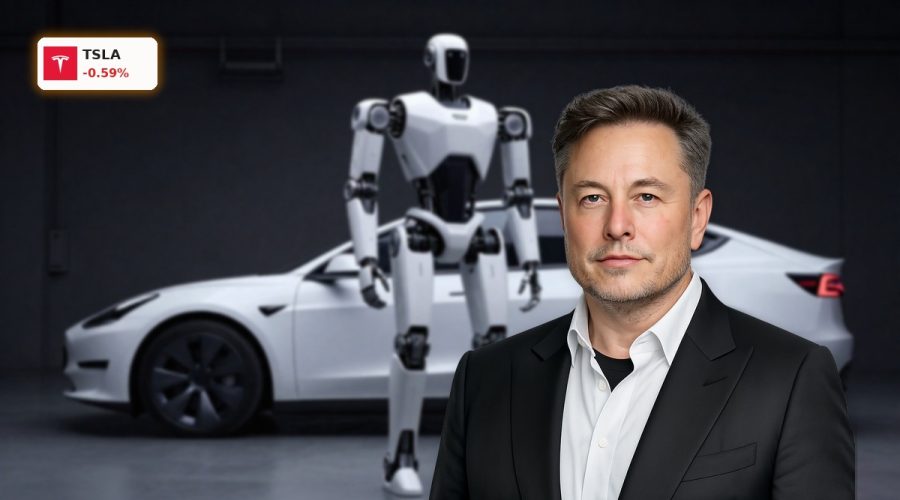
Can Tesla’s bold robotics and AI pivot really eclipse its car business, or will execution risks stall the grand vision?
How is Tesla reshaping its growth story?
Tesla, Inc. is increasingly being valued by the market as an AI and robotics play rather than a pure electric-vehicle manufacturer. Musk has said the company’s future rests on autonomy and a large fleet of Optimus humanoid robots, which he calls potentially the “biggest product of all time.” Under the broader Tesla Robotics Strategy, management envisions Optimus performing repetitive tasks in warehouses and factories, including at large logistics players that today rely heavily on human labor.
Analysts such as Andres Sheppard of Canter see the global humanoid robotics market expanding from about $2.9 billion in 2025 to roughly $15.3 billion by 2030, implying close to 40% compound annual growth. Tesla bulls model a unit selling price around $50,000 with estimated net profit of about $20,000 per robot, numbers that, if realized at scale, would dwarf the profitability of today’s automotive business. For semiconductor suppliers, each humanoid may carry a similar chip bill of materials to a modern car, around $500, opening an attractive parallel growth runway.
What does this mean for autonomy and AI?
The Tesla Robotics Strategy is tightly linked to the company’s Full Self-Driving (FSD) program. Tesla recently surpassed 8.4 billion FSD miles driven, moving closer to Musk’s stated 10 billion-mile threshold for unsupervised autonomy. Those data help train AI models not only for robotaxis but also for Optimus, where perception, planning, and control software share common building blocks. Tesla’s multibillion‑dollar AI investments, including in custom chips and in-house supercomputing, aim to capture slices of multi-trillion‑dollar markets like robotaxis and physical AI in industrial settings.
Yet skeptics remain vocal. Investor Gary Black of The Future Fund notes that TSLA has underperformed the Nasdaq 100 over the past five years despite major progress in unsupervised autonomy, arguing that earnings expectations for 2026–2028 have fallen sharply. He also believes Tesla has “fallen way behind” Alphabet’s Waymo in fully driverless rides, highlighting the execution risk embedded in the Tesla Robotics Strategy. For long‑term holders, that divergence between technological milestones and share-price performance is becoming harder to ignore.
Is the Cybertruck price hike a near-term headwind?
While the robotics narrative unfolds, Tesla’s core automotive decisions still move the stock. The company has raised the price of the more affordable Cybertruck AWD trim by roughly 17%, from $59,990 to around $69,990, only days after launch. That puts the truck above Tesla’s inflation-adjusted 2019 dual‑motor price estimate and raises questions about demand elasticity at a time of intense EV competition.
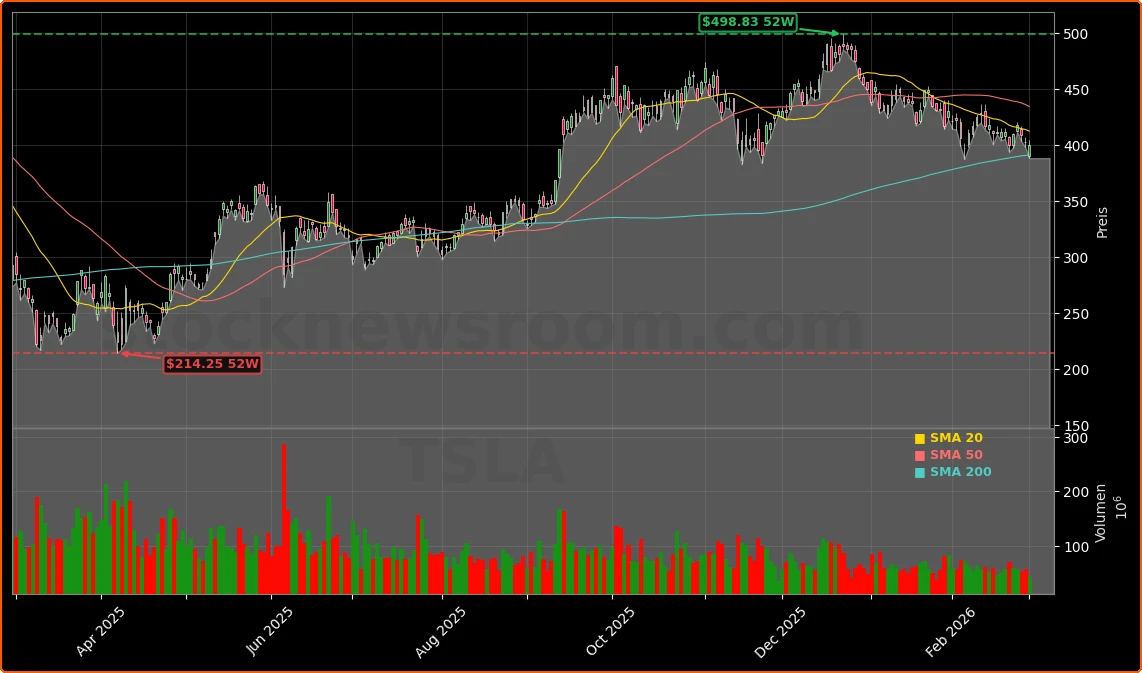
Critics such as Gary Black warn that the higher‑priced AWD model could cannibalize demand within the Cybertruck lineup rather than expand it, and may not meaningfully lift profits if volumes stall. TSLA is currently battling to hold chart support around its 200‑day moving average, historically a key range around $394–$400. Some on Wall Street fear that premium pricing on a still‑niche, complex vehicle could distract from executing the Tesla Robotics Strategy and scaling Optimus toward meaningful revenue contribution.
How do Europe and competitors factor in?
Despite near‑term stock weakness, Tesla is showing signs of stabilization overseas. Registrations in Spain surged roughly 74% year over year in February, while France and Norway also saw double‑digit growth after the rollout of cheaper Model 3 and Model Y variants. These gains come as Chinese rival BYD faces a sharp sales slowdown, potentially easing some price pressure in global EV markets.
At the same time, American investors must weigh Tesla’s AI lead against moves by challengers. Rivian is planning its own AI chip and “Universal Hands‑Free” system, and industrial robotics leaders such as Boston Dynamics are targeting similar humanoid use cases. Chipmakers like NVIDIA stand to benefit if a wave of humanoid deployments materializes across Tesla factories and third‑party warehouses, while Big Tech players such as Apple could eventually integrate physical AI into broader ecosystem strategies.
You don’t build generational wealth by chasing every tick – you build it by knowing your thesis and letting time work for you.
— Long-term Tesla shareholder on Wall Street
Conclusion
For now, day‑trading Tesla around volatility remains risky; many portfolio managers emphasize having a clear thesis and time horizon. The Tesla Robotics Strategy, with Optimus at its core, offers a compelling long‑duration narrative, but investors must balance that upside against execution risk in autonomy, uncertain Cybertruck economics, and a stock that has lagged broader tech benchmarks despite huge expectations.
Further Reading
- Tesla, Inc. (TSLA) Stock Price & Data (Yahoo Finance)
- Tesla’s Cybertruck AWD Price Hike of 17% (Yahoo Finance Singapore)
- Tesla Hits 8.4B FSD Miles: Is Unsupervised Autonomy Within Reach? (Zacks Investment Research)
- Tesla gains market in France, Norway in February (Reuters)