Is Tesla Strategy’s bold chip megafab and robo‑taxi pivot enough to justify today’s sell-off and its still lofty valuation?

How is Tesla Strategy hitting the stock today?
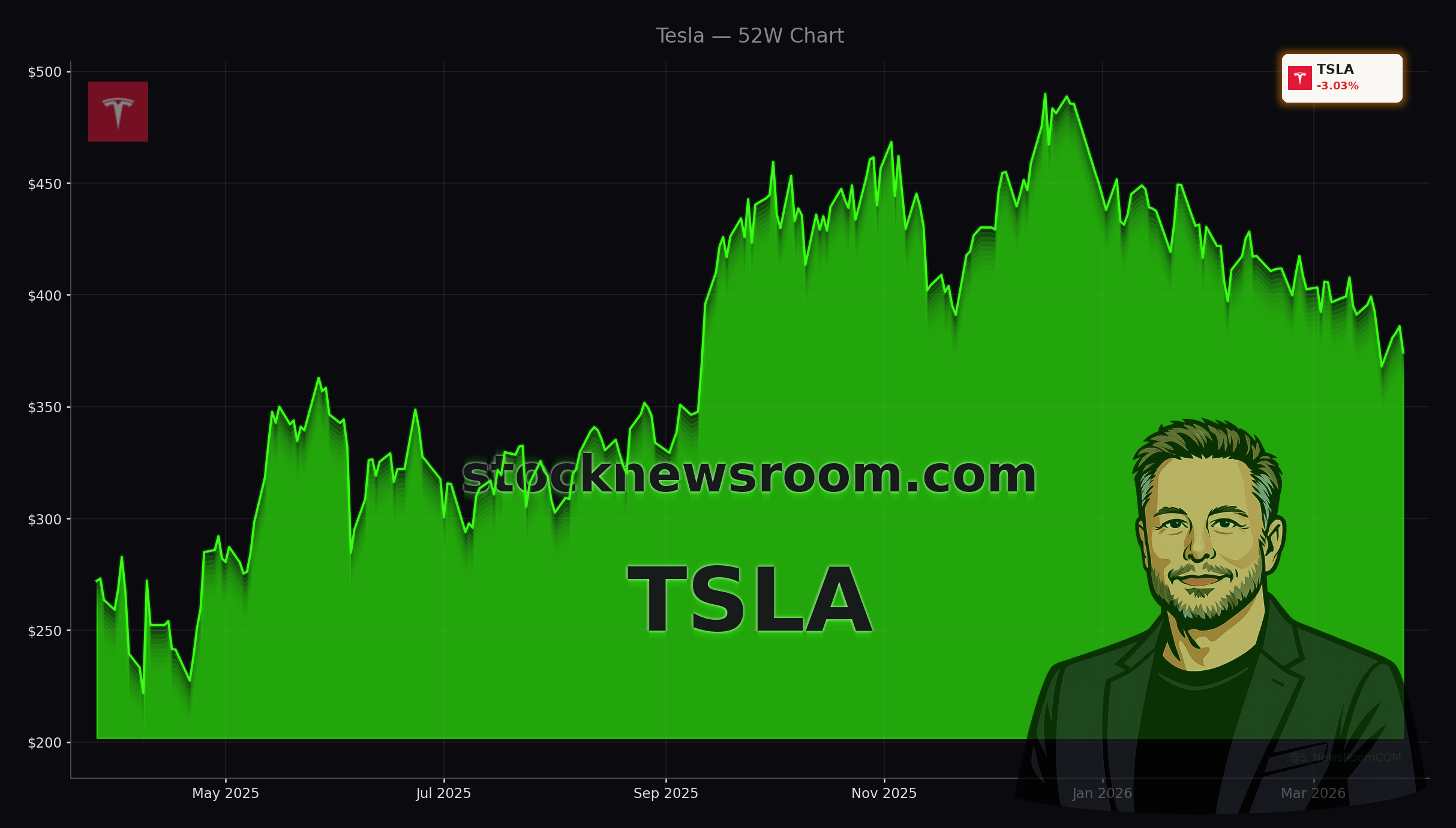
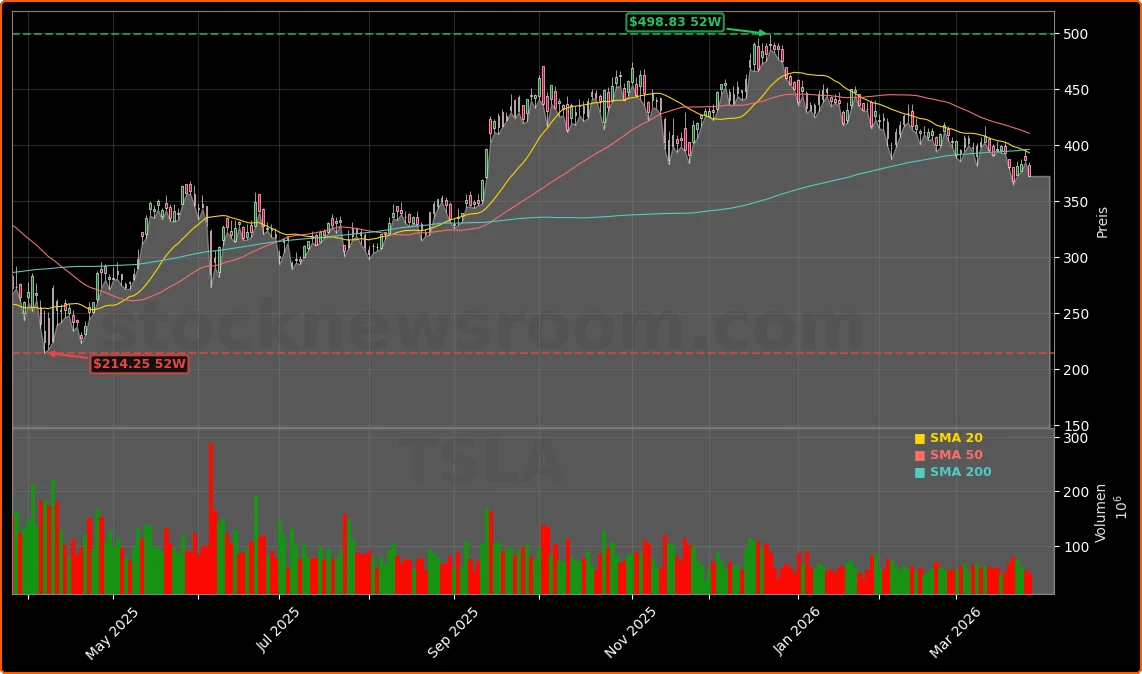
TSLA changed hands around $372.33 on Thursday, down roughly 3.5% on the day and about 15% year to date, even after a powerful rebound that recently pushed shares to a nine‑month high. The stock remains volatile and highly liquid, with average three‑month trading volume above 90 million shares, keeping it a favorite among day traders who exploit the sharp swings around catalysts like quarterly delivery reports and product announcements.
Near term, expectations for Q1 2026 deliveries are being reined in. RBC Capital analyst Tom Narayan projects about 367,000 units, slightly below the roughly 370,000 vehicles implied by other Visible Alpha‑tracked consensus estimates. Investor’s Business Daily also highlights that Tesla itself has compiled a more conservative analyst delivery figure, adding to caution ahead of next week’s report. Against that backdrop, Tesla Strategy is being judged less on unit growth and more on whether new businesses can support the premium valuation.
Why are chips suddenly core to Tesla Strategy?
The biggest strategic swing is Elon Musk’s plan to build a massive advanced chip manufacturing facility in the Houston area, together with SpaceX and xAI. Internally dubbed a Terafab‑scale project, the plant is intended to secure AI compute for self‑driving, the planned robo‑taxi network and Musk’s broader AI ambitions, potentially reducing reliance on external foundries and suppliers such as NVIDIA and Taiwan Semiconductor Manufacturing.
Simply Wall St. notes that the Terafab vision, if executed, could eventually challenge TSMC’s position in high‑end AI chips, raising questions about industry capacity and future customer relationships. Morningstar, analyzing the upcoming SpaceX IPO at an estimated $1.75 trillion valuation, argues that the “Musk effect” — extreme sentiment swings driven by his actions — could be even more pronounced at SpaceX than it has been at Tesla. For public TSLA holders, the chip fab underscores how quickly Tesla Strategy is converging with Musk’s private ventures in AI and space, blurring boundaries but also creating new optionality.
Longer term, a successful internal chip pipeline could improve margins on autonomous driving and robotics, and support the rollout of Tesla’s robo‑taxi program, which already operates in Austin and is expected to scale to more U.S. cities in 2026. However, the capex intensity and execution risk are high, and investors will watch closely how much of Tesla’s balance sheet is committed versus funding sourced from SpaceX, xAI, or a future SpaceX listing.
Can cheaper Superchargers defend Tesla’s EV moat?
While AI and chips grab headlines, Tesla Strategy in the core EV and infrastructure business is also evolving. This week, Tesla unveiled a new “Folding Unit” Supercharger for North America featuring a V4 cabinet with up to 500 kW capacity and eight posts per unit. Management says these units cut costs by at least 20% and can be deployed roughly twice as fast as prior generations, with simplified on‑site work and no Tesla technician required for commissioning.
For U.S. investors, that matters because charging infrastructure is one of Tesla’s most defensible moats as price competition erodes vehicle margins. An efficient Supercharger rollout supports cross‑brand adoption as other automakers move to Tesla’s NACS standard, creating a recurring revenue stream that could become more important if vehicle volume growth remains muted. Even as electricity prices have risen about 30% since 2022 while gasoline prices have retreated from their peaks, a Model Y can still travel roughly 250 miles on about $10 of home electricity versus about $30 in gasoline for a comparable ICE car, preserving a meaningful but narrower total‑cost‑of‑ownership edge.
Is China the biggest risk to Tesla Strategy?
China remains Tesla’s toughest market and a key pressure point for any realistic Tesla Strategy. Domestic competitors are rolling out aggressively priced premium EVs that undercut the Model 3 while matching or exceeding its specs. Xiaomi’s updated SU7, often branded the “Apple of China” car, recently logged about 15,000 pre‑orders in just 34 minutes with a starting price near $33,400, below the Model 3’s roughly $34,200 base in China. A new joint venture between SAIC and Huawei, sold under the Shangjie brand, saw its Z7 and Z7T models secure 18,000 pre‑sales within three hours, at similar or lower prices.
In 2025, Xiaomi’s SU7 became China’s best‑selling EV above the 200,000 yuan threshold, with roughly 258,000 units sold, pushing the Model 3 to sixth place around 200,000 units. At the same time, U.S. EV demand has flattened: Americans bought about 1.3 million all‑electric cars in 2025, barely above 2024 and only modestly higher than 2023, and the loss of the $7,500 federal EV tax credit in September triggered a 36% year‑over‑year plunge in Q4 EV sales. U.S. Tesla sales dipped to roughly 589,000 vehicles in 2025, down about 7% from 2024.
This backdrop helps explain why higher oil prices linked to Middle East tensions are no longer lifting TSLA as they once did. The market appears to believe that Americans already own as many EVs as they currently want, regardless of gasoline prices, making execution on the broader Tesla Strategy — chips, software, services and robots — more important than macro energy tailwinds.
Where do robots and valuations fit into Tesla Strategy?
Investors are also wrestling with how to value Optimus, Tesla’s humanoid robot program, and the broader AI narrative. Tesla plans to unveil the third generation of Optimus in the coming weeks, and management has floated the idea of repurposing existing vehicle plants to produce robots at scale if demand materializes. A newly approved compensation package for Elon Musk could, in theory, be worth up to $1 trillion if he can increase Tesla’s market capitalization roughly seven‑fold, which would likely require dominance in autonomous driving and robotics, not just EVs.
Wall Street opinion is split. Some market commentators highlight that, despite a 2,400%+ share price gain over the past decade, Tesla now trades at what many see as a relatively expensive multiple versus a slowing core business, with limited traditional upside on near‑term metrics. Others, including value‑focused comparisons from Zacks between Blue Bird and Tesla, argue that much of the current price already bakes in optimism around these new verticals. Citigroup, Goldman Sachs and other major banks have not issued fresh high‑profile upgrades in recent days, underscoring a more cautious institutional stance while retail traders continue to lean into the volatility.
Related Coverage
Investors looking for a deeper dive into Musk’s wider ecosystem may want to read this analysis of a potential Tesla–SpaceX merger and record‑setting SpaceX IPO, which explores how the Terafab chip project and cross‑company AI ambitions could either turbocharge shareholder value or dilute existing owners. The same piece, available at this link on StockNewsroom, also examines how tighter integration across Musk’s companies might reshape capital allocation, governance and competitive positioning in the global AI race.
In the end, Tesla Strategy is pivoting from a straightforward EV growth story toward an intricate mix of AI chips, charging infrastructure and humanoid robots, just as competition intensifies and deliveries slow. For U.S. investors, that means TSLA will likely trade less on gasoline prices or quarterly unit beats and more on confidence in Musk’s ability to execute on these high‑risk, high‑reward projects. The next catalysts — Q1 deliveries, Optimus Gen‑3 and concrete updates on the Houston chip fab — will show whether this evolving Tesla Strategy can justify the volatility and keep Tesla near the center of growth portfolios.