Can Tesla Terafab and a new Intel chip pact really rewrite Tesla’s story as EV growth slows and investors lose patience?

Does Tesla Terafab change the market narrative?
The Tesla Terafab initiative centers on a planned advanced semiconductor campus in the Austin area, designed to manufacture custom AI and robotics chips for Tesla, SpaceX and Musk’s AI venture xAI. Intel will provide packaging technology and help “refactor” fab processes to ramp output, aiming at an ambitious 1 terawatt of compute per year. For equity investors, that scale hints at a long‑term push to reduce dependence on third‑party suppliers for accelerators and edge processors, and to capture more of the value chain behind autonomous driving and humanoid robots.
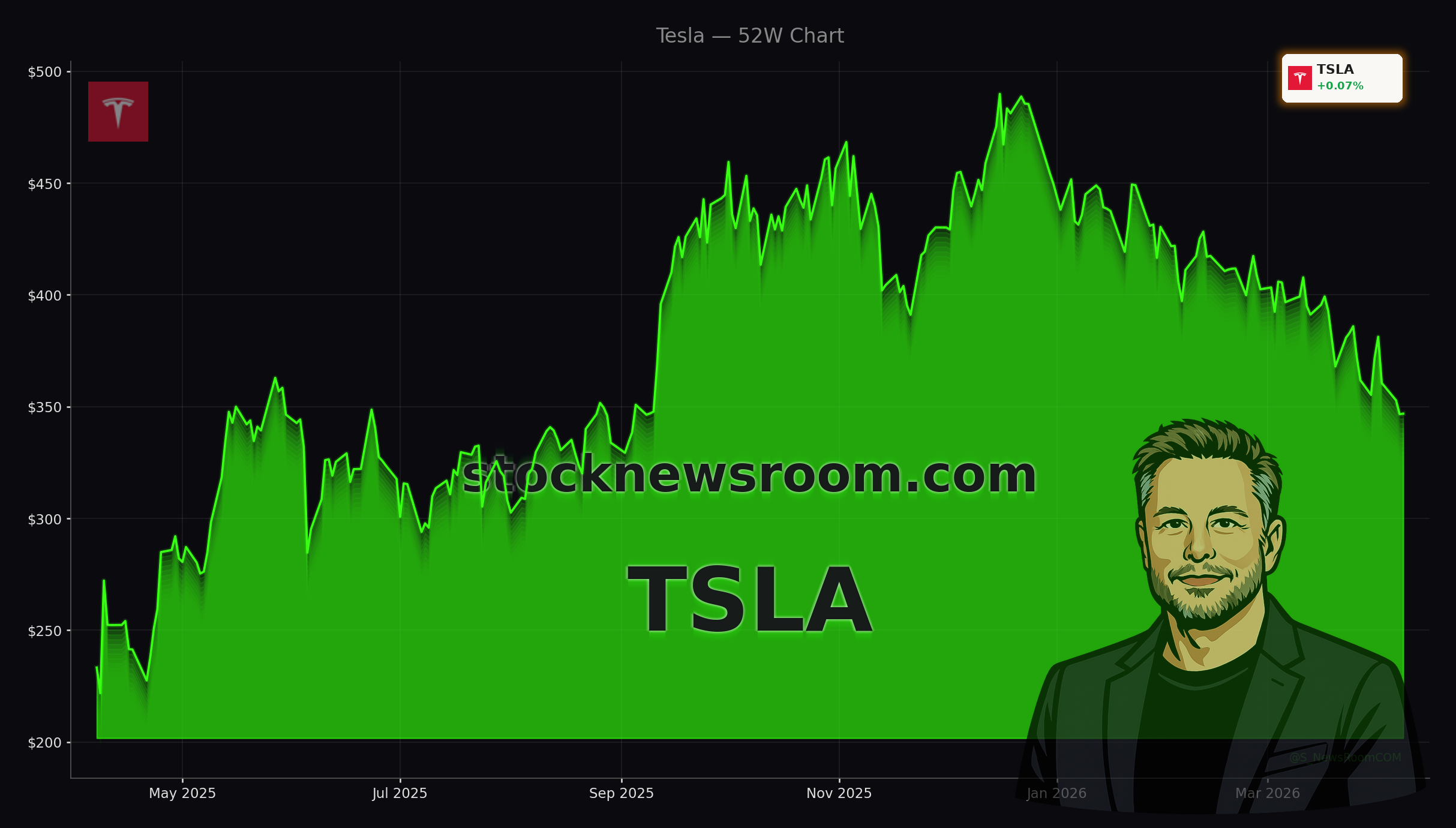
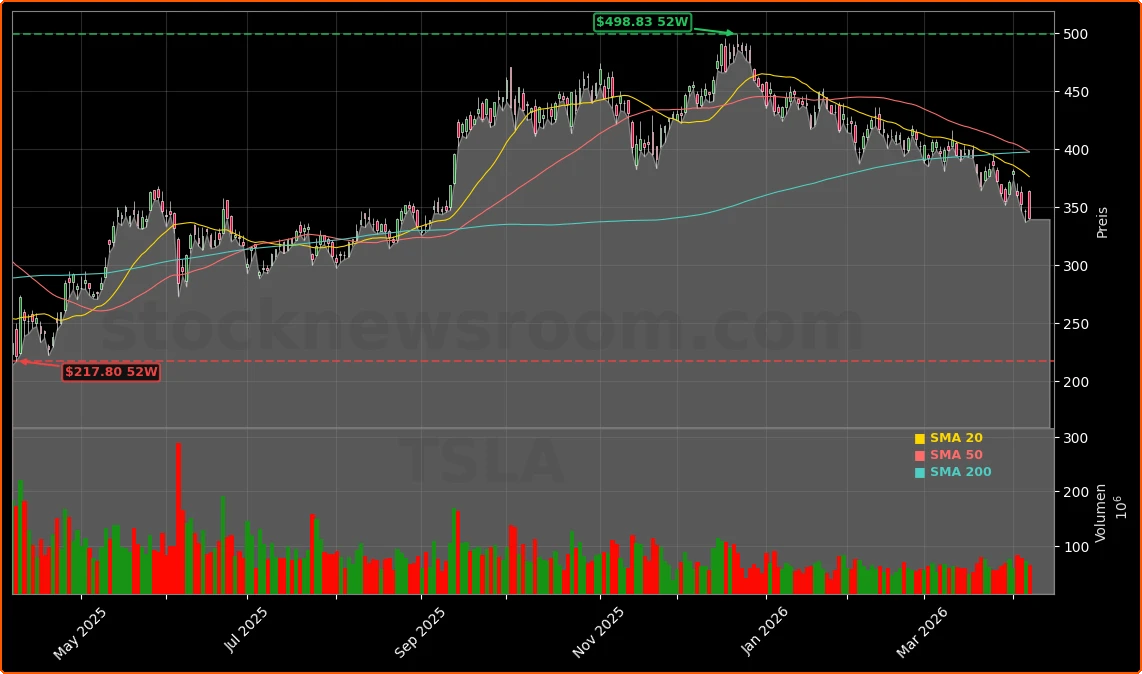
The timing is critical. Tesla shares are off about 23% year to date and trade around $340, after a brief bounce toward $360 on relief over a cease‑fire in Iran. The stock remains the worst performer in the so‑called “Magnificent Seven” in 2026, even as large‑cap tech has generally outpaced the broader S&P 500 in the latest rebound. Bears argue that Tesla’s premium multiple is harder to justify now that EV demand has cooled and U.S. tax credits have expired, while bulls see Tesla Terafab and Optimus robotics as the next leg of growth beyond cars.
Retail investors are clearly leaning into the new AI angle. Vanda Research data show roughly $256 million of net retail inflows into Tesla over the past five trading days, even as flows into other Magnificent Seven names such as NVIDIA and Meta have moderated. Cathie Wood’s ARK Invest has also stepped up dip‑buying, adding around 40,000 shares across multiple ETFs earlier in the week and nearly $14 million of stock in the latest pullback, maintaining a highly optimistic long‑term view.
How does Intel change Tesla’s AI ambitions?
Intel’s decision to join the Tesla Terafab project gives Musk’s chip plans a layer of industrial credibility that pure greenfield projects often lack. Intel shares climbed on the news that it will package custom chips for SpaceX, xAI and Tesla at the Texas site, which is expected to host two fabs: one for edge processors in vehicles and robots, and another for orbital or data‑center‑class AI chips. For Intel, the partnership is a way to showcase advanced packaging and foundry services as it tries to catch up with NVIDIA and TSMC in the AI semiconductor race.
For Tesla, bringing chip design and part of manufacturing in‑house is consistent with its broader strategy. The company already develops custom hardware for autonomous driving and is making progress on the Optimus humanoid robot, where Goldman Sachs analyst Mark Delaney recently highlighted milestones in hand and forearm engineering and manufacturability. Tesla says it is content with the pace of development and is prioritizing capability and reliability over flashy demos, while using off‑the‑shelf components where commoditized and building core IP internally.
If Tesla Terafab executes as planned, Tesla could reduce its reliance on external GPU suppliers and potentially lower the cost of compute needed for Full Self‑Driving, robotaxis and factory automation. That would also deepen the ties between Tesla and SpaceX, feeding into speculation that a future SpaceX IPO and potential corporate restructuring could bring Musk’s companies under a tighter umbrella, though any such mega‑deal would be complex and controversial.
Can chips offset Tesla’s EV and policy headwinds?
Despite the AI buzz, Tesla’s core automotive metrics remain under pressure. The company delivered 358,023 vehicles in the first quarter, missing analyst estimates in the 366,000–370,000 range. While that figure was up 6.3% year over year, the growth came off a weak base and marked a sharp sequential drop from the record fourth quarter of 2025. In the U.S., the expiration of the $7,500 federal EV tax credit at the end of last year and persistently high interest rates have weighed on demand and affordability.
Competition is intensifying as well. Chinese EV makers such as BYD and legacy automakers like General Motors and Ford are expanding battery‑electric offerings, even if some are slowing near‑term investment. On the positive side, Tesla registrations in Germany quadrupled in March to 9,252 vehicles, and March registrations in France nearly tripled, signaling that European demand can still respond when pricing and product fit align. Meanwhile, Tesla’s energy and services segments continue to post double‑digit growth, softening the impact from more volatile vehicle sales.
Wall Street remains deeply split. JPMorgan analyst Ryan Brinkman keeps a Sell rating with a $145 price target, implying about 60% downside from current levels, and warns that expectations for a sharp inflection in performance beyond this decade carry substantial execution risk. In contrast, the average Street target sits closer to $460, and some long‑only and hedge fund investors still view the current pullback and compressed P/E multiple as a potential entry point into a multi‑vertical Musk platform spanning EVs, storage, robotics and AI.
What does Tesla Terafab mean versus U.S. tech peers?
For U.S. portfolios, the key question is whether Tesla Terafab makes Tesla look more like a cyclical automaker with an AI kicker, or an emerging platform play akin to Apple or NVIDIA in earlier phases of their ecosystem builds. Unlike pure software or cloud providers, Tesla must fund heavy capex both in EV factories and in chip infrastructure, raising concerns about capital intensity and returns on invested capital. Yet if Tesla can leverage its skateboard EV platform, autonomous software stack and in‑house silicon to scale robotaxis and Optimus, the upside case resembles a mobility and robotics infrastructure provider rather than just an automaker.
At the same time, macro and policy risks remain. Local authorities in Texas recently voted to withhold part of previously approved incentives tied to reporting gaps at Gigafactory Texas, even though Tesla significantly exceeded job and investment commitments. Environmental groups are also pressing the company to follow through on its promised “ecological paradise” and riverfront restoration around the factory, underscoring that regulatory and ESG considerations will run in parallel with high‑stakes industrial bets like Tesla Terafab.
Related Coverage
Investors looking for a deeper dive into the valuation debate can read Tesla Forecast -4% Crash: Is $145 or $2,600 More Likely Now?, which contrasts bearish targets from firms like JPMorgan with highly bullish scenarios tied to robotaxis and AI. The piece also discusses how the current pullback fits into the broader AI cycle across mega‑cap tech and what it could mean for position sizing in concentrated growth portfolios.
Tesla Terafab is ultimately about rewiring Tesla’s story from a pure EV manufacturer to a vertically integrated AI and robotics company. For investors, the project could justify a premium multiple if execution on chips, Optimus and autonomous mobility matches the ambition, but it also adds capex risk on top of already volatile auto fundamentals. The next 12–18 months, as ground breaks in Austin and first Tesla Terafab output comes into view, will be critical in determining whether today’s skepticism turns into the next leg higher for the stock.