
Can The Trade Desk AI Strategy turn a 74% stock collapse into a long-term comeback story for investors?

Is Wall Street overreacting to The Trade Desk?
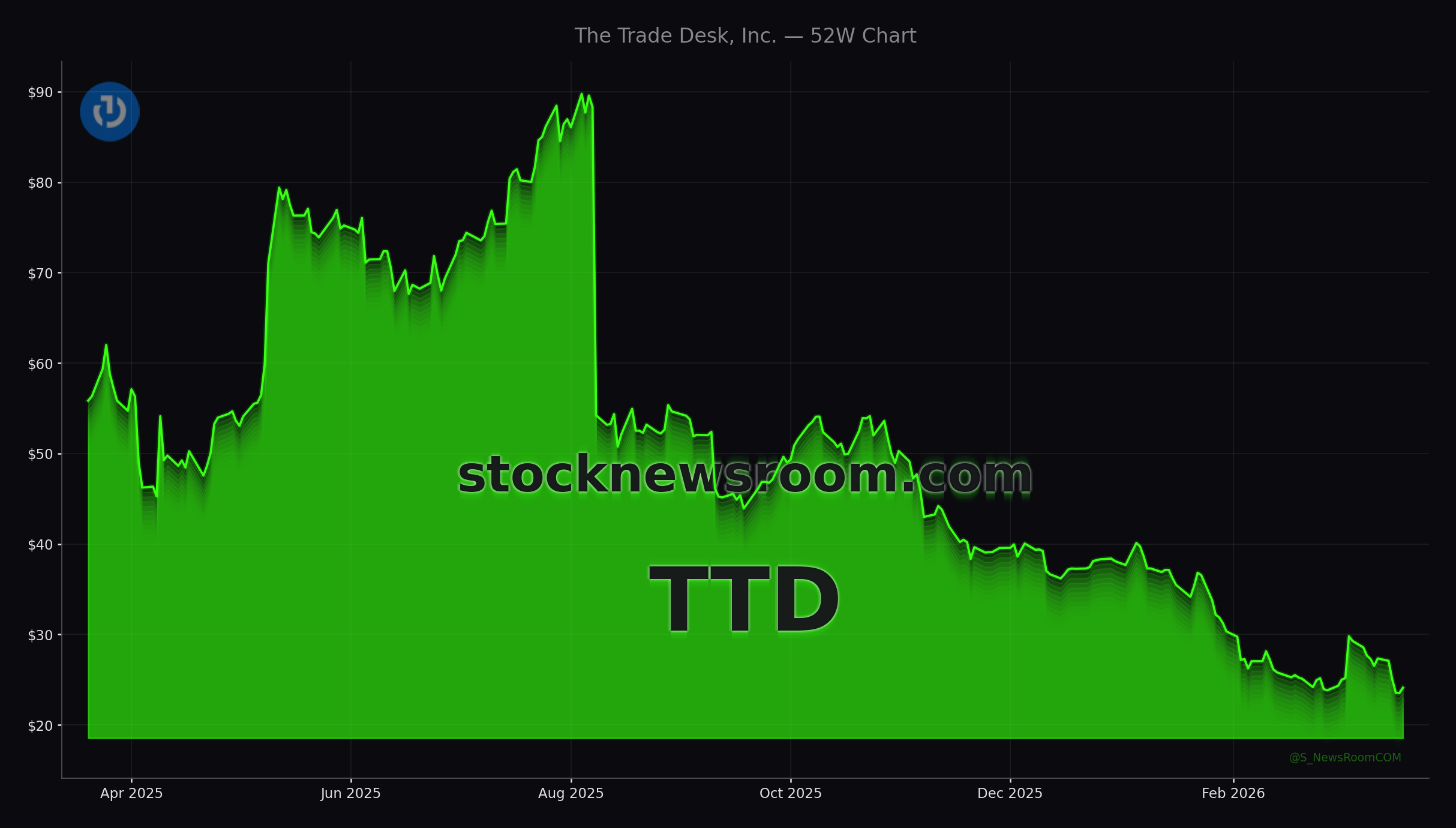
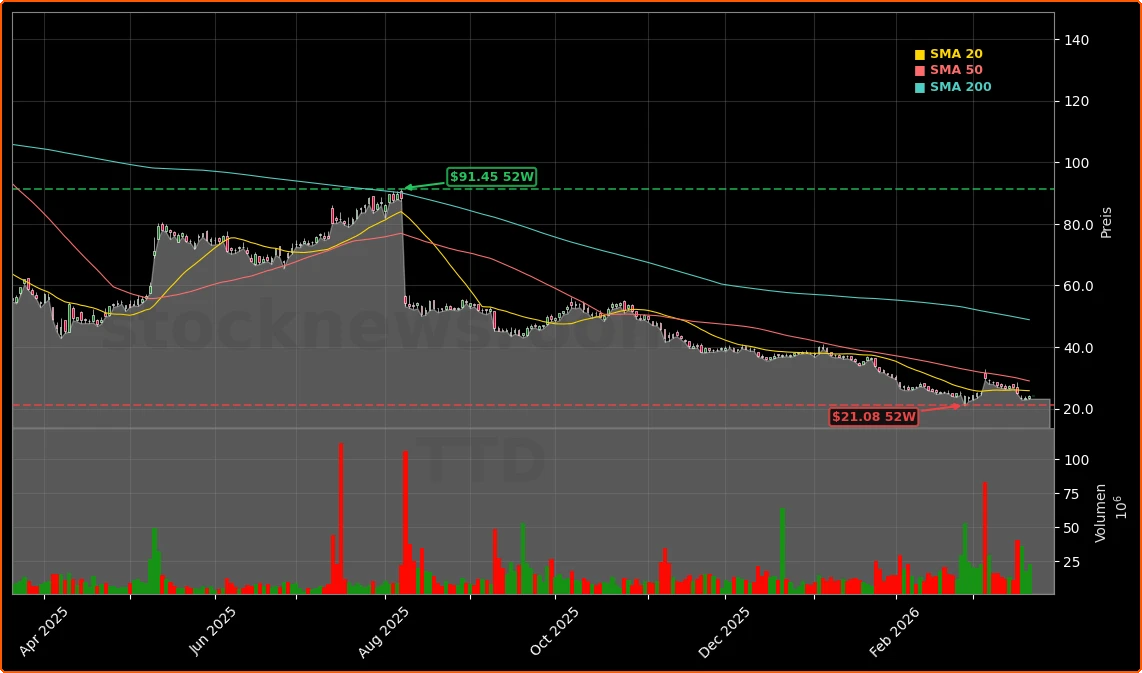
At Friday’s close, The Trade Desk, Inc. finished the session at $24.11, up 2.55% on the day, with after-hours trading nudging the stock to $24.20. That rebound barely dents a brutal slide from a 52-week high of $91.45, leaving the adtech leader down about 74% from its peak and back at multi-year lows. Against a backdrop where the NASDAQ and S&P 500 are much closer to their highs, the stock is trading as if its business model is in structural decline.
Yet over the last 12 months, The Trade Desk generated approximately $2.9 billion in revenue, growing about 18.5% year over year. Gross margins are hovering near 79%, with net margin above 15% and more than $440 million in after-tax profit. Debt remains minimal, with a debt-to-equity ratio around 0.18, leaving the company effectively unlevered compared with many adtech peers. On fundamentals, those are not the numbers of a dying platform.
Instead, sentiment has been hammered by a cluster of issues: cooling growth after years of outperformance, intensifying competition from Amazon in programmatic advertising, a rocky rollout of the Kokai AI platform, and a surprise CFO exit that triggered a nearly 40% single-day sell-off in 2025. The latest blow is the public fallout with French agency giant Publicis Groupe, which has stoked fears that major ad holding companies could redirect spend toward rival demand-side platforms.
What is happening with Publicis and agencies?
The immediate catalyst for this week’s volatility is a high-profile clash with Publicis. After an audit, the agency alleged that The Trade Desk had levied opaque or unauthorized fees and advised clients to stop using its platform. The Trade Desk has strongly denied wrongdoing, arguing that auditors were effectively demanding confidential billing information that included other customers’ data, something it says it cannot share under existing agreements.
The dispute lands at a sensitive time. Morningstar recently cut its fair value estimate for the stock from $33 to $29 per share, citing increased risk from strained relationships with major agencies such as Publicis, WPP, and Dentsu. According to that analysis, agency holding companies accounted for around 30% of gross spend in 2025, so even partial budget shifts toward competing DSPs could slow growth in 2026 and beyond.
Jefferies has also flagged the Publicis conflict as a material risk, warning that near-term revenue growth could decelerate as agencies reassess their tech stacks. Several analysts on Wall Street have moved to more cautious stances in recent days, with multiple downgrades focused less on balance sheet health and more on the potential erosion of trust with key intermediaries in the global ad ecosystem.
For U.S. investors, the core question is whether this is a one-off turf war or the start of a broader rejection of The Trade Desk’s independent, open-internet positioning. The company argues that its modern, transparent platforms threaten the legacy, opaque fee pools that agencies have long relied on, and that pushback is inevitable as money moves from closed ecosystems to data-driven bidding tools.
How central is The Trade Desk AI Strategy?
All of this is unfolding just as The Trade Desk AI Strategy becomes more central to its long-term value proposition. The Kokai platform is designed to use AI to optimize campaigns across channels, sharpen performance measurement, and automate workflows that used to require heavy manual intervention. While some buyers have complained about losing granular knobs and dials, the strategic goal is clear: make the DSP more efficient and indispensable as ad budgets fragment across TV, mobile, streaming, retail media, and the open web.
Recent commentary from Zacks highlights how The Trade Desk is betting that AI will deepen its competitive moat by boosting advertiser ROI and productivity. In a market where NVIDIA and other AI infrastructure leaders capture most of the headlines, The Trade Desk AI Strategy represents a downstream, application-layer play on the same trend: using machine learning to squeeze more value out of each ad dollar, regardless of screen or format.
The most eye-catching element is the reported early-stage discussion with OpenAI to help integrate and serve ads inside ChatGPT. With hundreds of millions of weekly active users, ChatGPT represents one of the most engaged digital surfaces globally. If OpenAI prefers independent partners over giants like Apple or Amazon for ad monetization, The Trade Desk AI Strategy could position the company as a primary funnel for AI chatbot advertising, potentially expanding its total addressable market significantly.
Why is the CEO buying so aggressively?
Against this backdrop, founder and CEO Jeff Green has made one of the boldest insider bets in recent tech history. Between March 2 and March 4, he purchased roughly 6 million shares of The Trade Desk on the open market, investing about $148 million of his own capital at prices between $23.49 and $25.08. That is not a token confidence gesture; it is a conviction trade that the market is mispricing the long-term payoff of The Trade Desk AI Strategy and the durability of its customer relationships.
Insider buying of this magnitude often draws the attention of contrarian investors, particularly when it coincides with multi-year low valuations and strong underlying financials. While there is no guarantee that Jeff Green’s timing is perfect, the move sends a clear signal that management believes current fears about the Publicis dispute and agency churn are cyclical rather than existential. Compared with megacap platforms like Tesla or NVIDIA, where insider buying tends to be modest relative to total compensation, this transaction stands out for its scale.
How does this fit into the broader AI race?
The Trade Desk now sits at the intersection of two stories driving U.S. portfolios: the rerating of growth stocks with ad exposure, and the intense competition over monetizing AI front-ends. While megaplatforms such as Apple and Microsoft focus on embedding AI in devices and productivity suites, The Trade Desk AI Strategy is squarely aimed at the ad-funded open internet and emerging surfaces like chatbots and connected TV.
For investors comparing opportunities across the NASDAQ, The Trade Desk offers a different AI angle than chipmakers or hyperscalers: it is a software-layer beneficiary if AI-driven personalization and measurement increase the value of independent ad inventory. The key risk is that agency conflicts, plus mounting competition from walled gardens and retail media networks, could cap how much of that upside it captures.
Related Coverage
The Publicis dispute has already been dissected in detail in Maik Kemper’s analysis, which asks whether the recent drawdown is a temporary trust shock or a deeper reset. Investors can explore that angle in The Trade Desk Publicis audit -6.2% crash shocks investors, which dives into the audit claims and agency dynamics behind the sell-off.
For a broader view on how AI spending is reshaping tech valuations, Kemper’s piece on Meta offers valuable context. In Meta Platforms AI Strategy: -2.1% Capex Shock for $META, he examines whether heavy AI capex builds a long-term moat or risks disappointing shareholders, a debate that also frames how investors might think about The Trade Desk AI Strategy and its own capital allocation.
In summary, The Trade Desk AI Strategy is colliding with short-term turbulence in agency relationships and a deeply pessimistic share price, even as the company posts robust growth, high margins, and minimal leverage. For U.S. investors, Jeff Green’s massive insider purchase, the rumored ChatGPT ad opportunity, and the Kokai rollout suggest the story is far from over. The next few quarters will show whether AI execution and rebuilt trust with agencies can turn today’s skepticism into tomorrow’s upside.