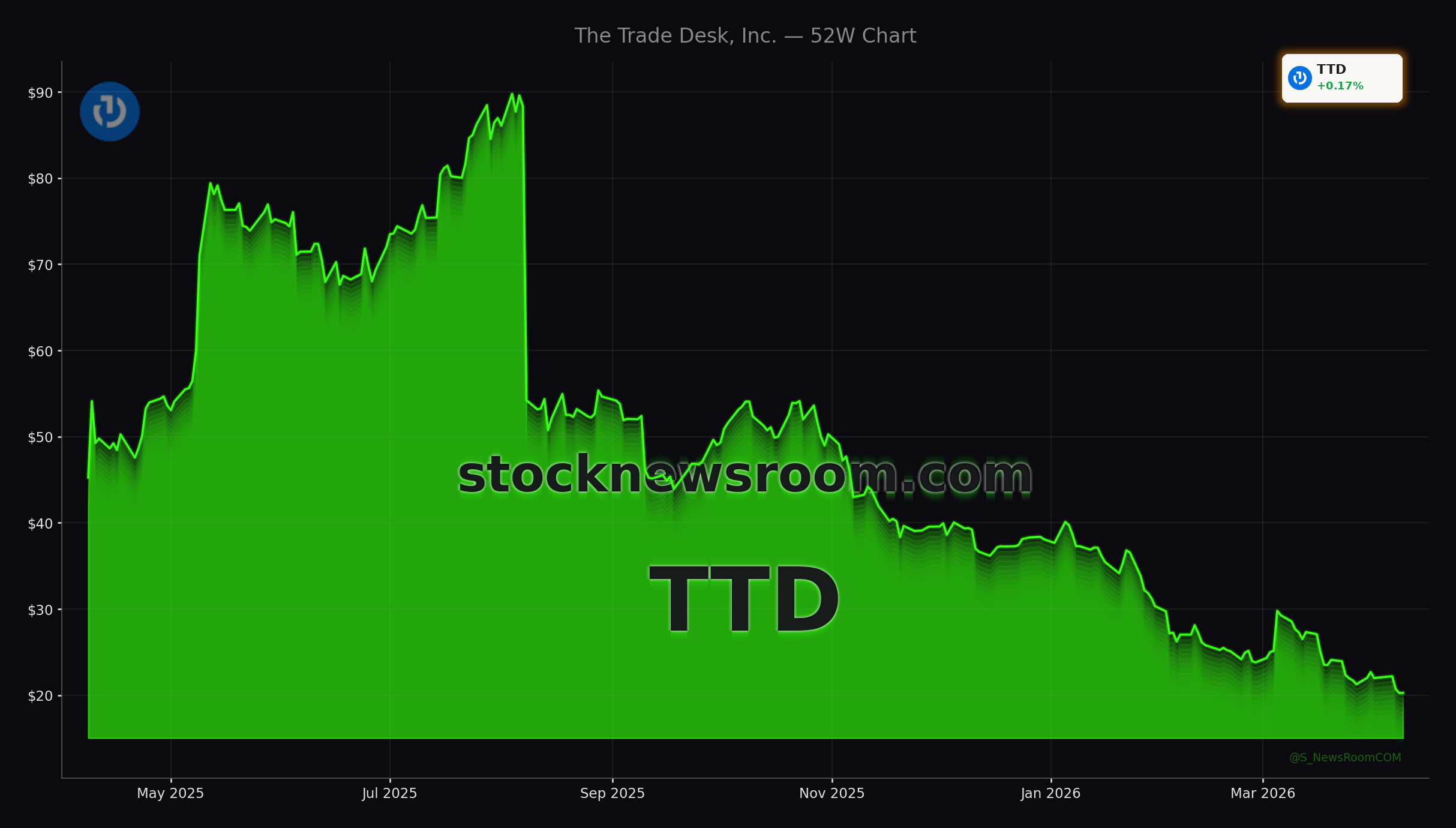

Is The Trade Desk’s Kokai rollout just a temporary stumble or the start of a deeper reset in its growth story?

How badly is The Trade Desk hurt on Wall Street?
At $20.41 in Thursday’s session, The Trade Desk, Inc. trades only marginally above its previous close of $20.23, up 0.81% intraday but still deep in bear‑market territory for the past year. The stock is down more than 50% over 12 months and roughly 47% year to date, a sharp reset for a digital advertising name once treated as a premium growth compounder on the NASDAQ. Options “whale” activity in recent sessions shows traders actively positioning around elevated volatility rather than a clear bullish or bearish consensus.
Fund managers have not abandoned the name altogether. Fulcrum Capital recently initiated a roughly $2.6 million position in Q4, while Baillie Gifford disclosed a small passive stake of just over 150,000 Class A shares. At the same time, Wells Fargo has trimmed its price target, and the broader analyst community has cooled: consensus now sits around a “Hold” rating, with average targets near the low‑$40s, implying upside from current levels but far from the lofty expectations of prior years.
The Trade Desk Analysis: is growth really slowing?
Beneath the share‑price carnage, revenue is still growing. In fiscal 2025, The Trade Desk delivered about $2.9 billion in sales, up roughly 18% year over year. Growth decelerated through the year, from about 25% in Q1 to 14% in Q4, but it remained firmly positive even as many software and adtech peers struggled with budget headwinds and AI‑driven reallocations of marketing spend.
Profitability remains a key pillar of any The Trade Desk Analysis. Adjusted EBITDA margin reached an impressive 47% in Q4 2025, and operating cash flow for the year climbed more than 34% to roughly $993 million. Customer retention has stayed above 95% for 12 consecutive years, underscoring stickiness among major brands and agencies using the company’s demand‑side platform to buy ads across the open internet. Management is guiding for at least $678 million in Q1 2026 revenue, with the May 7 earnings release viewed as the next major catalyst by Wall Street.
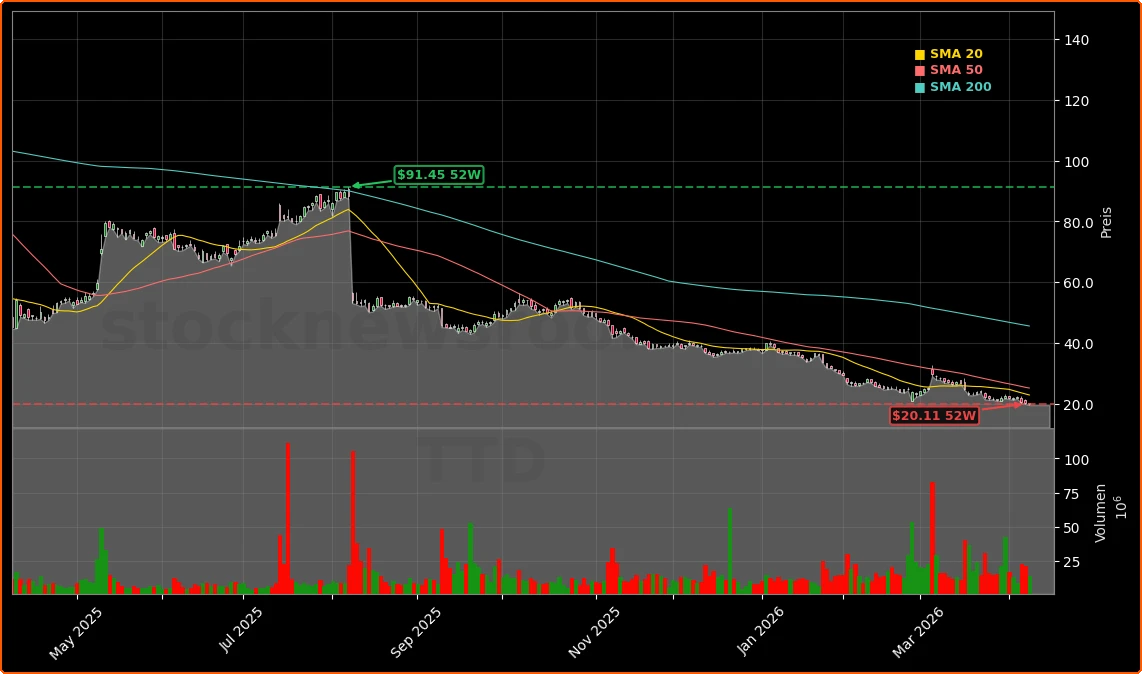
What went wrong with Kokai and investor trust?
The core narrative break came with Kokai, The Trade Desk’s AI‑driven buying platform that now underpins nearly all client campaigns. For more than 30 quarters the company consistently beat revenue estimates, a track record that supported a rich valuation multiple. That streak ended with a Q4 2024 miss tied to a slower‑than‑expected Kokai rollout, shattering the perception of flawless execution.
The fallout has extended beyond guidance. A securities class action lawsuit is already in progress, and law firm Kahn Swick & Foti has opened a separate investigation into whether executives failed to disclose material risks around the Kokai transition and related revenue impact. This legal overhang feeds into a broader crisis of confidence: investors are now treating management commentary with greater skepticism and demanding more granular disclosures on platform performance and adoption.
How serious are the fee and governance concerns?
More recently, The Trade Desk has been pushed into the spotlight over fee structures and transparency. Publicis Groupe has raised concerns about how certain fees are presented to clients, prompting a public dispute that contributed to a sharp one‑day sell‑off before a partial after‑hours rebound. The company has pushed back against the criticism, but the episode adds to questions about governance and alignment with large agency partners that control sizable budgets.
On the leadership side, investors have also had to digest multiple executive departures and board changes. Director Gokul Rajaram recently resigned, forfeiting a portion of unvested restricted stock, while remaining board members continue to receive equity grants in lieu of cash fees, aligning some of their compensation with shareholder outcomes. Overall, the pattern reinforces the sense that The Trade Desk is navigating an internal restructuring at the same time it is contending with external legal and competitive pressure.
Can The Trade Desk compete with Amazon, Google and Meta?
Any realistic The Trade Desk Analysis must weigh the company’s independent positioning against the scale of Big Tech rivals. Amazon’s advertising business has surpassed $60 billion in annual revenue and is expanding further into demand‑side tools, backed by powerful first‑party retail data and owned ad inventory. Alphabet’s Google and Meta Platforms continue to refine their AI‑driven ad systems, using massive data sets no open‑internet player can match.
The Trade Desk, by contrast, operates as a neutral platform, not owning inventory or large pools of first‑party user data. Its value proposition lies in cross‑publisher reach, objective measurement and the ability to optimize spend across streaming, mobile and web inventory outside the “walled gardens.” If the ad market remains fragmented—with retailers, streamers and independent publishers all competing for budgets—this neutral role could become even more important. But if brands consolidate around closed ecosystems operated by companies like Apple, NVIDIA‑powered cloud platforms, Tesla’s in‑car ecosystems or other tightly controlled networks, independent DSPs may find it harder to capture incremental share.
Related Coverage
For a deeper dive into the recent trust shock, The Trade Desk controversy: -7.5% plunge shocks investors examines how the fee‑transparency dispute and sentiment shift triggered a sharp sell‑off and what it could mean for future agency relationships. Investors interested in the broader adtech and AI landscape can also read AppLovin Forecast: -4.5% Plunge but $710 Target Looms, which explores how another high‑growth platform is balancing near‑term volatility against aggressive long‑term price targets.
In conclusion, The Trade Desk Analysis today sits at the intersection of solid fundamentals, damaged credibility and stiffening competition, leaving the stock priced more like a controversial turnaround than a high‑confidence compounder. For long‑term investors who still believe in the resilience of the open internet and in Kokai’s ability to deliver superior AI‑driven performance, the current valuation may offer asymmetric upside if management can rebuild trust. The upcoming May 7 earnings report and progress on the legal front will be crucial in determining whether this sell‑off proves to be a lasting reset or an overreaction that ultimately rewards patient shareholders.