Is the latest The Trade Desk Forecast signaling a temporary reset or a deeper shift in how investors value this ad-tech leader?
How is The Trade Desk, Inc. resetting expectations?
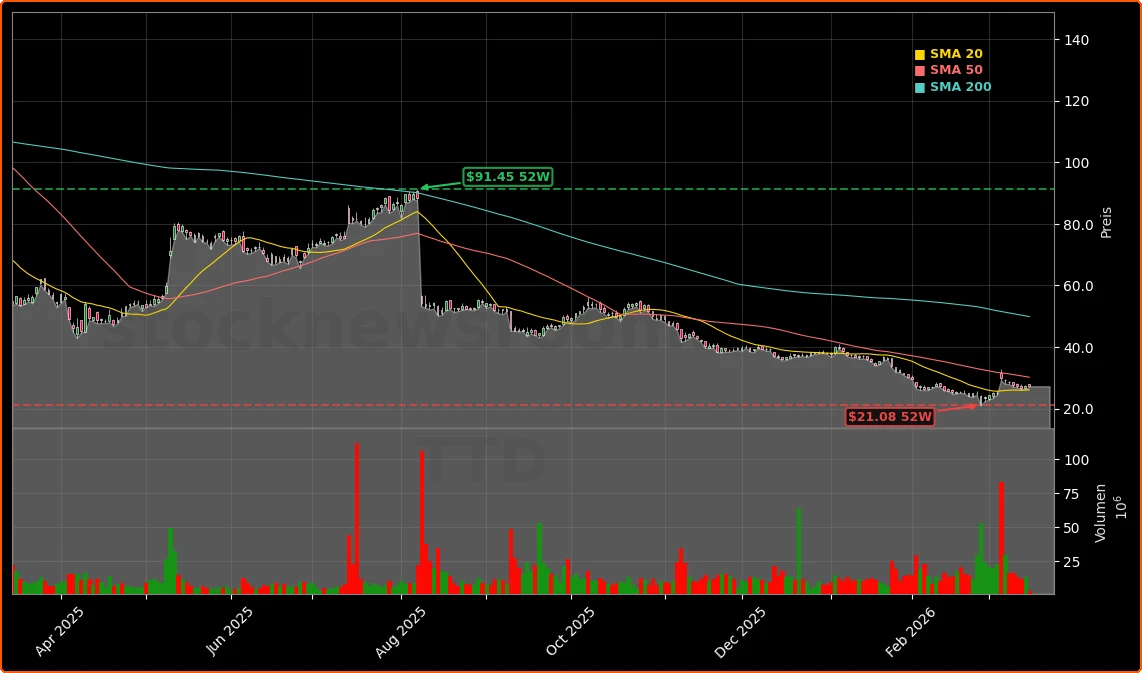
The Trade Desk, Inc. (TTD) shocked investors with its steep post‑earnings sell‑off after missing its own Q4 2024 revenue estimate, capping a year in which the stock fell more than 50%. Revenue for 2025 reached about $2.9 billion, up 18% year over year, a clear slowdown from 26% growth in 2024. The fourth quarter was even softer at 14% growth, signaling that momentum is cooling as the broader digital ad market digests macro uncertainty and the shift toward AI‑driven ad buying.
Despite the growth deceleration, the company remains solidly profitable. Net income climbed 13% to roughly $443 million, with the profit growth muted largely by a sharp increase in income tax expense rather than a deterioration in the underlying business. For a stock that once commanded a premium growth multiple, this mix of slower, but positive, growth and sustained profitability is central to any new The Trade Desk Forecast.
Valuation has compressed dramatically. TTD now trades at a trailing price‑to‑earnings ratio near 31, only slightly above the S&P 500’s ~29, and its forward P/E around 13 reflects how aggressively the market has repriced expectations. That multiple is closer to a mature value stock than a high‑growth ad‑tech platform once mentioned in the same breath as NVIDIA or Apple in AI‑driven narratives.
Why did AI and Kokai backfire for The Trade Desk Forecast?
A major driver of sentiment has been the rollout of Kokai, The Trade Desk’s AI‑powered ad‑buying platform. Intended to automate and optimize campaign decisions, Kokai instead frustrated many customers. Media buyers complained that they could no longer see all key parameters on a single screen, and that the higher level of automation reduced the manual controls they had relied on to fine‑tune campaigns. That usability backlash has weighed on adoption and contributed to concerns that the company misjudged how quickly agencies and brands would embrace a more opaque AI system.
Externally, the competitive landscape has also shifted. Alphabet and Amazon have tightened their “walled gardens,” steering premium ad inventory toward their own platforms and making it harder for independent demand‑side platforms like The Trade Desk to secure top‑tier placements. At the same time, new AI search and assistant experiences from players such as OpenAI have raised questions about whether traditional display and video ads will lose relevance as users spend more time inside conversational interfaces rather than surfing the open web.
Recent reports that OpenAI has been in talks with The Trade Desk to power ad placements within ChatGPT have therefore become a key variable in the updated The Trade Desk Forecast. If a partnership materializes, it would give the company a foothold in next‑generation AI interfaces and help reassure investors that the open internet ad model is evolving, not disappearing.
What are analysts and rivals signaling now?
On Wall Street, opinions are starting to stabilize after last year’s rout. Independent research firm Arete upgraded Trade Desk Inc. to “Neutral” from “Sell,” setting a $25 price target, which sits slightly below the current share price but marks an acknowledgment that much of the bad news is already reflected in the stock. Other bullish commentary from U.S. equity strategists has framed TTD as one of several AI‑adjacent software names where the 2025 sell‑off may have gone too far.
Peer comparisons also matter for portfolio decisions. While mega‑cap platforms like Meta Platforms and Tesla grab headlines, TTD offers more focused exposure to the open‑internet ad ecosystem rather than closed social or commerce networks. Unlike hardware‑driven AI winners such as NVIDIA, The Trade Desk must prove that its software layer remains indispensable as advertisers experiment with new tools, including generative‑AI‑enabled creative and measurement.
Conclusion
Internationally, the company is leaning into EMEA and APAC expansion, where growth is outpacing North America and diversifying revenue away from U.S. cyclicality. For investors managing diversified tech allocations across the NASDAQ and S&P 500, that global angle, coupled with a compressed valuation, is increasingly central to any bottom‑up The Trade Desk Forecast over the next three to five years.
Further Reading
- The Trade Desk, Inc. (TTD) Stock Price, News, Quote & History (Yahoo Finance)
- The Trade Desk Stock Isn’t What It Was a Year Ago. Here’s What Changed. (The Motley Fool)
- 3 Reasons Why The Trade Desk Is a Screaming Buy Right Now (The Motley Fool)
- Trade Desk’s EMEA and APAC Push Strengthens International Growth (Zacks Investment Research)