Is The Trade Desk Insider Purchase a rare buy signal in ad-tech turmoil or just bravado against slowing growth and Amazon pressure?
Does The Trade Desk Insider Purchase change the story?
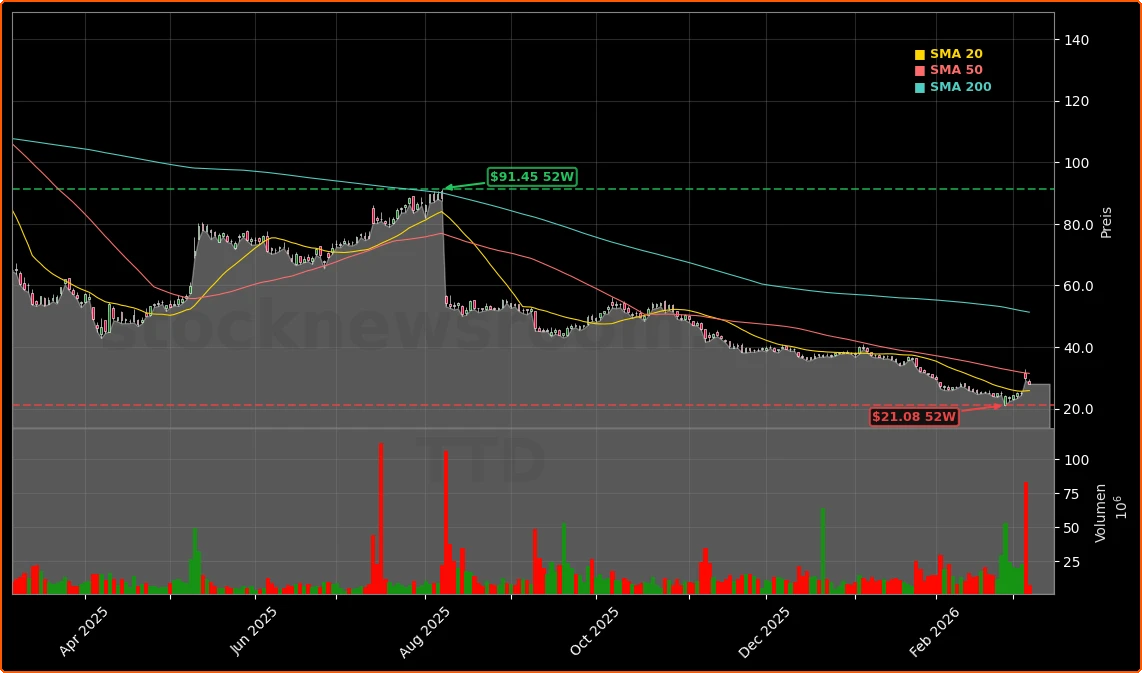
The Trade Desk, Inc. has endured one of the sharpest reversals among large-cap tech names, with the stock losing more than half its value over the past year as revenue growth decelerated and competitive pressure from Amazon’s ad business intensified. Against that backdrop, CEO Jeff Green disclosed that he bought 6 million shares between March 2 and March 4 at average prices between about $23.50 and $25.10, a move that propelled the stock nearly 18% higher on Thursday before today’s pullback.
The scale of The Trade Desk Insider Purchase is striking: it is not a token insider buy, but a concentrated wager from the executive with the deepest insight into the company’s pipeline, technology roadmap and customer relationships. It comes as the company’s shares trade at $28.06, down 5.81% from Thursday’s close of $30.05, reflecting renewed caution after the initial short-covering and momentum spike faded in Friday’s session.
For U.S. investors, the key question is whether Green’s aggressive buying signals that the market has overshot to the downside on a business that still posts double‑digit growth and robust profitability, or whether it is simply an expression of confidence that will take time to be validated by fundamentals.
How weak is growth at The Trade Desk?
The recent sell-off was triggered less by what The Trade Desk just reported and more by what management guided for. In Q4 2025, revenue grew 14% year over year to about $847 million, or 19% when stripping out political ad spending, and full‑year 2025 revenue rose 18% to roughly $2.9 billion. Adjusted EBITDA reached about $1.2 billion, with customer retention above 95% for the 12th consecutive year, underscoring sticky relationships with big brands and agencies.
The problem is the trend line: quarterly revenue growth slowed sequentially from 25% to 19% to 18% and then to 14% over 2025. Management’s guidance for at least $678 million of revenue in Q1 2026 implies growth of only around 10% versus the prior year. That deceleration, particularly against Amazon’s 23% ad revenue growth in its latest quarter, has rattled investors who once paid a substantial premium for The Trade Desk’s faster expansion.
Valuation has compressed sharply. Depending on which earnings metric investors use, the stock now trades at around 26–33 times trailing earnings and roughly 4 times sales, a dramatic reset from peak multiples and now in the same ballpark as the S&P 500’s earnings valuation. Bulls argue that such levels more than discount the slowdown, especially if The Trade Desk can return to mid‑teens or better growth over the next few years.
The Trade Desk Insider Purchase vs. rising AI and Amazon threats?
The other major pillar of the debate is competitive positioning. The Trade Desk’s demand‑side platform lets advertisers buy programmatic ads across the open internet, including connected TV, mobile, audio and display, without favoring any particular publisher. Management maintains that this neutral, data‑driven approach gives brands better reach at lower cost than closed systems run by giants like Amazon and Alphabet.
In one example shared by the company, a large appliance manufacturer found that campaigns run through The Trade Desk reached 70% more unique households and delivered six times better performance versus Amazon’s demand‑side platform, at around 30% lower total cost. The Trade Desk has also leaned heavily into artificial intelligence to evaluate millions of ad impressions per second, betting that smarter bidding and targeting can offset the pricing pressure of a buyer’s market in digital advertising.
Still, Wall Street is increasingly split. Morningstar recently downgraded The Trade Desk’s economic moat rating from “Narrow” to “None,” citing intensifying competition and the growing importance of AI in ad‑tech that could erode the company’s advantages over time. Wedbush analyst Alicia Reese went further, downgrading the stock to “Underperform” even as speculation swirled about a potential partnership with OpenAI, arguing that the rumored deal does not justify the recent jump in the share price.
Others see the OpenAI angle and balance sheet strength as underappreciated positives. One bullish analysis highlighted 14% year‑over‑year revenue growth in Q4, a free‑cash‑flow margin above 30% and an $800‑plus million net cash position, framing a case that The Trade Desk can fund aggressive R&D to stay at the forefront of AI‑driven advertising and still generate attractive returns for shareholders.
What does this mean for U.S. portfolios?
From a portfolio‑construction standpoint, The Trade Desk sits at the crossroads of two powerful themes dominating the NASDAQ and S&P 500: the shift to programmatic, data‑driven advertising and the broader AI boom led by names like NVIDIA and Apple. Unlike mega‑cap platforms that sell ad inventory on their own properties, The Trade Desk operates as a pure‑play software layer on top of the open internet, giving it leverage to industry growth but also exposing it directly to competition from much larger rivals.
Technically, the stock has just bounced sharply off multi‑month lows on unusually high volume, suggesting capitulation by sellers and fresh interest from buyers. But with the price still down more than 55% over 12 months and more than 80% from its all‑time high, sentiment remains fragile. Options commentary from Schwab Network has highlighted key downside support levels traders are watching if selling pressure resumes, alongside resistance zones that could come into play if a rebound extends.
For growth‑oriented investors willing to accept volatility, the combination of a large The Trade Desk Insider Purchase, a de‑risked valuation and a still‑growing multi‑trillion‑dollar programmatic ad market creates an intriguing, if high‑beta, setup. For more conservative investors, Morningstar’s moat downgrade and Wedbush’s Underperform rating are reminders that execution risk and competitive threats from Amazon, Alphabet and even AI‑rich platforms like Tesla’s in‑car advertising ambitions cannot be ignored.
I don’t think there’s any company in our industry that’s better positioned to take advantage of advances in AI.
— Jeff Green, CEO of The Trade Desk
Conclusion
In the end, The Trade Desk Insider Purchase does not remove the need for growth to reaccelerate, but it does tilt the risk‑reward calculus for investors who believe AI, new partnerships and continued share gains in connected TV can restore mid‑teens or better growth over the next few years.
Further Reading
- The Trade Desk, Inc. (TTD) Stock Price, Quote & News (Yahoo Finance)
- The Trade Desk: The OpenAI Deal Looks More Than Just Rumors (Seeking Alpha)
- Trade Desk Stock Surged on OpenAI Partnership Report. Don’t Get Excited Just Yet, Says Analyst. (Barron’s)
- Downgrading The Trade Desk’s Moat to None From Narrow (Morningstar)