Is The Trade Desk Open Internet Strategy a rare AI-driven bargain after a brutal sell-off, or just another adtech value trap?
Is Wall Street mispricing The Trade Desk?
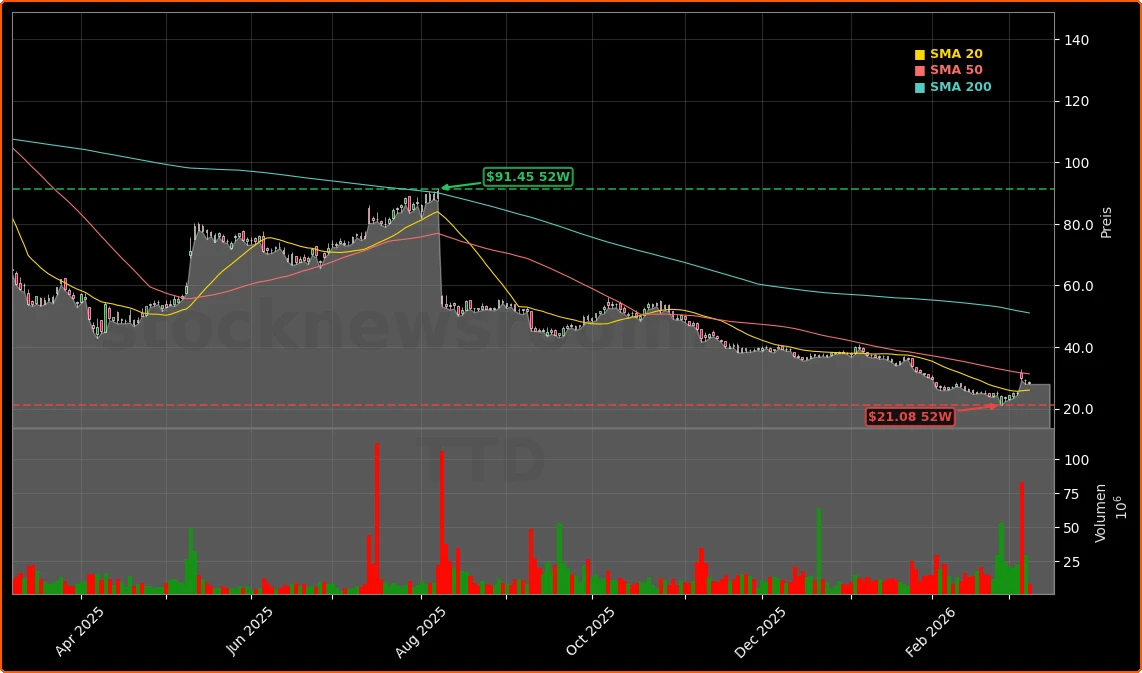
The Trade Desk’s share price around $28, versus a prior close of $29.26, caps a brutal 12‑month stretch in which the stock plunged roughly 67%. Revenue is still growing, but at a slower clip, and the company has lost its long streak of quarterly beats, shifting investor psychology from “can do no wrong” to “show me.” Over the last three months alone, the stock is down roughly 25%, reflecting macro ad headwinds, intensifying competition and skepticism that AI will favor independent platforms over integrated ecosystems.
Yet the same pullback has made the valuation look far more reasonable compared with other adtech names and high‑multiple software peers on the NASDAQ. Some institutional investors are leaning in: Barclays PLC recently boosted its position by more than 300% in Q3, buying over 2.3 million additional shares and signaling confidence that the current drawdown may be overdone. At the same time, analyst opinions remain mixed, with some firms trimming price targets or moving to neutral ratings on concerns about guidance misses and slowing growth.
Against this backdrop, The Trade Desk Open Internet Strategy is pitched as the core reason the stock could be a rare bargain in U.S. tech portfolios rather than a classic value trap. The company is effectively telling Wall Street that the market structure in digital advertising is changing in its favor, even if near‑term numbers look messy.
How does The Trade Desk Open Internet Strategy work?
Jeff Green’s thesis hinges on a macro shift: in 2025, ad inventory supply grew faster than demand across the open web. When supply is concentrated in a few platforms, those players enjoy strong pricing power. But when inventory explodes across retailers, streamers, broadcasters and independent publishers, buyers gain leverage and need better tools to compare and optimize campaigns.
The Trade Desk sits squarely in that gap as an independent demand‑side platform (DSP). It does not own inventory and does not prioritize one publisher or channel over another. Instead, it positions itself as a neutral optimizer across the open internet, allowing brands to decide in real time whether a dollar is better spent on connected TV, mobile, display, audio or emerging retail media placements. In that context, The Trade Desk Open Internet Strategy is to turn fragmentation into an advantage: more supply and more channels mean more data points for its algorithms to exploit.
The company’s AI engine, Kokai, has become the centerpiece of this approach. Kokai is designed to score impressions, set bids dynamically and allocate budgets across channels based on performance signals rather than contractual lock‑ins. Management now describes Kokai not as an experiment but as the foundation of the platform, a key evolution as The Trade Desk shifts from challenger to scaled infrastructure provider in the ad stack.
Can Kokai compete with Big Tech ecosystems?
The bullish case is that neutrality plus AI will matter more as advertisers demand measurable performance instead of raw reach. In a supply‑rich, fragmented environment, brands want to know which impressions drive app installs, subscriptions or sales — not just which platform offers the biggest audience. The Trade Desk Open Internet Strategy, powered by Kokai, aims to provide exactly that cross‑publisher, cross‑channel transparency.
However, the counterargument is powerful. Amazon, Google, Meta and Apple control vast pools of authenticated first‑party data and premium inventory. NVIDIA GPUs, custom chips from Apple and others are fueling their proprietary AI models, which are being embedded deep into closed ecosystems. Many advertisers prefer the simplicity of buying media, measurement and attribution within a single walled garden, even if that means less transparency.
For The Trade Desk, the structural battleground is connected TV (CTV) and premium streaming inventory. Video already accounts for roughly half of its business, and the company is aggressively courting budgets that once flowed automatically to linear TV or directly to platforms like Netflix and Disney. If those streamers keep a sizable share of their ad supply open to programmatic bidding, The Trade Desk can remain a key gatekeeper. If, instead, too much premium inventory migrates into exclusive or preferential deals with the largest ecosystems, the open internet narrows and the upside of neutrality shrinks.
What does this mean for U.S. investors now?
From a portfolio perspective, TTD has shifted from a hyper‑growth favorite to a contested turnaround story on the NASDAQ. Recent commentary highlights three execution tests for 2026: proving Kokai is a defensible moat rather than a feature that rivals can copy, securing long‑term access to premium CTV supply, and reaccelerating growth without sacrificing margins. Meanwhile, speculation about a potential partnership with OpenAI has added an AI premium back into the narrative, though some firms like Wedbush have warned against overhyping unconfirmed collaborations.
Sentiment remains volatile. In one of the S&P 500’s weakest recent weeks, The Trade Desk jumped roughly 22%, a sharp reversal that underscored how heavily positioned investors were against software and adtech names perceived to have an “AI problem.” That snapback suggests part of the pressure was about positioning and conviction, not just fundamentals. For long‑term investors, the decision now is whether to side with the pessimistic view that Big Tech will eventually dominate most digital ad flows, or with Jeff Green’s view that a stronger open internet will keep independent optimization platforms relevant and valuable.
The reality is that the open internet isn’t fading — it’s evolving, and in a supply‑rich world neutral optimization becomes more valuable, not less.
— Jeff Green, CEO of The Trade Desk
Conclusion
Ultimately, The Trade Desk Open Internet Strategy frames the company as an arbitrator in a complex, supply‑heavy market rather than a miniature walled garden trying to imitate Tesla‑style vertical integration. If this arbitrator role grows along with CTV and retail media, today’s depressed share price could mark an attractive entry point for diversified U.S. tech portfolios.
Further Reading
- The Trade Desk, Inc. (TTD) Stock Price, Quote & News (Yahoo Finance)
- Why The Trade Desk CEO Thinks the Open Internet Just Got Stronger (The Motley Fool)
- This Stock Up Nearly 900% in the Past Decade Is a Rare Bargain Opportunity (The Motley Fool)
- TTD Declines 25% in the Past 3 Months: How to Play the Stock? (Zacks Investment Research)