Can a potential The Trade Desk OpenAI partnership really flip one of ad-tech’s biggest losers into a new AI monetization winner?
The Trade Desk and OpenAI: Why this potential ad deal matters for Wall Street
The market’s sudden excitement around a potential The Trade Desk OpenAI partnership reflects two powerful narratives colliding: the need for OpenAI to monetize its enormous user base and the search for a new growth vector for a heavily oversold ad-tech leader. Reports indicate that OpenAI has been in early but advanced discussions with The Trade Desk to help design and sell advertising inventory across its AI products, including its chat interfaces with hundreds of millions of weekly active users. For OpenAI, which faces massive compute and infrastructure costs, a scaled, programmatic ad layer could become a critical revenue stream. For The Trade Desk, which specializes in demand-side platform (DSP) technology for programmatic ad buying, becoming a core partner for one of the most visible AI platforms on the planet would represent both a validation of its tech stack and a new, differentiated inventory channel outside traditional web and mobile.
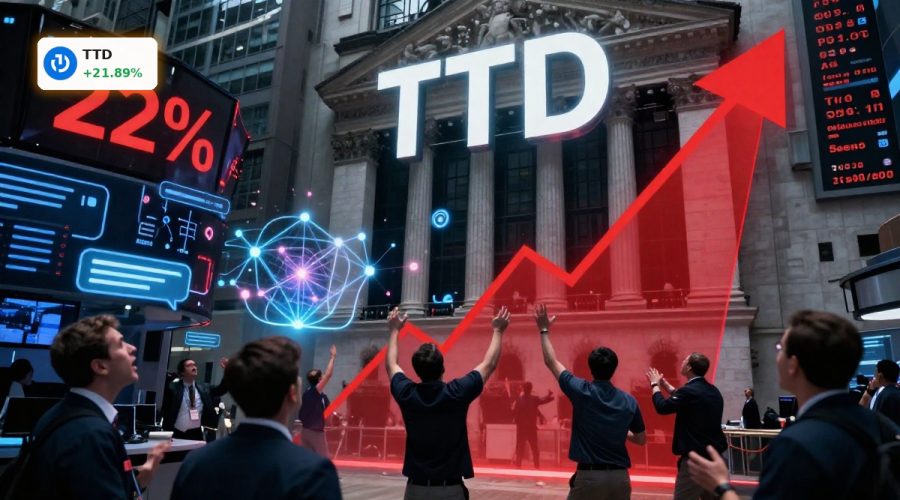
That strategic angle explains why the stock, which closed the prior session at $25.00, is indicated around $30.68 in early trading, up roughly 22% pre-market. At $25.17 at the regular session open, The Trade Desk was down more than 30% year to date and about 63% over the last twelve months, making it one of the worst performers among software names on the NASDAQ and within the broader S&P 500 technology cohort. The potential The Trade Desk OpenAI partnership is therefore being interpreted not just as another supply integration, but as a possible narrative reset: from “legacy ad-tech under pressure” to “key monetization partner for a flagship AI ecosystem.”
Crucially, the talks are not finalized, and investors should treat the current move as a repricing of probabilities rather than a confirmation of future revenue. However, in a market environment where AI-driven ad inventory has propelled the likes of NVIDIA on the infrastructure side and mega-cap platforms such as Apple and other consumer-facing giants on the demand side, aligning with OpenAI could give The Trade Desk a long-term strategic footprint that competitors will struggle to match.
The Trade Desk stock: From five-year lows to a sharp relief rally
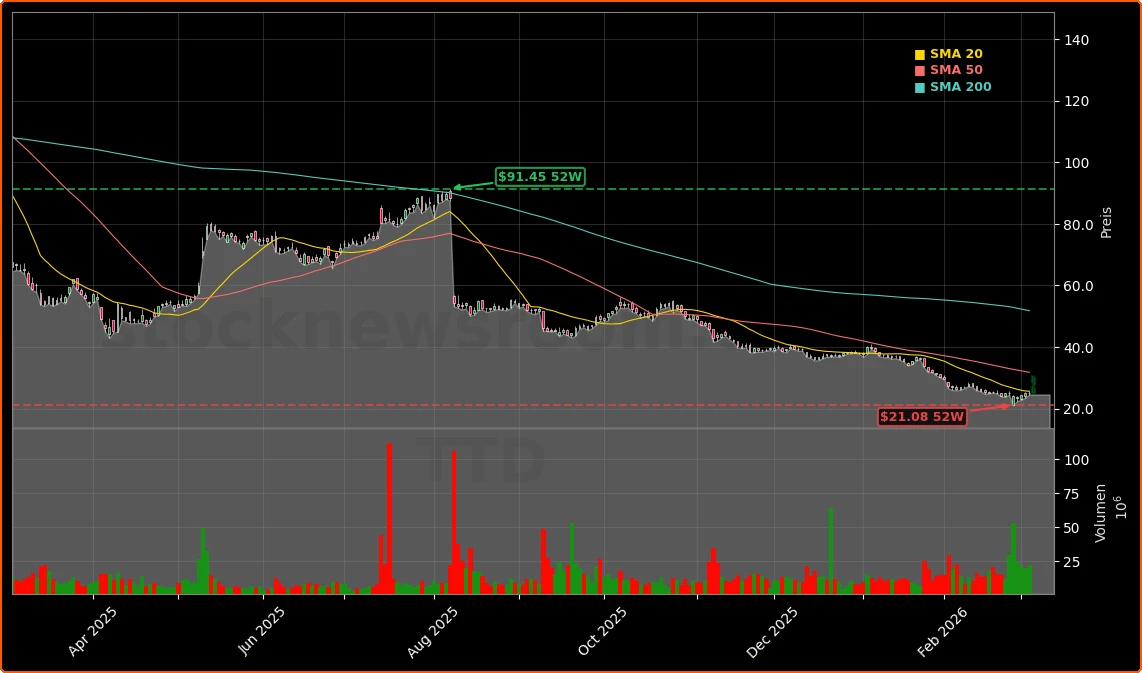
To understand why the tape is reacting so violently today, it is worth revisiting what happened to The Trade Desk over the past year. After years of outperformance, the stock has been hit by a confluence of headwinds: fears that AI agents could disintermediate traditional DSPs, intensifying competition from large ecosystems like Amazon and AppLovin, and investor disappointment with decelerating top-line guidance. These concerns pushed The Trade Desk to its lowest level in almost five years just days ago, a move that many technical traders interpreted as a clear breakdown and a possible signal of further downside.
At those lows, the stock had shed more than one-third of its value since the start of 2026 and nearly two-thirds versus a year ago. Short interest climbed into the double digits, near 11%, making The Trade Desk a favored vehicle for hedge funds betting against ad-tech and software broadly. Against this bearish backdrop, Thursday’s pre-market surge toward $30 per share merely lifts the stock back to roughly a one-month high, underscoring how deep the prior drawdown had been. Technical analysts are now closely watching the $31–$32 area, which includes the 50-day moving average near $31.78. A decisive move above that zone on strong volume could trigger systematic buying from trend-following strategies and quant funds, adding fuel to what is already starting to look like a squeeze on short positions.
However, investors should distinguish between a technical bounce and a sustainable re-rating. The current move is driven by two catalysts: news flow around the possible The Trade Desk OpenAI partnership and a very visible insider transaction. While those are powerful in the short term, the medium-term trajectory for the stock will still hinge on fundamentals: revenue growth, margins, and the company’s ability to fend off walled-garden competitors such as Apple’s privacy framework, Amazon’s ad machine, and vertical players like AppLovin in mobile gaming.
The Trade Desk OpenAI partnership: How big could the ad opportunity be?
From a strategic standpoint, the The Trade Desk OpenAI partnership narrative is compelling because it taps into a largely untapped frontier of digital advertising: conversational and generative AI interfaces. OpenAI has reportedly amassed roughly 900 million weekly active users across its products, an audience that rivals or exceeds some of the largest consumer internet platforms. Yet its core revenue model still leans heavily on subscriptions and API usage, while infrastructure and R&D costs remain enormous. Introducing a sophisticated, privacy-conscious ad layer into this environment is non-trivial, which is where The Trade Desk’s expertise could become highly valuable.
If The Trade Desk can help OpenAI design ad formats that are contextually relevant, non-intrusive, and aligned with regulatory expectations, the potential revenue pool could be substantial. Even modest ad ARPU (average revenue per user) on hundreds of millions of weekly users could translate into billions of dollars of annualized ad spend over time. The exact commercial structure is unknown, but it could range from a managed-service style arrangement to a deeper, platform-level integration where The Trade Desk becomes the primary demand aggregator for certain ad slots within OpenAI properties.
For investors, the critical question is how much of that potential spend could realistically accrue to The Trade Desk’s P&L. While it is too early to model precise numbers, the scenario is asymmetric: if talks do not result in a definitive deal, the immediate downside is limited to today’s sentiment-driven premium; if a partnership is signed and ramps successfully over several years, it could create a new, high-growth revenue stream that is less exposed to the cyclical swings of traditional display and CTV advertising. This asymmetric payoff profile is what is being rapidly repriced into the stock today.
It is also worth noting that such a partnership would further differentiate The Trade Desk from other independent ad-tech players that lack unique inventory relationships. In a market where large advertisers increasingly want direct access to premium, brand-safe environments that can demonstrate measurable ROI, the ability to offer programmatic access to AI-native ad experiences could become a competitive edge. That positioning might not immediately close the gap versus giants like Google and Meta, but it could strengthen The Trade Desk’s pitch as the leading independent DSP in a world where AI-native surfaces become a material part of the ad mix.
Jeff Green’s $148 million insider buy: Vote of confidence or just good optics?
Layered on top of the The Trade Desk OpenAI partnership headlines is a second, arguably equally important catalyst: CEO and founder Jeff Green has just executed one of the largest insider stock purchases in the company’s history. Regulatory filings with the SEC show that Green acquired around 6 million shares, with an aggregate value of about $148.1 million based on recent prices. That is not a token gesture; it is a highly visible commitment of personal capital, and the first major insider purchase of size since board member David Wells bought shares nearly four years ago.
Large insider buys, particularly by founders and CEOs, are often interpreted as strong signals that internal leadership believes the stock is undervalued relative to long-term prospects. In this case, the timing is notable: Green stepped in after the stock had broken to multiyear lows and sentiment had turned deeply negative. From a behavioral standpoint, that can help put a psychological floor under the name, especially for institutional investors who look for alignment between management and shareholders. It also potentially pressures short sellers, as betting aggressively against a company whose founder has just written a nine-figure personal check is a higher-conviction stance.
Still, investors should be careful not to over-interpret insider buying as a guarantee of short-term returns. There are numerous examples in tech where insiders purchased meaningful amounts of stock well before the ultimate bottom. What the move does indicate is that Green sees significant value over a multi-year horizon, which aligns with the company’s still-solid balance sheet: no debt and roughly $867 million in net assets. Combined with a forward 2026 P/E around 15 at a $30 share price and a PEG ratio near 0.5 based on mid-to-high teens expected growth, the valuation now screens as “growth at a reasonable price” compared to many richly priced SaaS and cloud peers.
Competitive landscape: Can The Trade Desk defend its niche against tech giants?
Even if the The Trade Desk OpenAI partnership materializes, investors must assess the broader competitive landscape. The Trade Desk operates as an independent DSP, enabling advertisers and agencies to buy programmatic ads across the open internet, connected TV, audio, and other channels. That independence is a selling point for brands wary of letting walled gardens both sell and measure their own inventory. However, the ecosystem has been shifting. Alphabet’s advertising engine continues to grow at scale, Amazon’s ad business is expanding quickly, and vertically integrated players like AppLovin have carved out strong positions in mobile gaming ads.
In addition, platform-level changes such as Apple’s App Tracking Transparency (ATT) have altered mobile ad economics, pushing more budgets into first-party data-rich environments and making it harder for third-party ad-tech to maintain historic targeting precision. Some investors fear that as AI agents proliferate, large platforms could internalize more ad decisioning and bypass third-party DSPs altogether, placing pressure on The Trade Desk’s long-term take rate. The OpenAI discussions, if they result in a durable partnership, partially counter that thesis by demonstrating that even cutting-edge AI platforms may opt to collaborate with specialized ad-tech firms rather than building every component in-house.
From a financial perspective, The Trade Desk has historically distinguished itself with consistent revenue growth and a strong record of beating EPS estimates, even as guidance has recently turned more cautious. Several independent analyses highlight its robust margins and efficient capital allocation, which help justify its premium multiple relative to slower-growing advertising conglomerates. Still, recent quarters have shown some margin compression and decelerating revenue growth, which bears argue is evidence of a maturing business facing tougher competition. That tension between quality fundamentals and slowing momentum is at the heart of the current valuation debate.
On Wall Street, opinion is mixed but gradually turning more constructive at these levels. Some research outlets now classify The Trade Desk as an attractive GARP (growth at a reasonable price) candidate, citing its debt-free balance sheet and scalable platform. Others remain cautious, pointing to the stronger near-term execution and higher visibility at mega-cap peers like Alphabet and to a lesser extent Tesla’s broader AI narrative on the automotive side drawing marginal capital away from mid-cap software names. Formal target changes from big banks such as Citigroup, Morgan Stanley, or RBC Capital Markets have not yet fully reflected today’s news, but any subsequent upgrades in coming days could further legitimize the idea that the worst of the de-rating is behind the stock.
Risk-reward for U.S. investors: Is The Trade Desk finally a buy again?
At around $30–$31 in early Thursday trading, The Trade Desk sits at an interesting junction for U.S. and global investors. On the one hand, the risk profile remains elevated. The The Trade Desk OpenAI partnership is not yet a signed contract, and there is no guarantee that any eventual agreement will meaningfully move the needle on revenue or margins in the next 12–18 months. Macroeconomic conditions for advertising are also not immune to a slowdown: if corporate marketing budgets tighten, even structurally advantaged platforms can see demand wobble. Competitive pressure from ecosystem giants and ongoing privacy regulation risks have not disappeared, regardless of today’s enthusiasm.
On the other hand, the upside case is clearer than it has been in months. The stock has already absorbed a massive drawdown, sentiment was deeply washed out, and valuation multiples have compressed to their lowest levels in years. The combination of a potential The Trade Desk OpenAI partnership unlocking a new category of AI-native ad inventory, a founder-CEO committing $148 million of personal capital, and a pristine balance sheet gives the bull case tangible pillars beyond vague AI hype. For investors with a multi-year horizon, this setup resembles many classic inflection points in high-quality growth names where the narrative finally bottoms before fundamentals reaccelerate.
Position sizing remains key. Given the binary nature of the OpenAI talks and the inherent volatility in mid-cap ad-tech, many portfolio managers may prefer to build positions gradually, using any post-rally consolidation or broader market pullbacks to add. For growth-focused investors who can tolerate volatility, The Trade Desk at a mid-teens forward P/E with double-digit expected growth and potential AI optionality looks increasingly attractive relative to some fully priced mega-caps. More conservative investors may wait for clearer evidence in upcoming quarters that revenue growth is stabilizing and that any AI-related partnerships are translating into concrete financial impact.
Conclusion
Ultimately, the next phase in the The Trade Desk OpenAI partnership story will likely be driven by execution and communication. Management’s commentary on upcoming earnings calls, any formal announcement of a deal, and early case studies around AI-ad performance will determine whether today’s surge marks the start of a sustainable trend reversal or just another sharp rally in a still-fragile downtrend. For now, the combination of strategic potential, insider conviction, and improved valuation has put The Trade Desk back on the radar of serious U.S. investors.
Further Reading
- The Trade Desk, Inc. (TTD) Stock Price, Quote & News (Yahoo Finance)
- Trade Desk Stock Jumps. Why the Beaten Down Shares Are Getting a Big Boost. (Barron’s)
- Wall Street Breakfast Podcast: Ad Deal Buzz Lifts Trade Desk (Seeking Alpha)
- TTD Stock: Time To Buy The Dip? (Forbes)