Is the The Trade Desk Publicis audit just a temporary trust shock or the start of a deeper structural reset for the ad-tech leader?

How hard did markets hit The Trade Desk?
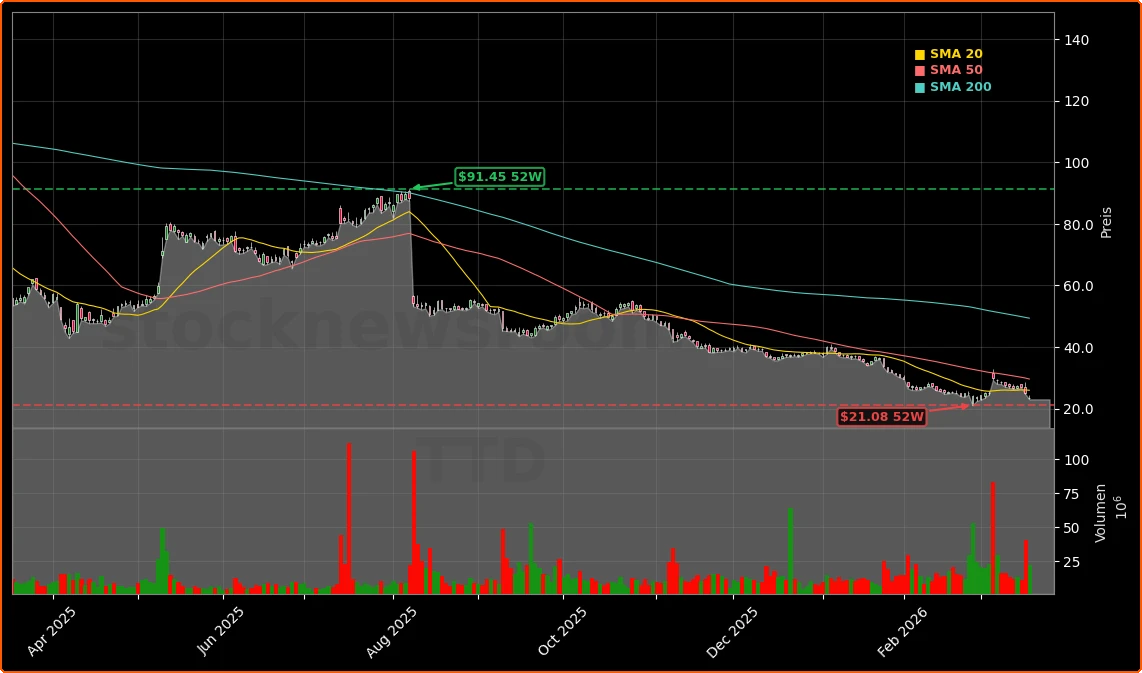
The Trade Desk Publicis audit headlines immediately translated into selling pressure. While the S&P 500 slipped just 0.1% and communication services barely moved, TTD extended a two-day decline to about 13%, closing Wednesday at $23.51 versus a prior close of $24.81. The shares now trade more than 75% below their 52-week high of $91.45 and are approaching the 52-week low near $21, making the stock one of the Nasdaq’s most bruised ad-tech names.
This damage comes on top of an already brutal 12 months: TTD is down more than 55% over the past year as investors reassessed its ability to compete with AI-fueled walled gardens at Google, Meta Platforms and Amazon. The Trade Desk Publicis audit controversy has now added a trust discount to what was already a growth- and competition-driven rerating.
What exactly did Publicis challenge?
The flashpoint is a third-party audit commissioned by Publicis that examined The Trade Desk’s fee structures and billing practices. The review reportedly flagged issues such as fee layering, unauthorized auto-enrollment of clients into paid features, and insufficient evidence that certain media was being passed through at cost. In response, Publicis told its roster of blue-chip advertisers it could no longer recommend spending on The Trade Desk’s platform.
The Trade Desk disputes the characterization of a “failed” audit, but the nuance is largely irrelevant to short-term trading: the perception that a top agency has lost confidence is enough to threaten spending flows. Morningstar analyst Mark Giarelli reacted by cutting the firm’s economic moat rating on The Trade Desk to “none” and lowering its fair value estimate, citing opaque fees and rising competitive pressure from integrated AI tools at tech giants.
Is the The Trade Desk Publicis audit a structural threat?
The core risk for investors is that the The Trade Desk Publicis audit exposes a structural vulnerability. Unlike Google, Meta Platforms and Amazon, which own media inventory and run closed-loop measurement systems, The Trade Desk operates purely as a buy-side platform. Its independence is its selling point — but it also means there is no captive inventory to cushion the blow if agencies route dollars elsewhere.
Platform spend reached about $13.4 billion in 2025, so even modest client redirection can materially affect growth. Morningstar and other Wall Street analysts warn that large holding companies pushing back on fees could accelerate a shift of budgets into walled gardens or alternative DSPs. That said, recent financials still look resilient: revenue grew around 18% year over year to roughly $2.9 billion in 2025, with customer retention above 95% for the 12th consecutive year, and Q4 earnings per share of $0.59 easily topping estimates near $0.34.
How are CEO and analysts reacting?
Amid the turmoil, CEO Jeff Green sent a powerful signal by buying more than 6.1 million Class A shares between March 2 and March 4 at prices from $23.49 to $25.08. Such insider buying during a crash suggests management sees the selloff as disconnected from long-term fundamentals and the company’s Kokai AI roadmap.
On Wall Street, the The Trade Desk Publicis audit has sparked a wave of caution but not outright capitulation. The consensus price target sits around $32–33, implying double-digit upside from current levels, with a roughly balanced mix of Buy and Hold ratings across firms like Zacks Investment Research and others covering the stock. However, Morningstar’s moat downgrade and bearish commentary from outlets focused on ad-tech competition highlight that trust erosion can be more damaging than a typical earnings miss.
For U.S. investors comparing options across the sector, The Trade Desk now trades at a discounted forward P/E versus many high-growth software peers, reflecting concerns that AI-heavy ecosystems from Google and Meta Platforms could increasingly disintermediate independent DSPs, even as The Trade Desk pushes its own Kokai AI platform.
In the end, the The Trade Desk Publicis audit saga compresses multiple narratives into a single moment: questions about transparency, the power of agencies as gatekeepers, and whether open-internet ad infrastructure can keep pace with walled-garden AI. For portfolios heavily exposed to ad tech, the stock’s collapse underscores the importance of trust-driven business models, while the CEO’s large share purchase and still-solid fundamentals argue this may be more reset than obituary. The next major client updates and any further agency statements will determine whether this is a temporary reputational hit or the start of a deeper business realignment.