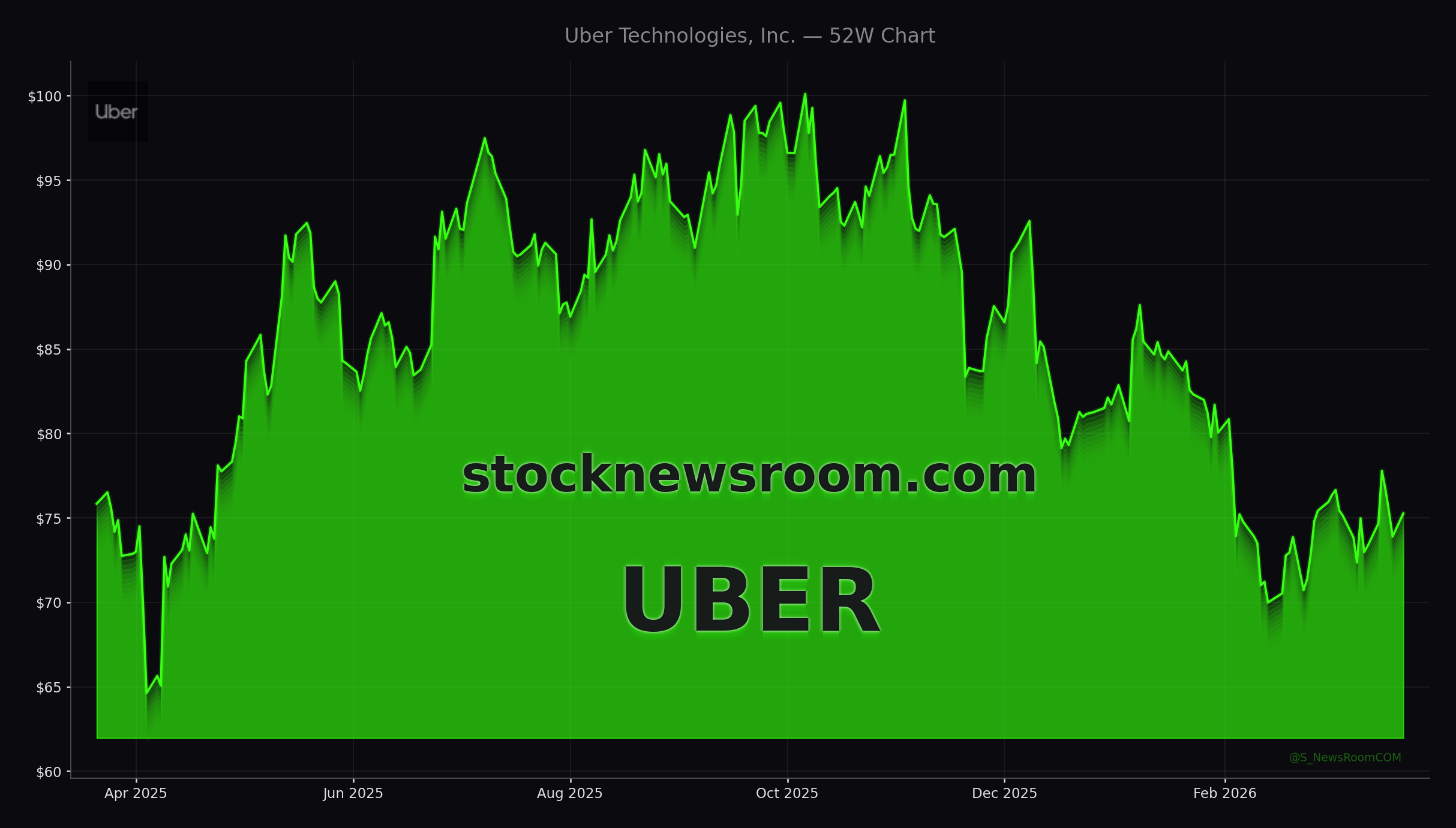

Can the Uber Robotaxi Deal with Rivian turn a $1.25 billion bet on autonomy into a long-term margin machine for investors?

How does the Uber Robotaxi Deal change the story?
Uber Technologies, Inc. has spent the past few years moving from a rides-only app to a broad logistics and local commerce platform spanning mobility, food delivery, groceries and retail. The Uber Robotaxi Deal with Rivian adds a new layer to that platform: a dedicated fleet of up to 50,000 midsize R2 electric vehicles that can be configured as Level 4 robotaxis over time. Rivian CEO RJ Scaringe and Uber CEO Dara Khosrowshahi have reportedly worked on different versions of this agreement for about a year, reflecting both the strategic importance and the uncertainty around metrics like revenue per mile and utilization.
At an agreed investment size of $1.25 billion, this is one of the largest vehicle and autonomy-linked arrangements Uber has ever signed. For Rivian, the structure gives revenue visibility and funding for its autonomy software efforts. For Uber, it is an option on lower-cost, electric autonomy at scale without having to build cars or full self-driving stacks itself, contrasting sharply with vertically integrated models like those pursued by Tesla.
What makes the Rivian partnership different for Uber?
Unlike some of Uber’s other collaborations, the Rivian tie-up is notable because there is no separate third-party autonomous software provider embedded in the deal. Rivian is developing both the physical R2 vehicle and key autonomy capabilities, while Uber provides the demand, routing, payments and marketplace layer. That end-to-end control on Rivian’s side could simplify integration and speed up deployment if Level 4 capabilities mature as expected later this decade.
Scaringe has said he is “very bullish” on the industry’s progress toward Level 4 and sees this as a chance to do something “exciting and large” with Uber. The R2’s midsize form factor, designed for urban practicality and passenger comfort, aligns with what Uber wants in a robotaxi: a flexible cabin that can serve rides, deliveries, and potentially other local commerce use cases. Over time, that could allow Uber to use the same hardware for multiple revenue streams, improving economics compared with single-purpose fleets.
How do other AV partnerships fit around the Uber Robotaxi Deal?
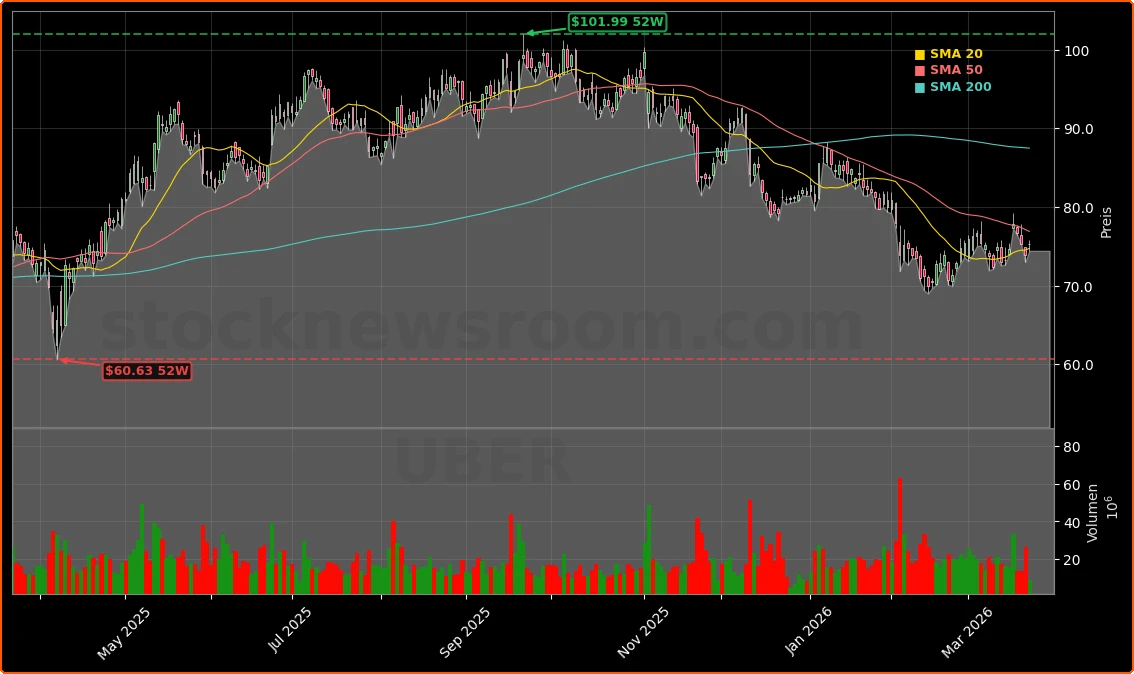
The Uber Robotaxi Deal does not stand alone. Uber has built a broad network of autonomous vehicle partners, including NVIDIA, Zoox, Wayve and Nissan, and plans to be testing or operating AVs across 18 cities globally by the end of 2026, up from 15 as of Q4 2025. Citigroup analysts argue this breadth makes Uber one of the best-positioned companies to benefit from the global expansion of autonomous vehicles and reiterate their view that Uber is becoming the default marketplace where AV providers commercialize at scale.
That multi-partner strategy reduces single-vendor risk and gives Uber leverage in negotiations, while Rivian’s large, dedicated R2 commitment provides a backbone for fleet planning. The approach stands in contrast to companies that bet on owning both hardware and software stacks outright. Rather than trying to match Apple or Tesla in end-to-end control, Uber is aiming to be the neutral layer that orchestrates trips, pricing and customer relationships across many robotaxi providers.
What does autonomy mean for Uber’s margins and growth?
Uber’s management has argued that the total addressable market for its platform extends far beyond ride-hailing into a multi-trillion-dollar global logistics and local commerce opportunity. Delivery has already expanded into groceries, retail and convenience goods, and grocery and retail alone are framed as a trillion-dollar opportunity. Adding robotaxis could materially change the margin profile of that ecosystem by lowering per-mile operating costs, especially in less dense suburban and international markets that are currently growing 1.5 to 2 times faster than major cities but remain underpenetrated.
As autonomy scales, higher-margin layers such as advertising and subscription products like Uber One gain further importance. Advertising has already surpassed early internal expectations as a percentage of gross bookings, and Uber One counts 46 million members, representing about half of gross bookings. Robotaxis could increase session length and frequency, boosting ad inventory and subscription value. If AVs allow more reliable, lower-cost supply, Uber can capture more local transactions without linearly increasing driver incentives, lifting EBITDA margins over time.
How should investors view competitive and regulatory risks?
For U.S. investors, the key question is whether Uber can convert its AV partnerships into sustainable competitive advantages before rival platforms or automakers close the gap. Tesla is pushing its own FSD-based robotaxi concept, while legacy automakers and tech firms, including players powered by NVIDIA’s automotive chips, are pursuing a mix of in-house and partnership-led approaches. Uber’s strategy avoids the heavy capex of building cars but depends on continued regulatory progress on Level 4 approvals and public acceptance of driverless rides.
Safety perceptions remain a wild card. Recent political rhetoric in the U.S. has highlighted passenger safety fears in traditional ride-hailing, particularly among women commuting in major cities. Robotaxis could either alleviate these concerns through standardized, sensor-heavy vehicles and constant monitoring, or amplify them if high-profile incidents undermine trust. For portfolios with exposure to mobility and AI, that regulatory and reputational overhang is as important as any spreadsheet model of robotaxi unit economics.
Related Coverage
For a deeper dive into how autonomy is reshaping Uber’s valuation narrative, readers can review detailed analysis of Uber’s broader robotaxi strategy and Wall Street’s reaction, which examines whether current pricing fully reflects the AV optionality. To compare Uber’s platform play with another U.S. tech giant, coverage of Amazon’s entertainment strategy and stock reaction explores how content, AI and logistics investments can move mega-cap shares and offers a useful benchmark for multi-vertical platform bets.
We saw a real opportunity to do something exciting and large with Uber, and what came together is one of the largest deals they’ve done in terms of investment and vehicle fleet size.— RJ Scaringe, Rivian CEO
In sum, the Uber Robotaxi Deal with Rivian underscores Uber’s ambition to be the central marketplace for autonomous trips and local commerce, not just another ride-hailing app. For long-term investors, the combination of AV partnerships, advertising and subscriptions suggests a path to structurally higher margins if execution and regulation cooperate. The next few years of pilot programs and city-by-city rollouts will show whether this Uber Robotaxi Deal becomes a real inflection point or just one more step in a long autonomy journey.