Is Uber’s robotaxi pivot a fleeting hype or the catalyst that finally rewires its margins and long-term valuation?
Is Wall Street underpricing Uber’s AV pivot?
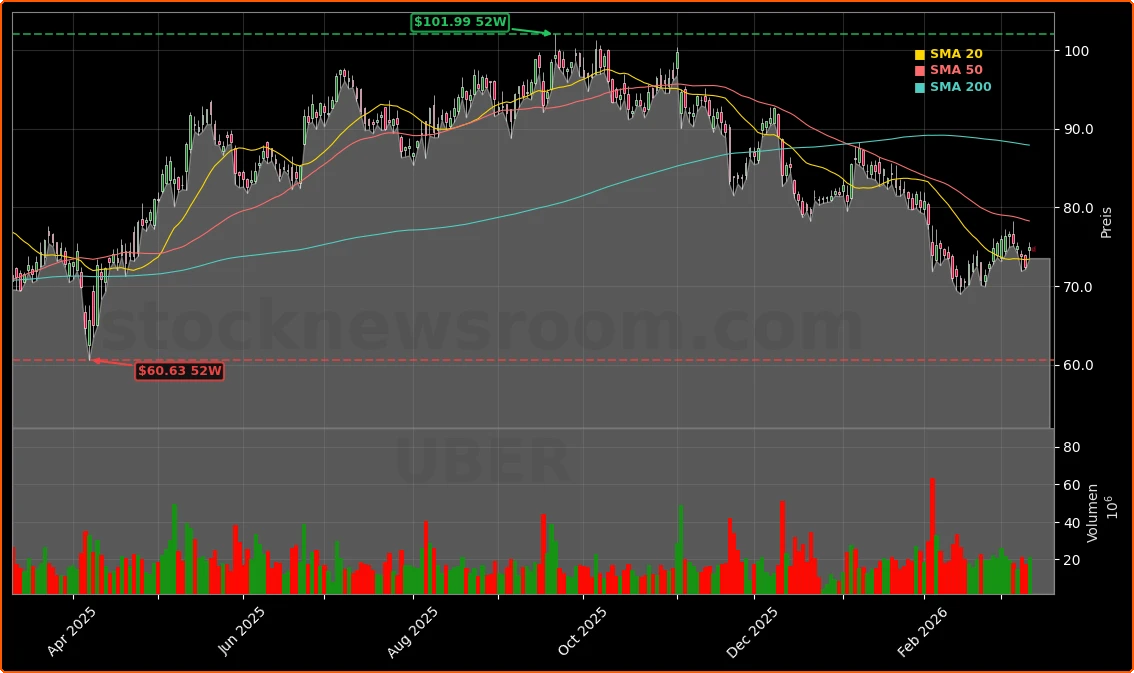
Uber shares rose 3.61% to $74.97 on Wednesday, before slipping slightly in after-hours trading to $74.40. Despite the bounce, the stock is still well below its 52-week high of $101.99, after a roughly 12% pullback over the last three months. That decline comes even as the company delivers some of its strongest fundamentals yet and advances the Uber Robotaxi Strategy across the U.S., Europe and Asia.
In the fourth quarter, Uber’s gross bookings climbed 22% year over year to $54.1 billion, with revenue up 20% to $14.4 billion. Monthly active platform consumers jumped 18% to 202 million, underscoring the company’s global scale across mobility and delivery. Non-GAAP operating income rose 46% to $1.9 billion, and free cash flow surged 65% in the quarter to $2.8 billion, bringing full-year 2025 free cash flow to $9.8 billion, up 42%.
Management sees the growth runway intact, guiding for Q1 2026 gross bookings to increase 17% to 21% year over year on a constant-currency basis. Yet the market remains focused on how the shift to autonomous vehicles could reshape the economics of ride-hailing and challenge Uber’s human-driver model.
How central is Zoox to the Uber Robotaxi Strategy?
Uber’s latest move is a high-visibility partnership with Zoox, the autonomous driving subsidiary of Amazon. Zoox’s purpose-built robotaxis, which lack steering wheels and pedals, will be integrated into the Uber app, with paid rides targeted to begin in Las Vegas this year and in Los Angeles by mid-2027, subject to regulatory approval.
In the near term, Zoox continues to operate limited, non-paying services in Las Vegas and San Francisco. The Uber tie-up is designed to turn those pilots into a commercial business by tapping Uber’s massive demand base and data on rider behavior and traffic patterns. Uber customers in eligible areas will be automatically matched with a Zoox robotaxi when available, similar to how they are routed today among different vehicle categories and price tiers.
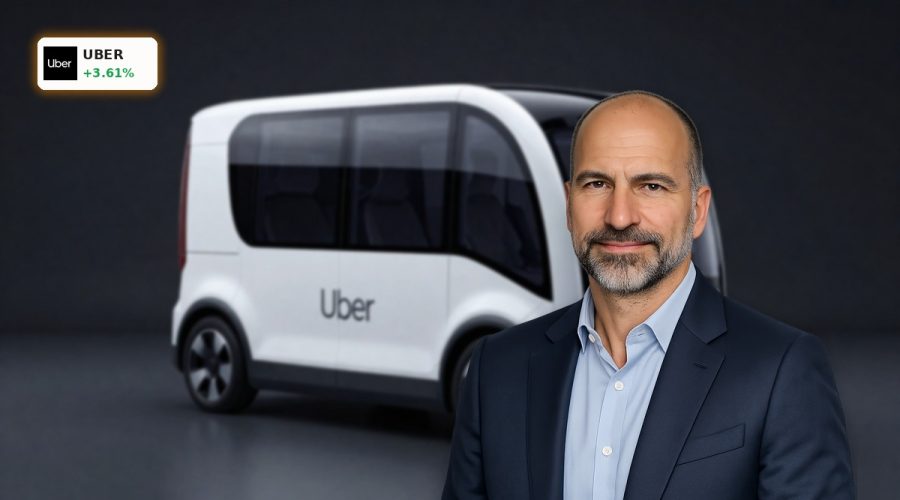
Uber CEO Dara Khosrowshahi argues that autonomy could be a margin-expanding catalyst rather than a pure threat. He has emphasized that AVs “unlock a multi-trillion dollar opportunity for Uber” by amplifying its existing strengths in global scale, demand density and real-time marketplace matching. The Uber Robotaxi Strategy is explicitly platform-based: instead of building its own vehicles, Uber wants to be the neutral marketplace orchestrating AV fleets from multiple partners.
Where do Nissan, Wayve and competitors fit in?
The Zoox agreement is only one leg of a broader push. Uber has also signed a memorandum of understanding with Nissan and U.K. autonomous startup Wayve to develop robotaxis based on the Nissan Leaf, using Wayve’s “AI Driver” technology. A pilot program in Tokyo is planned for late 2026, marking Uber’s first autonomous partnership in Japan and signaling ambitions to roll out AV services in more than 10 cities worldwide.
These multi-partner alliances are meant to counter momentum from rivals. Alphabet’s Waymo is already running paid, fully driverless services in several U.S. cities, while Tesla continues to promote its own robotaxi plans built around its installed base of vehicles and Full Self-Driving software. Other tech and auto players are also in the race, from NVIDIA’s AV compute platforms to legacy OEM experiments, intensifying competitive pressure on Uber’s core business model.
For now, Uber enjoys the advantage of scale and an entrenched user base that sees it as the default ride-hailing app in many markets. If the Uber Robotaxi Strategy succeeds, those same users may never need to switch apps to access autonomous rides, regardless of who builds the cars. But if competitors like Waymo or a vertically integrated player such as Apple or Tesla can offer cheaper, more reliable AV rides outside Uber’s ecosystem, they could siphon off both riders and drivers over time.
How are analysts valuing the risk–reward?
Even after the pullback, Uber’s forward price-to-earnings multiple sits around 22, implying Wall Street still expects years of double-digit growth and improving profitability. Large free cash flow generation gives Uber room to keep investing in AV partnerships and technology without sacrificing its path to higher margins.
Major brokerages remain broadly constructive. Citigroup has highlighted Uber as a core large-cap internet holding, arguing that the company’s marketplace scale and balance sheet leave it well-positioned to navigate autonomy. Evercore ISI recently named Uber among internet stocks that look oversold following broader AI and geopolitical worries, grouping it with Amazon and Meta as beneficiaries of secular digital demand.
At the same time, analysts acknowledge that autonomous-driving uncertainty justifies some valuation discount versus high-growth software names. As long as the timing and economics of robotaxis remain unproven, investors are likely to assign a risk premium to Uber, especially relative to pure-play AI infrastructure winners like NVIDIA. For risk-tolerant investors, that tension could represent an entry point: if the Uber Robotaxi Strategy delivers, current levels may underestimate long-term earnings power; if competing AV platforms dominate outside Uber’s network, the stock could re-rate lower.
Autonomy fundamentally amplifies the strengths of our existing platform: global scale, deep demand density, sophisticated marketplace technology, and decades of experience matching millions of trips in real time.
— Dara Khosrowshahi, CEO of Uber
Conclusion
For now, Uber’s combination of robust cash generation, accelerating AV partnerships and a stock price well under its 52-week high keeps the debate finely balanced. The next few years of regulatory decisions, pilot results and partnership execution will show whether the Uber Robotaxi Strategy transforms a ride-hailing pioneer into a central tollbooth of the autonomous era.
Further Reading
- Uber Technologies, Inc. Quote & Profile (Yahoo Finance)
- Nissan, Uber, Wayve announce robotaxi tie-up (Reuters)
- Uber taps Amazon’s Zoox for robotaxi rollout (USA Today)
- Uber Stock Is Down 12% in Just 3 Months. Time to Buy? (The Motley Fool)