Can UiPath’s first full year of GAAP profit and a fresh buyback offset investor fears about slowing AI automation growth?
Why did UiPath fall after a beat?
On the surface, the latest UiPath Earnings looked like a textbook tech win. Fourth-quarter revenue rose about 14% year over year to roughly $481 million, comfortably ahead of expectations near $465 million. Adjusted earnings per share came in at $0.30, beating consensus estimates around $0.25–$0.26. The company also announced a new $500 million share repurchase authorization for fiscal 2027, on top of having just finished a prior $1 billion program.
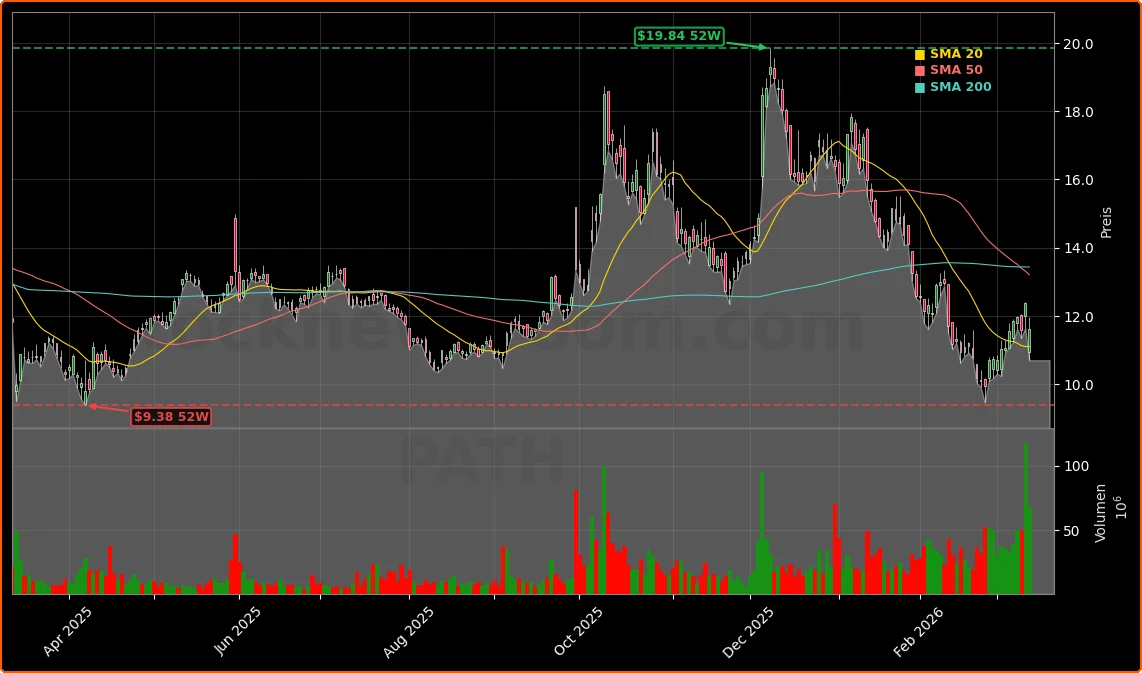
Despite the beat, PATH opened in the red on the NYSE and was recently down around 6%, underperforming a broader software group that has seen a rotation higher in March. With the stock at about $11.60 and roughly 40% below its late-2025 highs, the reaction reflects mounting concerns that top-line growth is slowing just as investors are demanding faster AI-driven acceleration, not gradual expansion.
UiPath’s updated full-year outlook implies revenue growth closer to 10% and acknowledges about a 1 percentage-point headwind from the shift toward SaaS and cloud delivery. For a name often compared to high-multiple AI beneficiaries like NVIDIA or Tesla in terms of “automation plus AI” potential, that pace now looks more mid-teens at best, not hypergrowth.
How strong were profitability and cash flows at UiPath?
Beneath the market’s skepticism, the UiPath Earnings report showed a business turning decisively profitable. Quarterly non-GAAP operating income reached about $150 million, a margin of roughly 31%, while full-year non-GAAP operating income climbed to around $370 million, up more than 600 basis points in margin terms. Most notably, UiPath Inc. posted its first full year of GAAP operating profit, at roughly $57 million, with Q4 GAAP operating income at about $80 million.
Free cash flow was another highlight. Adjusted free cash flow in the quarter approached $182 million, and about $372 million for the year, supporting an aggressive capital return strategy. UiPath repurchased roughly 30.9 million shares during the fiscal year at an average price around $10.92 and has bought an additional 14 million shares since January 31, effectively completing a $1 billion buyback ahead of launching the new $500 million plan.
Management also raised its long-term non-GAAP operating margin target to 30% from a prior 20% model, signaling confidence that internal automation, disciplined spending and cloud scale can keep expanding profitability even if revenue growth remains in the low-teens range. For value-oriented tech investors, that combination of rising margins, positive GAAP earnings and substantial cash generation stands in sharp contrast to many younger AI software names still burning capital.
What did guidance reveal about growth risk?
The forward-looking piece of the UiPath Earnings release is where the bull and bear cases diverge. For the first quarter, management guided revenue to $395–$400 million, above Wall Street’s consensus, and projected annual recurring revenue (ARR) in the $1.894–$1.899 billion range. For fiscal 2027, UiPath expects revenue of about $1.754–$1.759 billion and ARR of $2.051–$2.056 billion, both slightly ahead of prior estimates but still implying only low double-digit top-line growth.
RBC Capital Markets has described the execution as solid, noting that ARR growth around 11% and a year-end level of $1.853 billion were broadly in line with expectations. Barclays has highlighted UiPath’s visibility into demand for its AI products, calling the 2027 ARR outlook slightly better than feared. At the same time, Bloomberg Intelligence has warned that the revenue mix raises questions about subscription momentum and competitive pressure in automation as generative AI tools proliferate.
Management itself struck a cautious tone on macro conditions, pointing to “pockets of strength and pockets of pressure” in global demand, alongside uncertainty from geopolitical tensions in regions such as the Middle East. While UiPath prices largely in local currency and reports minimal FX impact, a slower enterprise spending backdrop could cap upside to ARR growth, particularly in discretionary automation projects.
Is agentic AI the next Palantir-style catalyst?
The strategic question for U.S. investors is whether UiPath’s agentic AI push can unlock an inflection similar to what investors have seen in other AI platform stories. UiPath now generates nearly $200 million in ARR from AI products, and about 90% of customers with more than $1 million in ARR use AI modules. Customers spending over $100,000 in ARR who adopt AI tend to spend almost three times more than non-AI buyers, a sign that automation plus generative agents is deepening wallet share.
Management is betting on its agentic automation engine, Maestro, and vertical solutions in healthcare and financial crime compliance to drive that next leg of growth. The recent tuck-in acquisition of WorkFusion is aimed at strengthening capabilities in financial services, while partnerships with consulting giants like Deloitte and Accenture are intended to accelerate large-scale deployments.
Bulls argue that this positions UiPath closer to the platform stories seen at names like Palantir and even Apple in its ecosystem approach, while bears counter that current growth, around the mid-teens at best, falls well short of the explosive ramps that ignited past AI reratings. With PATH shares trading at a modest earnings multiple relative to high-flying AI peers and backed by about $1.6 billion in cash and no debt, the market is effectively demanding proof that agentic automation can bend the growth curve, not just the margin line.
Our ability to bring deterministic automation, agentic automation, and orchestration together in one trusted, governed system is a true differentiator.
— Daniel Dines, Founder and CEO of UiPath
Conclusion
In summary, the latest UiPath Earnings confirm that the company has turned the profitability corner and is returning substantial capital, but the stock’s 6% drop shows that Wall Street is now laser-focused on whether ARR growth can reaccelerate as AI automation moves from pilot projects to enterprise standard. For U.S. portfolios, UiPath remains a profitable, cash-rich automation leader whose next few quarters will likely decide whether it stays a value-style AI play or graduates into the market’s front row of AI growth names.
Further Reading
- UiPath Inc. (PATH) on Yahoo Finance (Yahoo Finance)
- UiPath margins shine as AI fuels growth (Proactive Investors)
- UiPath stock: why sell-off makes sense despite Q4 beat and buyback (Invezz)
- UiPath Stock Sinks 6% — But It Could Still Be the Next Palantir (24/7 Wall Street)