Are Ulta Beauty’s latest earnings and cautious 2026 outlook a temporary stumble or the start of a tougher chapter for the beauty leader?
Why did Ulta Beauty drop after a solid quarter?
Ulta Beauty, Inc. reported fiscal Q4 2025 diluted EPS of $8.01 on revenue of $3.90 billion. That marked double-digit sales growth of 11.8% year over year and pushed full-year net sales up nearly 9.7% to about $12.4 billion. However, the stock fell sharply, with the move extending earlier premarket losses of roughly 8%–10% after the print.
The main pressure point in the latest Ulta Beauty Earnings release was profitability. While revenue slightly topped typical Wall Street estimates near $3.8 billion, EPS came in a touch below consensus at around $8.03. Management highlighted higher fixed costs and reduced operating leverage as key reasons why the gross margin edged lower, partially offset by better supply chain efficiency and lower inventory shrink.
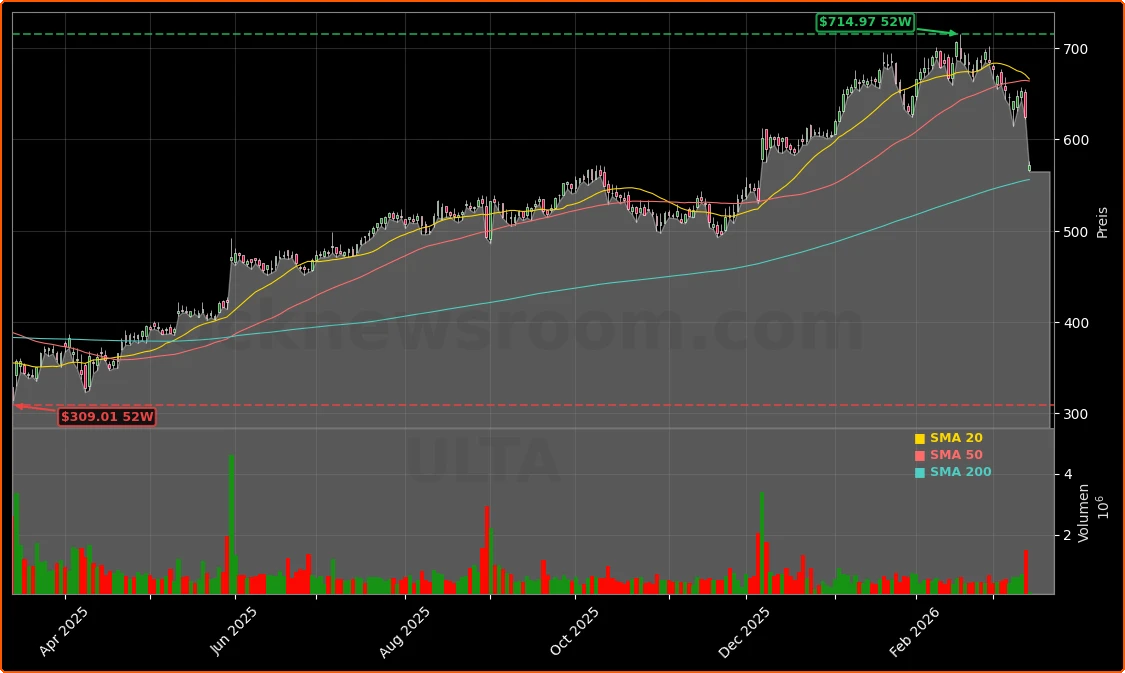
For US investors, the immediate takeaway is that Ulta remains a growth story in beauty but is no longer seen as immune to broader cost and macro headwinds. At about $572 per share and down around 8% on the day, ULTA is well below its 52‑week high, underscoring how quickly sentiment can swing on guidance, even when headline earnings are broadly healthy.
What does the 2026 Ulta Beauty Earnings outlook signal?
The forward-looking piece of the Ulta Beauty Earnings report drew the most scrutiny. For fiscal 2026, management guided net sales growth of 6% to 7% and diluted EPS between $28.05 and $28.55. The midpoint of that EPS range lands slightly under typical analyst expectations around $28.38, which was enough to disappoint a market priced for consistent upside surprises.
Comparable sales are now projected to rise just 2.5% to 3.5% in 2026, with the upper end only matching the average sell-side assumption of roughly 3.5%. Management described the outlook as intentionally conservative given uncertainty around US consumer spending, elevated gasoline prices linked to tensions in the Middle East, and a still-inflationary cost backdrop.
The guidance effectively tells investors to expect slower, more normalized growth after several years of outsized gains. That shift matters for valuation: Ulta has historically traded at a premium to many brick‑and‑mortar retailers because of its strong same‑store sales trajectory and high returns on capital. With margins under pressure and EPS growth more modest, some portfolio managers may reassess position sizes even if they remain constructive on long‑term beauty demand.
How does Ulta Beauty compare to other retail leaders?
In the current earnings season, investors have been quick to punish companies whose outlooks lag expectations, even when reported results are solid. Ulta’s post‑earnings slide on Friday echoes reactions seen recently in other high‑quality names when guidance turned cautious. Beauty remains one of the more resilient categories in US retail, yet rising costs and macro uncertainty are catching up with the sector.
Unlike mega‑cap tech leaders such as NVIDIA or platform giants like Apple, Ulta’s growth is tightly linked to US discretionary spending and traffic at physical stores. That makes its guidance a useful barometer for the health of middle‑ and higher‑income consumers. The beauty retailer has nevertheless continued to gain share in both mass and prestige segments and is pushing into wellness and “beauty‑from‑within” supplements through new partnerships.
Institutional ownership remains high. Legal & General Group Plc, for example, recently lifted its stake by about 4.4% to more than 369,000 shares, and the average Wall Street rating on ULTA sits at “Moderate Buy,” with consensus price targets in the mid‑$600s. That suggests many analysts still see upside from current levels, assuming management can stabilize margins and deliver on its mid‑single‑digit comp plan.
What are Ulta Beauty’s key strategic levers now?
Behind the headline numbers, the Ulta Beauty Earnings call emphasized several growth levers. The company is investing heavily in digital innovation, including AI‑driven personalization, which has powered double‑digit e‑commerce gains. A growing TikTok Shop presence and social‑commerce push are designed to capture Gen Z and younger millennial shoppers, an area where beauty brands that master short‑form video can see outsized returns.
Ulta is also leaning further into wellness and supplements through brands like Cymbiotika, whose products will roll out online and into more than 1,000 stores. That expansion aims to deepen the retailer’s “whole‑self” positioning and increase average basket size, offsetting any pressure from smaller discretionary purchases if fuel or utility costs remain high for US households.
Operationally, new distribution centers and supply‑chain upgrades are meant to claw back margin as the company scales. The leadership team, including the new CFO Christopher DelOrefice and CEO Kecia Steelman, reiterated a focus on profitable growth: gain share, but not at the expense of long‑term return on invested capital. For traders, technical levels around the 200‑day moving average near the mid‑$550s and a potential gap‑fill toward the mid‑$540s are being watched as possible support zones after the post‑earnings selloff.
Conclusion
Ultimately, the latest Ulta Beauty Earnings show a retailer that is still growing faster than much of brick‑and‑mortar retail, but now has to prove it can defend margins in a tougher macro environment. For long‑term investors, the pullback may offer a chance to reassess the risk‑reward as the company doubles down on digital, wellness, and social‑commerce initiatives ahead of the next quarterly update.
Further Reading
- Ulta Beauty, Inc. (ULTA) on Yahoo Finance (Yahoo Finance)
- Ulta Beauty, Inc. Q4 2025 Earnings Call Transcript (Insider Monkey)
- Ulta Beauty slides as rising costs hit margins; focus on TikTok push under new CEO (Reuters)
- Ulta Beauty Tumbles 8% in Early Trading — Here’s Why the Earnings Beat Isn’t Enough (24/7 Wall Street)