Is the US government facing an expensive tariff shock with billion-dollar refunds following the Supreme Court ruling?
What does the ruling change for US government tariffs?
In a 6-3 vote, the Supreme Court declared President Trump’s extensive IEPA tariffs unconstitutional. The International Emergency Economic Powers Act of 1977 is intended for “real national security emergencies,” not for a permanent tariff policy. This removes the central tool with which the US government tariffs had established a complex tax system, with rates exceeding 30%, since 2025. The decision initially reduces the average US tariff rate significantly—from approximately 16.9% to about 9%. However, the relaxation effect lasted only hours.
Trump responded with a new executive order: A flat import tariff of 15% will now be imposed under Section 122 of the Trade Act. While this instrument allows for duties for a maximum of 150 days, it could be effectively extended through repeated declarations of a balance of payments emergency. For companies, it is clear: The direction of US government tariffs remains protectionist, but the legal foundation is shaky.
How do the new 15% tariffs affect the global market?
The new one-size-fits-all tariff replaces a patchwork of IEPA duties and lowers the effective average rate to an estimated 13.5% to 13.7%. Particularly, China and Brazil are seeing lower burdens overall: For China, effective rates could drop from 32% to around 24%, while in Brazil, they could be more than halved. At the same time, particularly sensitive sectors such as steel, aluminum, semiconductors, and parts of the pharmaceutical industry remain subject to separate Section 232 tariffs of up to 50%—keeping the cost base high for importers.
The main victims are European exporters. For EU car manufacturers, around 15% tariffs on exports to the US remain, while steel and aluminum continue to face burdens of about 50%. A European assessment concludes that the flat 15% of the US government tariffs on certain products are higher than the duties that the planned US-EU trade agreement would have provided. The European Parliament has therefore formally put the ratification of this agreement on hold.
Tariffs: What does the tariff shift mean for businesses?
For globally operating corporations, there is an exceptionally uncertain planning environment. The 150-day limitation of the Section 122 tariffs means that no major location decisions should be made within the current window until the end of July—neither factory closures nor new establishments are viable on this basis. Many companies have already shifted supply chains in recent years, moving away from China to other Asian locations, South America, or to a lesser extent, Africa.
Retailers like Gap and online platforms like Amazon and Walmart have seen their margins severely impacted by peak tariffs of up to 50%. Now, the renewed restructuring of the US government tariffs forces them to streamline product ranges and prioritize higher-margin categories. Small manufacturers with a high import share of inputs are particularly suffering, as they cannot easily pass on cost increases. At the same time, political risks are rising: Several countries, including the EU, the UK, and Australia, are openly considering countermeasures.
Refund of $175 billion – what’s at stake?
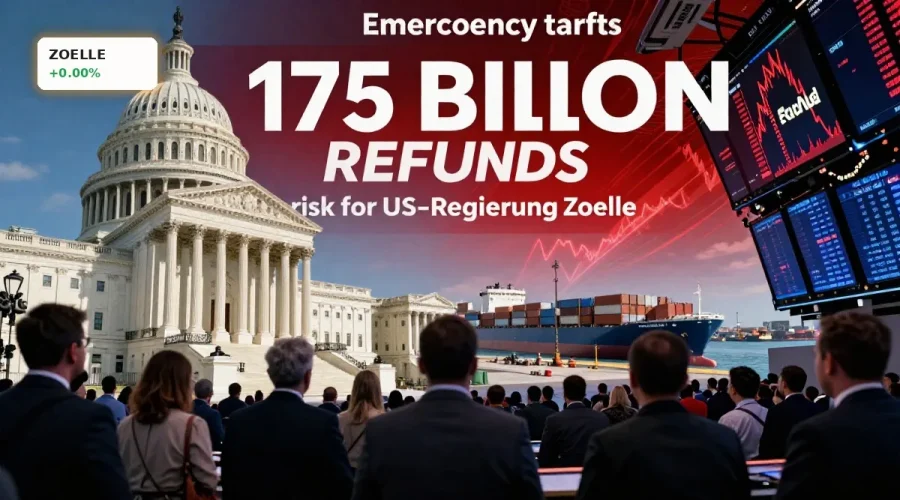
Since March 2025, US tariffs have reportedly funneled up to $175 billion into the federal treasury. Following the Supreme Court ruling, importers are questioning whether illegally collected duties will be refunded. Formally, the Court of Federal Claims and the Court of International Trade must now clarify what a refund mechanism might look like. Experts anticipate a lengthy, bureaucratic process lasting two to five years. Corporations like Apple (estimated $3.6 billion in tariff payments) or Costco have already filed lawsuits to position themselves early.
The political situation is highly charged: Democratic governors like Gavin Newsom and J.B. Pritzker are calling for direct payments to households, some exceeding $1,700 per family. The Trump administration, on the other hand, signals that it prefers to use the revenues for deficit reduction, and refunds are unlikely to find an easy path through Congress. For investors, it remains uncertain whether and to what extent companies will ever see money returned—a further uncertainty factor of the US government tariffs.
Only a stable tariff regime can lead to investments.
— Trade expert from a US think tank
Bottom Line
The current stance of the US government tariffs following the Supreme Court ruling solidifies a protectionist course without providing reliable conditions for businesses. For investors, this increases volatility in tariff-sensitive sectors such as industry, consumer goods, and automobiles, while export-oriented regions like the EU face additional pressure. Those invested should closely monitor the ongoing legal developments surrounding Section 122 and potential transitions to permanent Section 301 tariffs, and assess portfolios for tariff risks and global supply chain exposure.
Related Sources
- US Supreme Court ruling limits presidential use of IEPA for tariffs (Bloomberg)
- Analysis of Trump’s new 15% global tariff under Trade Act Section 122 (Reuters)
- EU freezes work on US trade deal after new US import tariffs (Financial Times)
- US tariff policy after Supreme Court ruling on Yahoo Finance (Yahoo Finance)