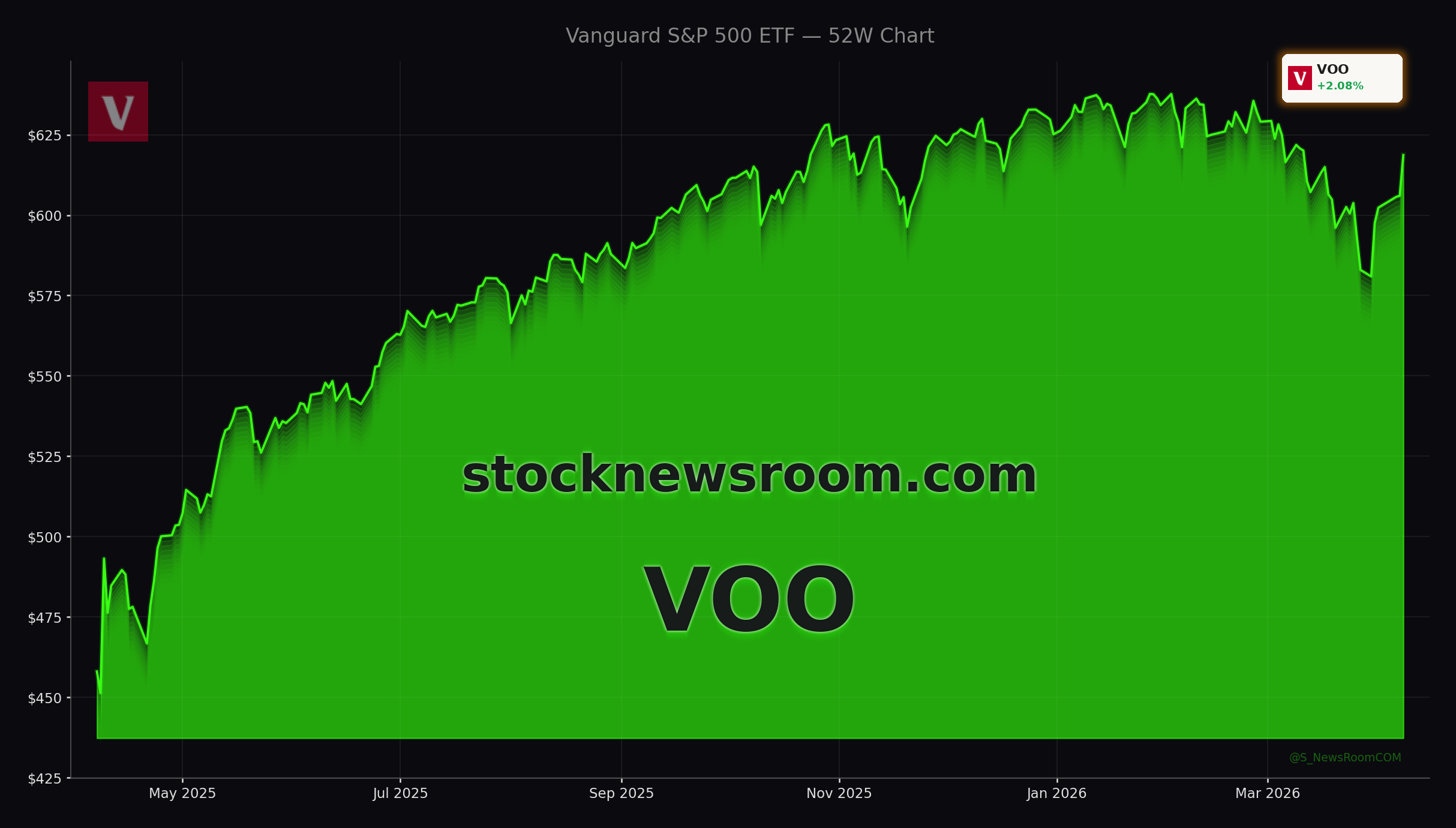

Is Vanguard’s S&P 500 ETF Strategy leaving money on the table by skipping a split even as VOO powers higher again?

Why no split for Vanguard?
Vanguard recently announced share splits for five of its index ETFs, but its flagship Vanguard S&P 500 ETF was deliberately left off the list. While an 8‑for‑1 split could easily bring the price per share below $100, Vanguard appears to see little benefit for a fund that already trades with some of the tightest spreads and deepest liquidity in the ETF universe. For U.S. investors, that decision clarifies the core of the current Vanguard S&P 500 ETF Strategy: VOO is designed to be an efficient institutional‑grade building block, not a trading gimmick.
At roughly $619 per share, some small accounts may find a single share expensive, but the fund’s penny‑wide bid‑ask spread means transaction costs stay minimal for those who can access fractional share trading or dollar‑based investing via online brokers. Vanguard charges a rock‑bottom 0.03% expense ratio on VOO, undercutting the SPDR S&P 500 ETF Trust (SPY) and iShares Core S&P 500 ETF (IVV), which helps explain why large allocations continue to flow into the fund despite short‑term volatility on Wall Street.
How is VOO trading after recent volatility?
Market action in 2026 has been choppy, with the S&P 500 under pressure from higher energy prices, renewed inflation worries and geopolitical risks. VOO has mirrored those swings: it gained 1.1% on March 23, then slipped 1.7% on March 27 as risk sentiment deteriorated. More recently, the ETF has inched higher with a 0.4% gain on April 6 and a further 0.1% rise on April 7, before today’s stronger move higher.
Technically, chart watchers have flagged a rising wedge pattern and bearish divergences that could drag VOO back toward the $600 area after testing record territory earlier in the year. Some strategists, including Tom Lee of Fundstrat, have warned of a possible 10%–20% pullback in the S&P 500 before the next leg higher. For long‑term holders of VOO, however, those signals matter less than whether the underlying U.S. large‑cap earnings power remains intact over the coming decade.
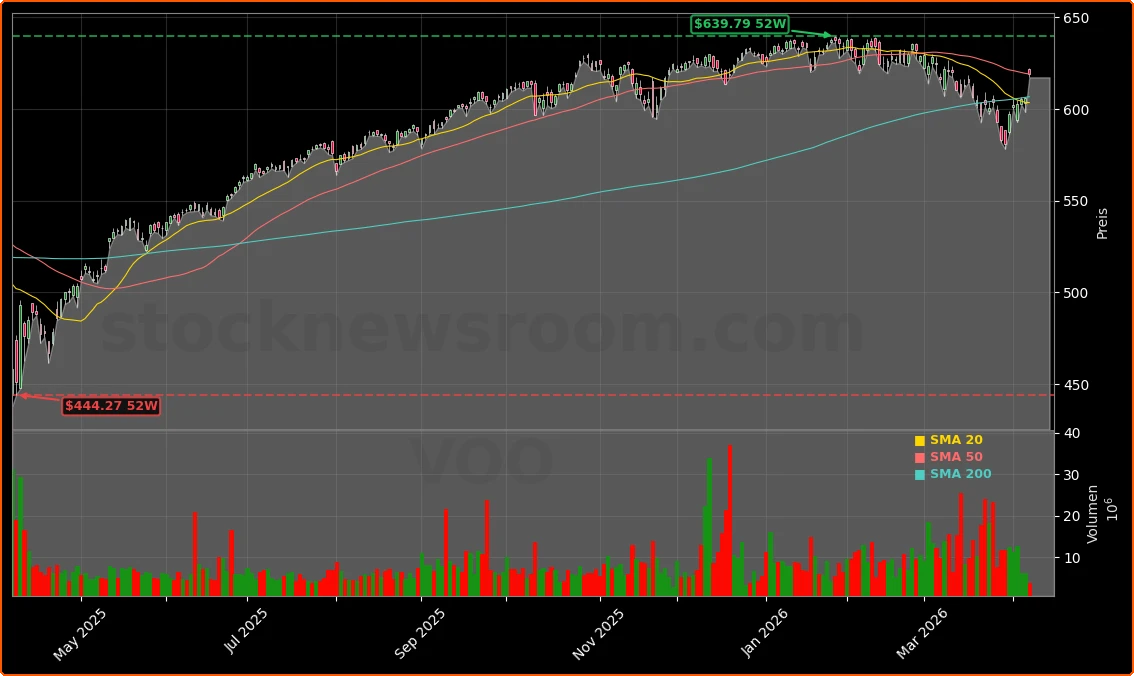
What drives the Vanguard S&P 500 ETF Strategy long term?
The long‑term Vanguard S&P 500 ETF Strategy is built on broad market exposure, not market timing. Over the past 10 years, VOO has delivered a total return of about 281%, driven heavily by mega‑cap technology and communication names. Companies such as NVIDIA, Apple and Microsoft, along with strong performers in cloud, e‑commerce and AI, now make up nearly a fifth of the ETF’s assets as the S&P 500’s market‑cap weighting has become more concentrated.
That concentration cuts both ways. On one hand, the same tech‑heavy profile that boosted returns during the last decade could continue to benefit from themes like artificial intelligence, data centers and the digital economy. On the other hand, it leaves VOO more exposed if these high‑valuation growth leaders stumble or if interest rates stay elevated, compressing multiples. Importantly, VOO does not provide downside protection; it is designed to track the index, not cushion drawdowns.
Strategists such as Tom Lee see a different side of the concentration story: he projects the S&P 500 could reach 15,000 by 2030, implying roughly 129% upside from current levels, with VOO as a straightforward way to participate. His thesis leans on a global labor shortage driving AI adoption, robust corporate profitability and a multi‑trillion‑dollar wealth transfer to younger investors who favor low‑cost index funds. That framework aligns closely with the passive, rules‑based approach embedded in the Vanguard S&P 500 ETF Strategy.
How does Vanguard stack up against rivals?
On Wall Street, VOO has become the primary low‑fee challenger to SPY and IVV. This year, VOO has already attracted more than $50 billion in new assets, while some competitors have seen net outflows, as investors rotate toward cheaper structures. With total assets now approaching the $1 trillion mark, the fund is consolidating its role as a core equity holding for institutions, advisers and retail investors alike.
Vanguard’s broader platform reinforces that competitive edge. The firm offers $0 commissions on stock and ETF trades for many accounts and is widely recognized for its client‑owned structure and focus on low costs. For investors comparing alternatives to large U.S. brokerages, Vanguard frequently appears alongside Fidelity, Interactive Brokers, Robinhood and E*TRADE as a top choice for buy‑and‑hold ETF and mutual fund investing.
For those weighing VOO against more speculative assets such as crypto‑linked products or so‑called Digital Asset Treasuries, the trade‑off is clear: VOO offers transparent exposure to 500 leading U.S. companies across sectors, while crypto strategies seek higher yields with substantially higher risk. In a diversified portfolio, VOO is often used as the U.S. large‑cap equity core, with satellite allocations to growth themes like Tesla or emerging technologies layered around it when appropriate.
While major Wall Street research houses such as Goldman Sachs, Morgan Stanley, Citigroup and RBC Capital focus their formal ratings on individual stocks and sectors rather than broad index trackers like VOO, their generally constructive long‑term outlooks on U.S. equities support the idea of keeping a sizable S&P 500 allocation for diversified growth.
In the end, the absence of a split underscores that the Vanguard S&P 500 ETF Strategy is about efficiency, scale and disciplined index exposure rather than optics. For American investors seeking low‑cost access to the S&P 500, VOO remains a core building block, even at a $600‑plus share price. The next chapters for VOO will likely be shaped less by structural tweaks and more by how U.S. megacaps such as NVIDIA, Apple and Tesla navigate AI, interest rates and the broader economic cycle.