Are the latest Volkswagen Earnings slump and margin shock a temporary detour or a warning sign for the entire auto sector?
How hard were Volkswagen Earnings hit in 2025?
Volkswagen closed 2025 with a dramatic deterioration in profitability despite largely stable revenue. Group sales were roughly unchanged at about EUR 322 billion, but net income after taxes dropped from EUR 12.4 billion to EUR 6.9 billion, a decline of around 44%. Operating profit was hit even harder, falling from EUR 19.1 billion in the prior year to EUR 8.9 billion – a de facto halving of the operating result.
That translated into an operating margin of just 2.8%, down 3.1 percentage points from the previous year and back in the range last seen in 2016 at the height of the diesel emissions scandal. In practical terms, Volkswagen generated only around EUR 1,120 in operating profit on a vehicle priced at EUR 40,000. For global investors accustomed to higher mid-cycle margins from mass-market automakers, the latest Volkswagen Earnings signal that the group is now running with far less cushion against cyclical shocks.
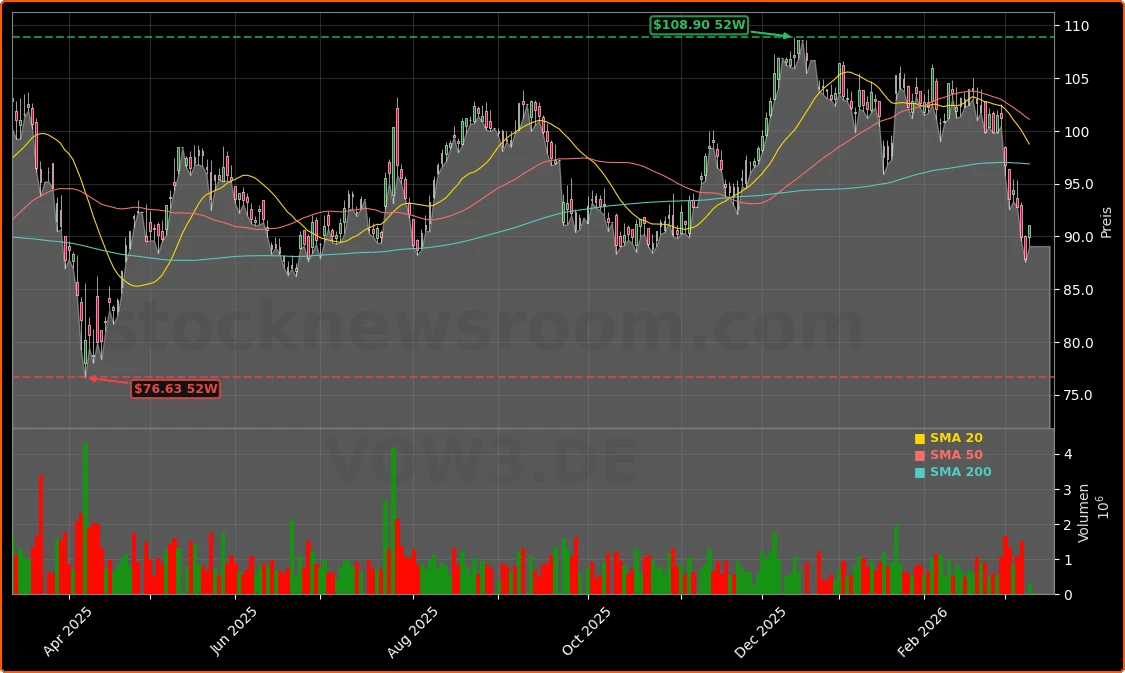
The share price has been volatile but not collapsing. Volkswagen (VOW3.DE) recently traded around EUR 91.08, up roughly 3.7% on the latest session, but still clearly below its 52‑week high near EUR 114. That pricing reflects a mix of deep skepticism about earnings power and some hope that 2025 marked a low point.
What drove the profit slump at Volkswagen?
Management highlighted several headwinds behind the weak Volkswagen Earnings. Higher US tariffs weighed on profitability, particularly for vehicles and components exposed to transatlantic trade. Additional burdens came from restructuring and spending tied to adjusting the product strategy at the Porsche unit, where a shift toward extending the life of combustion-engine models triggered sizable charges.
Currency movements and negative price/mix effects added further pressure, signaling that Volkswagen had to concede on pricing in key regions just as costs climbed. This erosion in pricing power stands in contrast to premium peers and to some extent to high-demand EV players like Tesla, which have more flexibility to adjust prices around model launches and technology upgrades. Even so, Volkswagen emphasized that cost reduction programs helped offset part of the damage, hinting at a deeper restructuring effort that could support margins in 2026 and beyond.
On the volume side, the group’s global deliveries slipped only marginally. Total vehicle deliveries across all brands dipped 0.5% to 8.98 million units, just below the nine-million mark. Gains in Europe were not enough to counter declining shipments in China and North America, two markets that are central to long-term growth but increasingly competitive due to aggressive Chinese EV makers and established players including NVIDIA-powered software-centric platforms from rivals.
Do cash flow and dividends soften Volkswagen Earnings?
Despite the profit hit, one bright spot in the Volkswagen Earnings picture is cash generation. The automotive division’s net cash flow improved to about EUR 6.4 billion from EUR 5.2 billion a year earlier, aided by better working-capital management and lower-than-feared capital outflows. Volkswagen had already flagged in January that 2025 free cash flow would be significantly stronger than initially expected, revising its internal assessment from roughly zero to around EUR 6 billion.
For debt investors and credit analysts, this cash-flow resilience is critical because it underpins Volkswagen’s solid liquidity and helps fund the transition to software-defined and electrified vehicles without over-reliance on capital markets. The company’s automotive net liquidity is expected to remain in a range of EUR 32–34 billion in 2026, giving it meaningful firepower compared with more leveraged peers.
Equity investors, however, will feel some of the pain. The proposed dividend on preferred shares is set to fall by about 17% to EUR 5.26 per share. That is below last year’s payout but slightly above market expectations, which had been around EUR 4.57 per share. For yield-oriented international investors, Volkswagen’s dividend remains attractive, but the cut underscores that earnings pressure is not just an accounting story – it is flowing directly into shareholder returns.
What do Volkswagen Earnings signal for 2026 and rivals?
Looking ahead, Volkswagen expects its 2026 revenue to grow in a narrow range of 0% to +3% year over year, paired with a targeted operating margin between 4.0% and 5.5%. That range implies a visible rebound from the 2.8% margin recorded for 2025 but still falls short of the levels global investors typically expect from a top-tier automaker. Consensus estimates before the report had generally pointed to margins near the upper end of that range, around 5.3%, suggesting that guidance is cautious rather than aggressive.
Volkswagen is projecting an automotive investment ratio of 11–12% for 2026 and a net cash flow between EUR 3 and 6 billion. The company continues to cite a challenging macro backdrop: slowing global growth, geopolitical tensions, trade uncertainties and volatile commodity, energy and FX markets. It also faces stricter emissions regulations that demand heavy ongoing capex and R&D, as well as intense EV competition from Chinese brands and from US-listed players such as Tesla and Apple-linked ecosystem partners in software and infotainment.
For US-based portfolios, Volkswagen now sits in a complicated middle ground versus global peers. The margin and earnings profile currently trail profitable premium brands and high-margin EV specialists, while the valuation reflects both deep restructuring risk and potential upside if cost programs and product refreshes succeed. Banks like Goldman Sachs, Morgan Stanley and Citigroup are likely to re-examine their models around free cash flow and margin normalization rather than pure volume growth, especially given the muted top-line guidance for 2026.
Our substance is robust, our future programs are working, and with strong financial momentum toward the end of the year we have further strengthened our company.
— Oliver Blume, CEO of Volkswagen Group
Conclusion
Overall, the latest Volkswagen Earnings confirm a tough year but also outline a path to incremental margin recovery. For international investors, the key questions now are how quickly the group can execute on restructuring, whether cash flow remains robust and how effectively Volkswagen can defend pricing power in a world where software, charging ecosystems and autonomous-driving partnerships increasingly define competitive advantage.
Further Reading
- Volkswagen Group reports 2025 full-year results and 2026 outlook (Volkswagen Group)
- Volkswagen profit falls sharply in 2025 on tariffs and Porsche charges (Reuters)
- Volkswagen 2025 earnings underline pressure on margins and EV transition (Bloomberg)
- Volkswagen AG Konzerngewinn 2025 bei Yahoo Finance (Yahoo Finance)