
Can Walmart’s strong quarter with record revenue overshadow the cautious forecast and growing concerns about US consumption?
How strong was Walmart’s quarter really?
Walmart Inc. narrowly exceeded expectations in the fourth quarter of 2025. Revenue rose by 5.6% to $190.7 billion, slightly above forecasts of around $190.6 billion. Operating income even increased by 10.8%—a clear signal that efficiency and margins are a focus. Adjusted earnings per share reached $0.74, up from $0.66 the previous year, and one cent above consensus estimates.
For the year, Walmart generated $713.2 billion in revenue, a 4.7% increase. Operating income climbed to $29.8 billion, while net income attributable to shareholders rose by 12.6% to $21.9 billion. This quarter confirms the company’s role as a barometer of US consumption—despite high interest rates, persistent inflation, and weaker consumer sentiment.
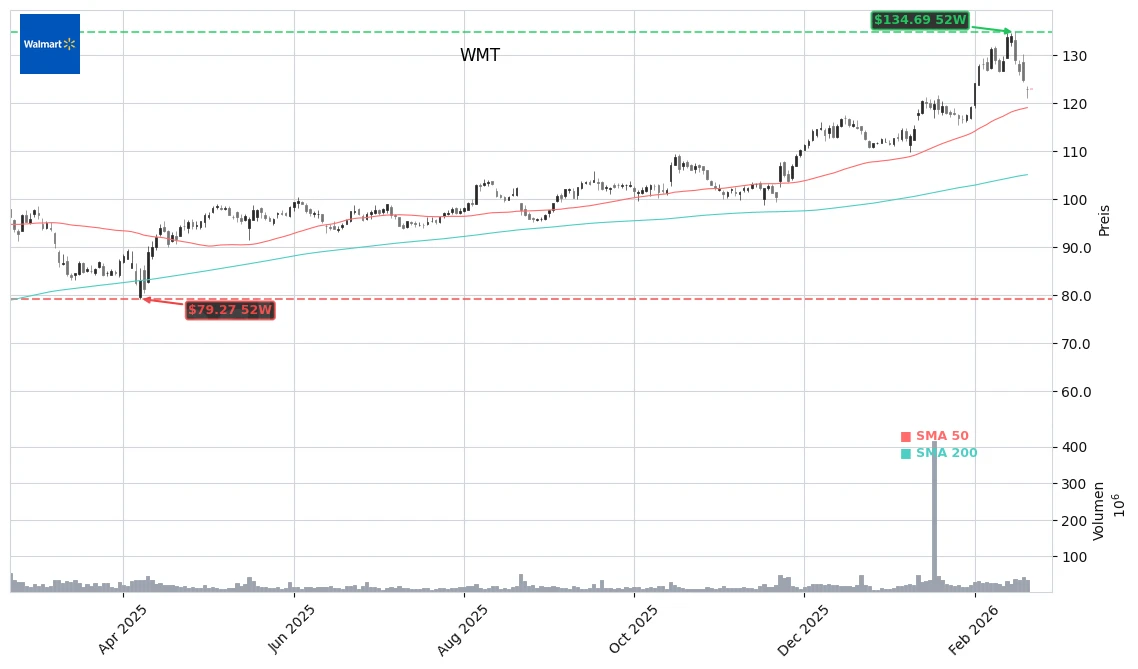
The stock price reflects the tension: After some fluctuations in pre-market trading, Walmart is currently at $126.56, just below the previous close of $126.62 (-0.05%) and slightly under the 52-week high of $134.64.
What drives growth at Walmart?
The latest Walmart quarter shows that the company is increasingly becoming a digital and data player. Global e-commerce revenue rose by 24%, and in the US, it increased by 27%. About 35% of online orders fulfilled from stores are now delivered in less than three hours—speed and convenience are becoming a second pillar alongside low prices.
At the same time, the advertising business is growing rapidly: global advertising revenue increased by 37%, with Walmart Connect in the US rising by 41%. For the full year, advertising revenue reached nearly $6.4 billion. Together with membership fees, which grew by over 15% globally, these high-margin areas now account for nearly a third of operating income.
Strategically, CEO John Furner is heavily investing in AI and automation. The shopping assistant “Sparky” in the app reportedly increases the average basket size by about 35%, with approximately half of mobile users already interacting with the agent. At the same time, about 60% of store deliveries in the US come from automated distribution centers, and roughly half of the e-commerce volume is handled through automated logistics—a lever for further margin improvements.
Why is the cautious forecast unsettling?
Despite the strong Walmart quarter, management has intentionally set a low bar for the current fiscal year. For the first quarter of 2027, the company expects adjusted earnings per share of $0.63 to $0.65—significantly below the previously expected $0.69. Walmart is targeting revenue growth of 3.5% to 4.5%.
For the entire year of 2027, the retailer is projecting revenue growth of 3.5% to 4.5% and adjusted earnings per share of $2.75 to $2.85. The market had anticipated nearly 5% revenue growth and an EPS of $2.97 on average. CFO John David Rainey attributes the cautious guidance to an “unstable and dynamic” macroeconomic environment, a weaker labor market, subdued consumer sentiment, and trade policy risks.
On the stock market, the outlook initially created selling pressure: the stock lost about 3% in pre-market trading before recovering significantly during the day. Many investors are betting that Walmart will start conservatively as it has in previous years and raise its targets throughout the year.
How are analysts reacting to Walmart?
On Wall Street, the overall sentiment remains positive despite the cautious forecast. Telsey Advisory Group reaffirms its buy rating and sets a price target of $135. Rothschild & Co Redburn also maintains a “Buy” rating with a price target of $150. KeyBanc Capital Markets sticks to “Overweight” and raises its target to $145—justifying this with Walmart’s strong position in the current consumption environment, the growing importance of e-commerce and AI, as well as potential tailwinds from looser monetary policy and higher US tax refunds.
Analyst Christopher Horvers from JPMorgan sees further margin potential and believes that earnings of up to $4 per share are possible in two to three years. Citigroup describes the fourth quarter as solid and sees Walmart well-positioned for 2026 and beyond. However, some market observers warn of the ambitious valuation: after the strong price increase, the stock is trading at times with a P/E ratio of over 40, significantly above historical averages.
„We believe it is wise to be somewhat more cautious with the outlook than we have been in the past,” said Walmart CFO John David Rainey, referring to the uncertain macroeconomic environment.
— John David Rainey, CFO of Walmart
Bottom Line
Overall, the current Walmart quarter presents an impressive picture: revenue, operating income, e-commerce, and advertising revenues are all growing significantly, while a $30 billion buyback program and a dividend increase signal additional shareholder friendliness. The cautious forecast may dampen enthusiasm in the short term, but many analysts like Telsey Advisory, Rothschild & Co Redburn, and KeyBanc see further potential for Walmart thanks to its AI initiatives, digital focus, and pricing power. For long-term investors, this Walmart quarter remains a strong argument for closely monitoring pullbacks in a volatile stock and potentially using them as an entry opportunity.
Related Sources
- Walmart Inc. – Quote & Overview (Yahoo Finance)
- Telsey Advisory Maintains a Buy on Walmart Inc. (WMT) (Yahoo Finance)
- Walmart Q4 Earnings and Revenues Surpass Estimates (Zacks Investment Research)
- Walmart Inc (NASDAQ:WMT) Shares Fall on Cautious Outlook Despite Solid Q4 Earnings (ChartMill)
- Walmart’s growing share of high-income shoppers helped its e-commerce business turn into a powerhouse (Business Insider)