
Can Walmart continue to impress investors quarter after quarter despite cautious guidance following record revenue and an AI push?
Walmart Quarter: Why is the Stock Falling Despite Record Year?
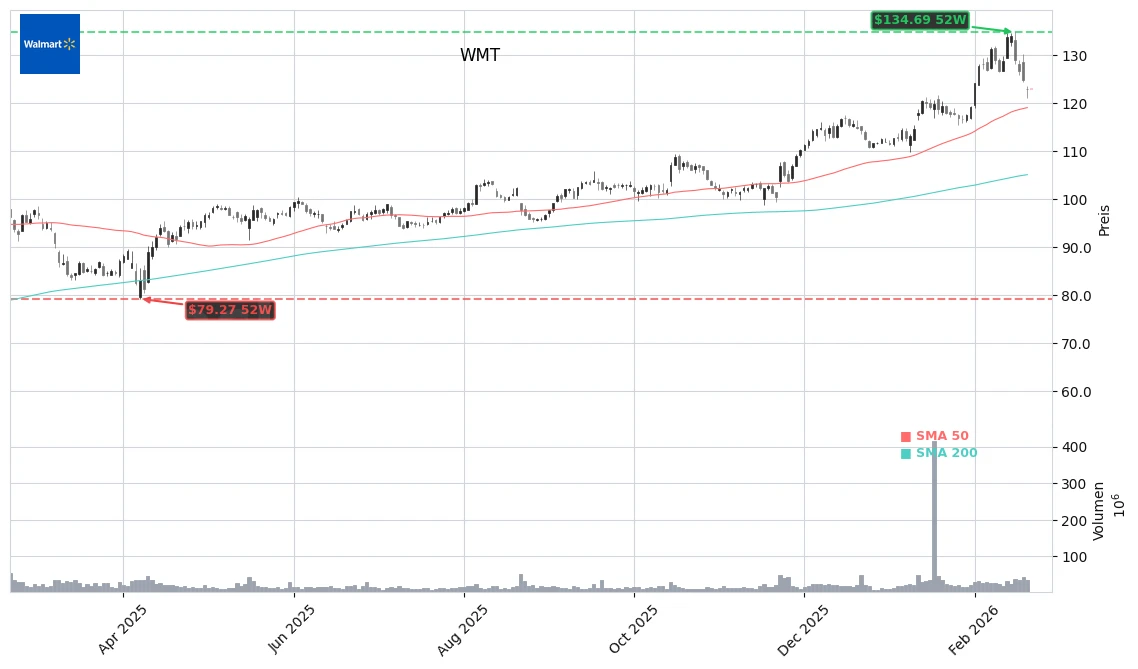
Initially, the stock market reacts poorly to Walmart’s quarter: shares of Walmart Inc. (WMT) close at $124.87, down 1.38% from the previous day. The stock is also slightly down in pre-market trading at $124.79. The trigger is less about operational performance and more about the cautious outlook from management. After a strong holiday season and record revenue of $713.2 billion in the past fiscal year, the company expects only a revenue increase of about 3.5% to 4.5% for the new year – Wall Street had anticipated closer to 5%.
Management remains defensive regarding profit as well. For fiscal year 2027, Walmart projects operational income growth of about 7%. Given a forward P/E ratio of around 44 to nearly 50, this forecast seems too conservative for many investors. Voices in the market are increasing that view the valuation as ambitious compared to highly profitable tech stocks like Nvidia.
How Strong is Walmart’s Operational Quarter Really?
Operationally, the latest Walmart quarter appears robust. Revenue in the U.S. rises by 5.6% to $190.7 billion, and same-store sales increase by 4.6%. E-commerce remains the growth engine: online sales in the U.S. are up in the high double digits, and the digital business is approaching the $100 billion annual revenue mark, with growth rates in the “high 20%” range.
Notably, margins and profits are growing faster than revenue. Automation and strict cost management allow operational income to increase by over 10% in the final quarter. At the same time, the company manages to keep tariff-related inflation under control. The like-for-like inflation across the entire basket of goods is just over 1%, with food prices even showing disinflationary to deflationary trends – particularly for eggs.
Demand is increasingly driven by higher-income households: a significant portion of spending in the fourth quarter comes from customers with annual incomes over $100,000. Nevertheless, Walmart maintains affordability as a core message and clearly positions itself on price and convenience.
How is Walmart Advancing its AI Initiative Quarter by Quarter?
The current Walmart quarter demonstrates how consistently the company is focusing on AI and technology. With the shopping platform “Sparky,” Walmart has integrated its own AI assistant into its app. About half of the app users are already utilizing it – and these customers spend approximately 35% more per order. Sparky provides contextualized, personalized search results and acts as a digital shopping advisor.
Simultaneously, Walmart is rapidly expanding its digital advertising business. Revenues from this segment are growing by over 40% and now stand at $6 to $7 billion. Despite this strong growth, it remains small compared to the hundreds of billions generated by digital advertising giants – indicating significant potential. AI is also being used to make in-store operations more efficient, such as with digital shelf labels that automatically adjust prices for up to 120,000 items.
Strategically, the company is leveraging its approximately 5,000 U.S. stores as distribution hubs. One-third of orders are already delivered in less than three hours, with 95% of the U.S. population able to be served within this timeframe. This merges Walmart’s physical presence and online commerce into an omnichannel model designed to compete with its arch-rival Amazon.
How are Analysts Responding to Walmart’s Valuation and Outlook?
While some market observers view the valuation level critically, major firms remain optimistic. Telsey Advisory Group reaffirms its “Buy” rating for Walmart Inc. and sets a price target of $135. Rothschild & Co Redburn goes even further, raising the price target to $150. Both cite the strong market position in grocery retail, the growing profitability in digital and advertising businesses, and the AI initiatives as the basis for an expected profit growth of around 14% annually until 2028.
KeyBanc also remains optimistic with an “Overweight” rating and adjusts its price target to $145. In contrast, some independent analysts caution: the combination of slowing revenue growth, only moderately rising profits, and a forward P/E significantly above historical averages suggests a hold position rather than new entries at current prices.
As a result, the picture remains ambivalent: fundamentally, Walmart delivers solid numbers quarter after quarter and makes rapid progress in transforming into a tech-driven retailer. At the same time, the valuation already reflects a lot of optimism – in an environment where weaker consumer sentiment, rising credit card defaults, and student loan delinquencies pose risks for 2026.
Walmart is now a tech company that just happens to sell eggs, fruit, and bananas.
— Walmart Management (Q4 Conference)
Bottom Line
The latest Walmart quarter underscores the operational strength, the growing importance of e-commerce and AI, and Walmart Inc.’s pricing power. For investors, the stock remains a quality asset, though its high valuation requires careful consideration. It will be crucial to see whether Walmart can exceed its conservative forecast and translate its AI initiative into sustainably higher profit growth – the upcoming quarters will be a significant test in this regard.
Related Sources
- Walmart Inc. on Yahoo Finance (Yahoo Finance)
- Retail Giant Beats Estimates Amid Tech-Driven Evolution (Zacks Investment Research)
- Walmart Q4: Too Expensive To Support Forward Operating Income Growth Expectations (Seeking Alpha)
- Telsey Advisory Maintains a Buy on Walmart Inc. (WMT) (Finviz)