
How can a more profitable Wayfair quarter beat expectations and still trigger a 13% stock crash?
How does the Wayfair quarter perform operationally?
Wayfair Inc. reports a net revenue of $3.34 billion for the fourth quarter of 2025, slightly above the expected $3.30 billion. This represents a growth of 6.9% compared to the previous year; adjusted for the exit from Germany, it would be even 7.8%. Particularly important for investors: the adjusted earnings per share reach $0.85, well above consensus estimates of around $0.64 to $0.66. Nevertheless, the company remains in the red overall, with a net loss of $116 million, impacted by one-time effects from stock-based compensation and debt management.
The Wayfair quarter confirms the strategic focus on profitability: adjusted EBITDA rises to $224 million, corresponding to a margin of 6.7%, more than doubling compared to the previous year. For the full year 2025, adjusted EBITDA grows by over 60% to $743 million. At the same time, annual revenue increases by 5.1% to $12.5 billion – the first increase since 2020. CEO Niraj Shah describes it as a “pivotal year” in which Wayfair has demonstrated both market share gains and profitability.
Why does Wayfair Inc.’s stock crash?
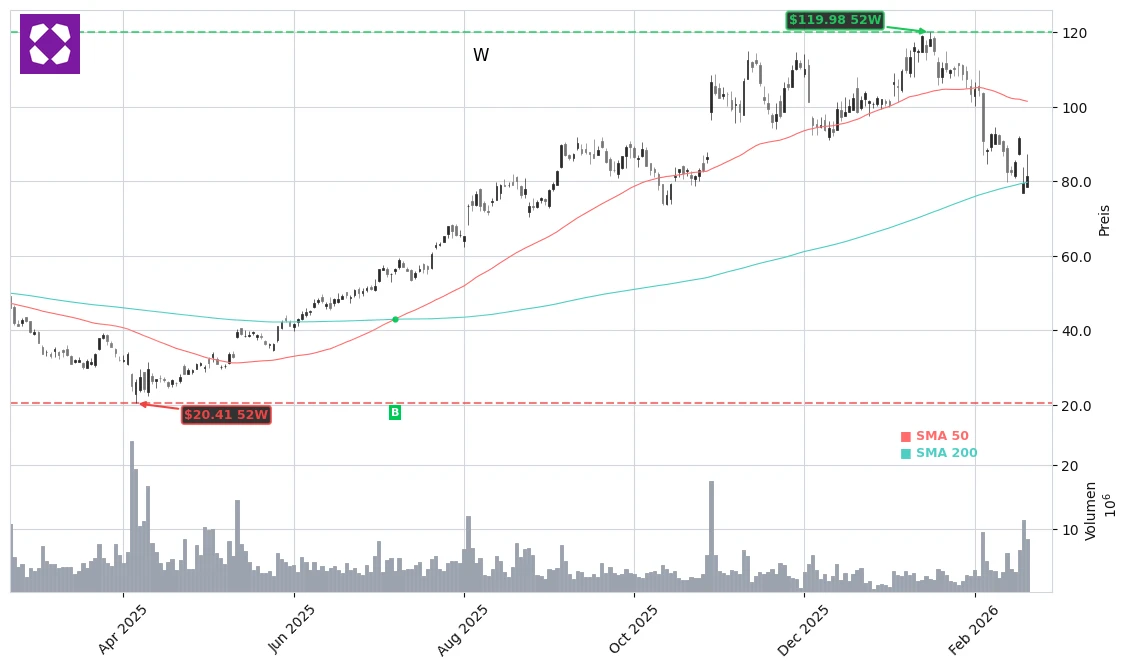
Despite the strong Wayfair quarter, the stock drops 13.02% on Thursday on Wall Street to $79.57, down from $91.48 the previous day. In after-hours trading, it continues to decline slightly to $79.43. This marks a four-month intraday low. The trigger is less about the reported figures and more about the perception that buyers expected even stronger growth. Analysts point out that the net revenue increase of 6.9% likely fell short of the high hopes of many investors, and the active customer numbers were slightly below expectations.
Additionally, there is some nervousness surrounding the margin outlook. Management signals that the gross margin may temporarily fall below the previously targeted range of 30% to 31% in the coming quarters to gain market share more quickly and expand loyalty programs. MarketWatch highlights that the stock is experiencing its weakest reaction to quarterly numbers in several years, as the unexpected net loss and planned investments in expansion and customer retention cloud short-term profit expectations. Proactive Investors also emphasizes market concerns about customer dynamics, even though the Wayfair quarter exceeded revenue and earnings forecasts.
How is Wayfair Inc. strategically positioned?
Operationally, Wayfair Inc. relies on several growth drivers that are already visible in the current Wayfair quarter. The company reports its third consecutive period of growth in new customers, while reorders continue to increase. The average order value rises to $301 from $290 the previous year; volume and prices are growing at a similar pace. In an overall declining furniture market – the category was down in the low single digits percentage-wise in the final quarter – this indicates market share gains.
Key levers include the loyalty program Wayfair Rewards, which now has over one million paying members, new services such as Wayfair Delivery Plus and Perigold Rewards, and the expansion of physical presence. Stores in Chicago, soon also large-format stores in Atlanta and Denver, as well as a smaller format in Columbus, aim to make the catalog breadth tangible and particularly increase spending per customer in frequently purchased categories like textiles and decor. The platform structure with supplier-held inventories reduces capital requirements. At the same time, Wayfair is heavily investing in AI: Shah sees the opportunity to improve quality, speed, and costs simultaneously – for example, through automated processes and personalized product recommendations, including an AI-based “Discover” tab in the app.
What is the balance sheet and outlook situation at Wayfair Inc.?
The balance sheet metrics from the Wayfair quarter appear robust. Free cash flow in the fourth quarter stands at $145 million, more than 40% above the previous year. Liquid assets total around $1.5 billion, with approximately $1.9 billion in total liquidity available, including credit lines. At the same time, net debt decreases significantly: the leverage falls from about four times EBITDA at the end of 2024 to below 2.5 times, after Wayfair repurchased over $100 million in 2027 convertible bonds, neutralizing more than five million potential shares of dilution.
For the current first quarter of 2026, management projects mid-single-digit percentage revenue growth – despite further industry weakness and pressures from harsh winter weather. The gross margin is expected to be at the lower end of the 30% to 31% range, with the contribution margin around 15%, while the adjusted EBITDA margin is anticipated to be between 4.5% and 5.5%. Zacks Investment Research positively highlights that Wayfair exceeded consensus estimates for both revenue and earnings per share, and marketing efficiency supports the margin. Barron’s simultaneously points to losses from early debt repayment that dampen reported earnings.
„2025 was a truly pivotal year in which we demonstrated both our market share gains and our profitability.”
— Niraj Shah, CEO of Wayfair Inc.
Bottom Line
The current Wayfair quarter combines strong operational metrics, significantly improved EBITDA, and solid cash flows – yet the double-digit stock plunge brings a sobering reality. For investors, it remains crucial whether investments in physical expansion, loyalty programs, and AI will only temporarily burden margins as planned and bring higher growth per customer in the medium term. If successful, the weak stock level following the Wayfair quarter could present an entry opportunity for long-term oriented investors.
Related Sources
- Wayfair Inc. (W) on Yahoo Finance (Yahoo Finance)
- Wayfair (W) Surpasses Q4 Earnings and Revenue Estimates (Zacks Investment Research)
- Wayfair Beats Earnings Estimates. Why the Stock Is Falling Sharply. (Barron’s)
- Wayfair earnings beat overshadowed by customer growth concerns (Proactive Investors)
- Wayfair Inc. (W) Q4 2025 Earnings Call Transcript (Seeking Alpha)