How can strong Workday Earnings look good on paper while the market still punishes the stock with a double-digit percentage drop?
Workday, Inc.: Why is the stock crashing despite good numbers?
The Workday Earnings for the fourth quarter initially appeared convincing: The adjusted earnings per share were $2.47, well above consensus estimates of around $2.32. Workday, Inc. also saw revenue growth, achieving approximately $2.53 billion, slightly above the expected $2.523 billion. Operationally, the core business with cloud-based HR and financial software continues to perform well.
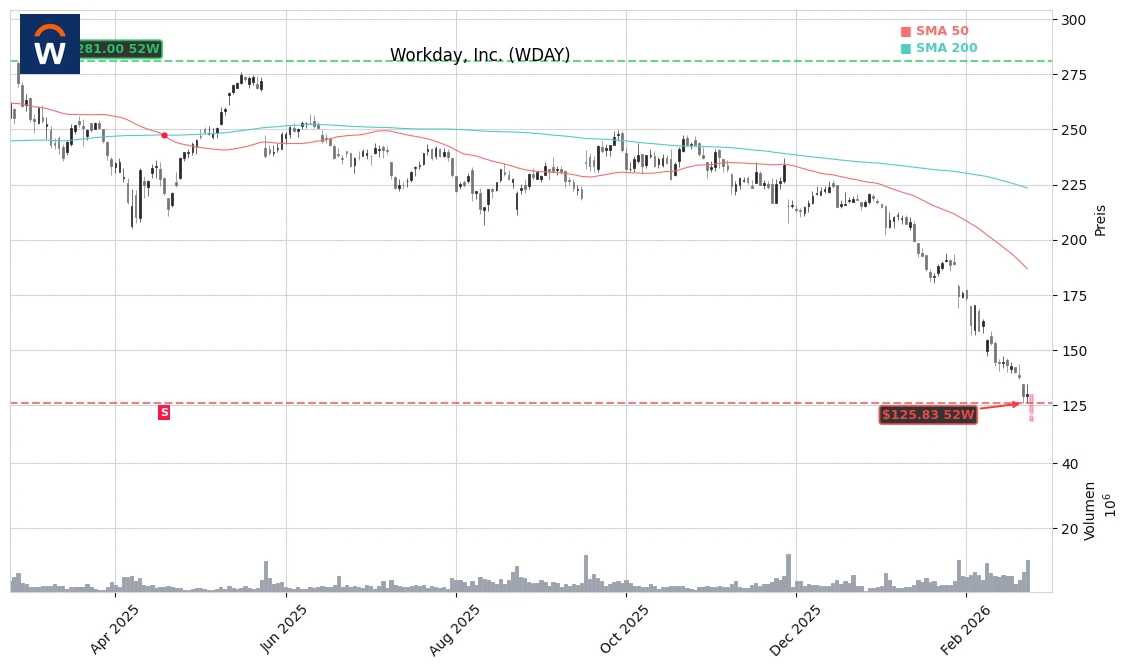
However, the market reacted negatively. The stock closed on Tuesday at $130.23, a daily increase of 0.79%. In pre-market trading today, the price has dropped to around $117.65—a decrease of nearly 10%. This continues a downward trend: In recent months, the stock has already lost about 40% of its value and is currently trading just above its 52-week low in Europe. The current sell-off indicates that the market is focusing less on the solid Workday Earnings in the rearview mirror and more on the dim outlook.
Workday Earnings: What is weighing so heavily on the outlook?
The crux of the issue is the forecast for the fiscal year 2027. Workday, Inc. is projecting subscription revenue growth of only 12% to 13%. This falls significantly short of the high growth rates of previous years and the more optimistic market expectations. Overall, Workday aims for revenue of $10.635 billion to $10.66 billion for the new fiscal year, while analysts were averaging closer to $10.72 billion.
Investors interpret this range as a sign that growth is noticeably slowing. The management cites a challenging macroeconomic environment, where many corporate clients are managing their IT budgets more tightly and delaying projects. However, the psychological component weighs even heavier: The market is questioning how resilient traditional enterprise software really is against AI agents and new competitors. This is where the skepticism arises, overshadowing the positive Workday Earnings.
Workday, Inc.: AI Opportunity or Existential Risk?
At the center of the debate is the role of artificial intelligence. On one hand, Workday, Inc. is investing heavily in AI capabilities, deeply integrating automation into its HR and recruiting workflows and pointing to clients like Anthropic, OpenAI, and Google, who utilize the platform. According to the company, billions of AI-powered actions are already processed through its systems annually, and initial AI products are expected to contribute hundreds of millions to recurring revenue.
On the other hand, investors fear AI-driven disruption: New, leaner software providers and specialized AI agents could attack parts of the traditional Workday portfolio and create pricing pressure. Investment banks like Morgan Stanley, Wells Fargo, and Jefferies have significantly lowered their price targets in recent weeks, although they do not uniformly recommend selling. For instance, JPMorgan Chase & Co. reduced its price target from $270 to $230 but maintained an “Overweight” rating—a signal that they still find the current valuation attractive despite the risks.
How are analysts reacting to the latest Workday Earnings?
The recent stock plunge intensifies an ongoing reevaluation in the software sector. Several firms had already rated Workday cautiously before the earnings report: Morgan Stanley lowered its price target from $280 to $200, Wells Fargo reduced it to $255, and Jefferies sees the stock as a hold with a target of $150. Evercore also downgraded the stock to “In-line,” noting that high AI investments could initially limit operational leverage.
Despite the cautious tone, some analysts point to positive aspects of the Workday Earnings. The company continues to meet the highly regarded Rule-of-40 metric of growth and margin, generates strong free cash flows, and is simultaneously building a growing AI revenue base. Thus, more optimistic voices argue that the current stock decline overstates concerns about AI disruption and could present long-term opportunities for risk-tolerant investors.
The market punishes Workday for its caution—now management must demonstrate that AI can truly close the growth gap.
— Editor in Chief
Bottom Line
For traders and investors, the situation remains ambivalent: In the short term, the outlook shock dominates price development; in the medium term, it will be crucial whether Workday successfully monetizes its AI products and proves that AI is more of a growth driver than a structural break in the business model.
Related Sources
- Workday, Inc. (WDAY) on Yahoo Finance (Yahoo Finance)
- Workday (WDAY) Beats Q4 Earnings and Revenue Estimates (Zacks Investment Research)
- Workday tumbles on dour revenue outlook amid AI threat (Reuters)
- Workday: Despite The Overblown Selloff, It Leans Toward Agentic AI (Seeking Alpha)