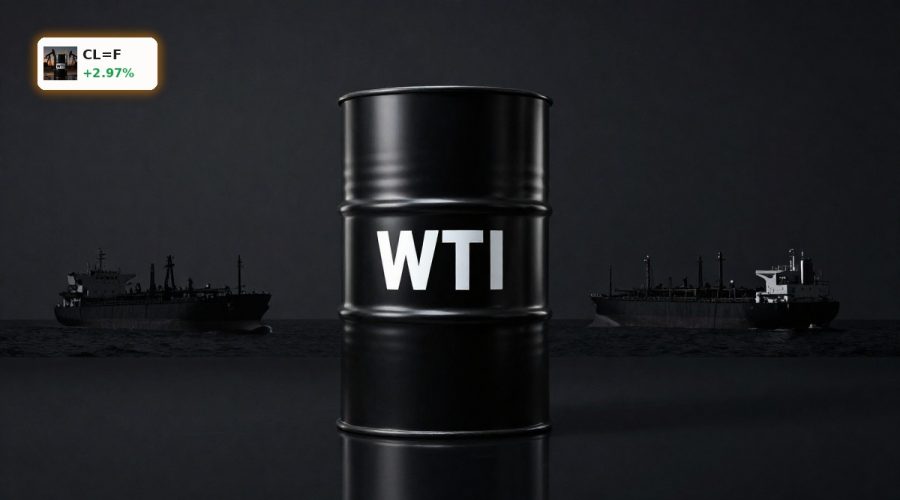
Is the WTI Oil Crisis about to turn a sharp price spike into a full-blown $200-per-barrel shock for global markets?

How tight is oil in the WTI Oil Crisis?
Front‑month **WTI Crude Oil** futures hover just below the psychologically crucial $100 mark, extending an advance of roughly 80% since December. Today’s 2.97% gain to $97.29 follows renewed reports that traffic through the Strait of Hormuz has collapsed by about 96%, with Iran demanding up to $2 million per ship for “safe” passage. Physical barrels in the Persian Gulf and Asia are trading at even higher premia than NYMEX futures, underscoring how acute the disruption has become.
Energy strategists at S&P Global have warned that if the Hormuz shutdown persists for another month, benchmark crude could briefly spike into the $200–$250 range as lost supply reaches hundreds of millions of barrels. Macquarie has floated a similar $200 scenario by June should the conflict escalate and shipping fail to normalize. At the same time, Dallas Fed survey data show U.S. executives still expecting longer‑term prices around the mid‑$70s, assuming the WTI Oil Crisis is ultimately contained.
What does this mean for Exxon Mobil and Chevron?
Major producers such as Exxon Mobil and Chevron are clear beneficiaries of higher realized prices, and energy remains one of the few S&P 500 sectors firmly positive since the Ukraine war began. Defensive oil‑stock strategies highlighted by Seeking Alpha emphasize integrated majors and select E&Ps as short‑term hedges against geopolitical turmoil and recession fears. U.S. shale output growth also underpins the consensus view from many analysts that prices can eventually drift back toward the $70s once Hormuz flows normalize.
Yet the WTI Oil Crisis is already bleeding into the broader market. Historically, moves above $90–$100 per barrel pressure consumer sentiment, airline earnings and high‑beta tech names like Tesla and NVIDIA, while boosting cash flows for refiners and pipeline operators. With SPX futures softer this week, Zacks notes that surging crude is one of several headwinds for risk assets in an otherwise quiet macro calendar.
How fragile is sentiment in the WTI Oil Crisis?
Price action around CL=F has become highly headline‑driven, with intraday swings of $4–$5 on social‑media remarks and shifting timelines for potential U.S. or Israeli strikes on Iranian energy infrastructure. War‑risk insurance premia for Gulf shipping are up nearly tenfold, and the U.S. is discussing a $20 billion backstop program to coax tankers back into the narrow, vulnerable strait. Any sign of a cease‑fire, new escort missions or partial reopening of lanes could trigger a sharp pullback toward the $70–$80 range flagged by several Wall Street houses.
For now, however, traders are positioning for continued volatility. Short‑dated calls on WTI and energy ETFs are in high demand, while some macro funds are tactically shorting rate‑sensitive growth stocks such as Apple against long crude exposure. Technical analysts point out that WTI has repeatedly stalled just under $100; a clean breakout above that level could be read as the market validating the most aggressive WTI Oil Crisis scenarios.
Related Coverage
Investors looking for a deeper dive into recent price swings can review earlier analysis in “WTI Oil Crisis Shock: $8 Plunge After Hormuz Blockade Hits Supply”, which examined whether the late‑March selloff was a lasting regime change or just another whipsaw in a news‑driven energy tape. That piece also explored how institutional portfolios were using oil options and energy equities to hedge geopolitical tail risks as the Hormuz situation first escalated.
The WTI Oil Crisis has pushed crude close to triple digits, forced Wall Street to game out a tail‑risk path to $200, and revived energy as a core portfolio hedge. For U.S. investors, the key question now is whether diplomatic progress or expanded U.S. supply can cap the rally before it morphs into a full‑blown inflation shock. The next few weeks of headlines out of Hormuz will likely determine whether this WTI Oil Crisis remains a tradable spike or evolves into a longer‑lasting structural regime for global energy markets.