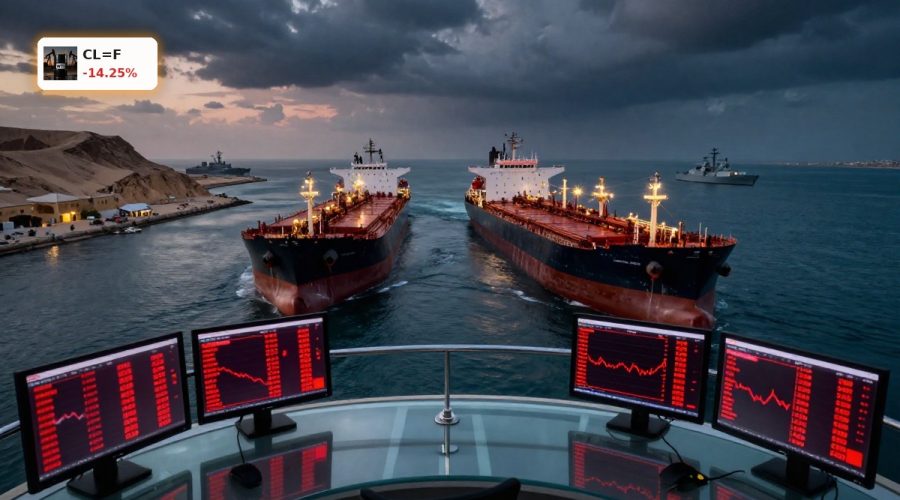
Is the WTI Oil Crisis already over just as traders had fully priced in a prolonged supply shock from the Iran conflict?

How did the WTI Oil Crisis unfold so fast?
The WTI Oil Crisis escalated over recent weeks as the conflict with Iran and the closure of the Strait of Hormuz ripped more than 15 million barrels per day from global seaborne supply. That bottleneck pushed WTI Crude Oil steadily above $110 and toward about $115–117 per barrel, levels not far from the highest range seen in the past decade. Traders aggressively priced in a prolonged disruption, with U.S. barrels suddenly becoming the key marginal supply for refiners in Europe and Asia.
Intraday, front‑month WTI spiked above $117 as headlines pointed to escalation, while short‑dated volatility surged and the futures curve moved into extreme backwardation. Near‑term contracts for delivery within days traded around $114–115, while contracts further out in the year slumped into the mid‑$70s, signaling that the market expected the WTI Oil Crisis to be sharp but temporary. Energy strategists repeatedly flagged the $110–$120 zone as the band where demand destruction typically starts, referencing the 2008 and 2022 episodes when expensive crude quickly choked off consumption.
Why did prices suddenly collapse on truce headlines?
The narrative flipped when Washington and Tehran signaled a two‑week ceasefire framework tied to the full reopening of the Strait of Hormuz. That announcement triggered a violent unwind across the oil complex. The front‑month CLK6 contract, which had traded above $117 earlier in the session, plunged below $93 at one point, while the next‑month CLM6 dropped toward $84. By late afternoon ET, WTI settled near $96.86, still down about 14.25% versus the prior close of $115.60.
This reversal compressed the volatility term structure: options markets, which had been heavily skewed toward upside calls and protection against further spikes, saw implied volatility fall sharply. Futures traders who had piled into long positions on fears of a drawn‑out WTI Oil Crisis rushed to liquidate, amplifying the move lower. Even as the physical market remains tight in the very short run—cargoes and storage logistics cannot normalize overnight—the forward curve is now telling investors that the worst‑case scenario has been taken off the table for the moment.
What does this mean for Exxon Mobil and Chevron?
Integrated majors like Exxon Mobil and Chevron had been among the biggest winners during the spike phase. With WTI near $115 and refining margins elevated, their upstream businesses enjoyed windfall cash flows, while downstream operations benefited from robust crack spreads. U.S. refiners such as Valero rode the rally as product prices from gasoline to jet fuel surged 40–50% in just a few weeks, a key headwind for airlines and logistics operators.
The sudden drop toward the high‑$90s does not erase those earnings tailwinds but trims the upside. At current levels, WTI is still well above most U.S. shale break‑evens, often cited around $40 per barrel, and even above the $60–$80 “comfort zone” many industry executives view as sufficient to justify new exploration and production. The bigger shift is in expectations: equity investors who bid up energy names as a pure play on the WTI Oil Crisis now have to factor in the risk that this turns into a short, sharp shock rather than a multi‑quarter supercycle.
For diversified portfolios with exposure to broad benchmarks like the S&P 500 and NASDAQ, the easing of crude removes one of the main arguments for further inflation surprises and delayed Fed cuts. Historically, stock indices have traded with a negative correlation to oil during supply shocks, and the first reaction to today’s selloff in crude was a modest bid in growth and rate‑sensitive names such as NVIDIA and Apple.
How are inflation trades and ETFs reacting?
The collapse in WTI from above $115 to under $100 is already reverberating across inflation‑sensitive assets. Commodity‑heavy and inflation‑hedge ETFs that had benefited from the run‑up in crude are seeing profit‑taking. Strategists at Zacks Investment Research recently argued that inflation risks would likely persist as long as oil stayed elevated and volatility remained high, steering investors toward commodity and quality‑factor ETFs. The latest price action complicates that view: while the absolute level of crude is still high by pre‑war standards, the direction of travel now eases pressure on central banks and on real incomes for U.S. households.
Retail enthusiasm in energy equities has also been visible in smaller producers such as W&T Offshore, whose stock (WTI) has swung sharply in recent days amid sector‑wide turbulence. Coverage from MarketBeat and others highlights how names like W&T Offshore remain highly sensitive to both spot price moves and shifting sentiment, with analysts adjusting revenue forecasts and price targets as the WTI Oil Crisis evolves.
WTI Oil Crisis: what should U.S. investors watch next?
For Wall Street, the core question is whether the WTI Oil Crisis fades into a short‑term dislocation or resurfaces if the ceasefire breaks down. The futures curve still prices a meaningful risk premium in near‑term barrels, but the steep backwardation into the $70s later this year suggests that traders expect U.S. shale and OPEC+ supply to rebalance the market once Hormuz flows normalize. Portfolio managers are watching positioning data for signs that speculative longs have been flushed out, which could reduce the odds of additional forced selling.
Long‑only investors in energy equities are now weighing whether the recent pullback is a buying opportunity or an early warning that earnings expectations will need to reset lower. Meanwhile, high‑beta tech names like Tesla and NVIDIA may benefit if lower fuel costs and receding inflation fears reignite appetite for growth. Multi‑asset allocators are also revisiting their commodity hedges, as the case for outsized exposure to WTI Crude Oil looks less compelling if the geopolitical premium continues to deflate.
Related Coverage
For a deeper dive into how this volatility pattern developed, including the earlier $8 intraday plunge after the first Hormuz blockade headlines, readers can review “WTI Oil Crisis Shock: $8 Plunge After Hormuz Blockade Hits Supply”. That analysis explores whether the WTI Oil Crisis is a lasting supply shock or just another brutal whipsaw in an overheated energy market, and complements today’s focus on the ceasefire‑driven reversal.
The WTI Oil Crisis has shifted in hours from an inflationary oil shock to a deflation of geopolitical risk premium, with WTI falling from above $115 to the high‑$90s and volatility compressing across the curve. For U.S. investors, the move eases pressure on consumer spending and rate expectations but also trims the windfall for energy producers that had thrived on triple‑digit crude. The next key catalysts will be whether the Hormuz reopening holds and how quickly physical flows normalize, which will determine if this week’s plunge marks the end of the crisis phase or just another chapter in a highly unstable oil market.