Can the latest CrowdStrike AI Integration with Claude Opus 4.7 really extend Falcon’s lead, or are rivals closing the gap faster?

How could CrowdStrike AI Integration move the stock?
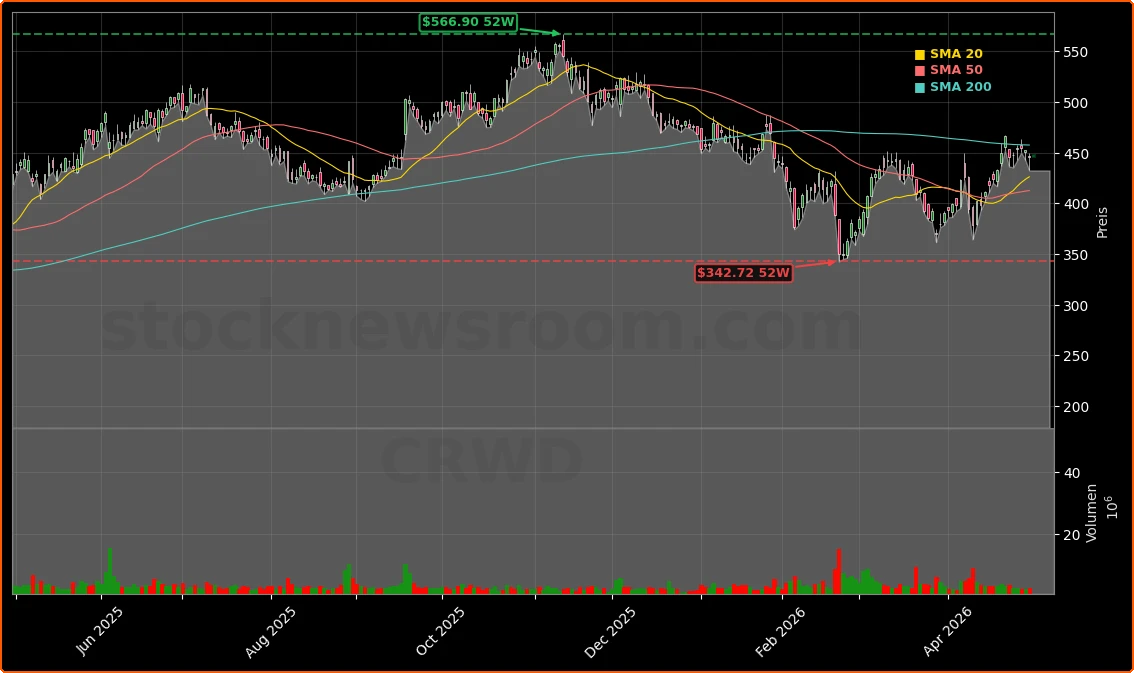
The new CrowdStrike AI Integration comes as Wall Street continues to reward AI-focused security names with premium valuations versus the broader S&P 500. At a market capitalization above $110 billion, CRWD already trades at a richer price-to-sales multiple than many cybersecurity peers, reflecting expectations that AI-enhanced modules will unlock additional cross‑sell and upsell opportunities. Management has highlighted a long runway, with the total addressable market projected to expand from about $149 billion in 2026 to $325 billion by 2030 as enterprises harden cloud, endpoint, identity, and data defenses.
Over the past five years, CRWD has delivered compound annual returns north of 17%, meaning a $100 position would be worth roughly $213 today. That track record underscores how consistent subscription growth and increasing module adoption inside large customers can translate into substantial shareholder value. The question now is whether embracing frontier models like Opus 4.7 can sustain that momentum in a more competitive AI security landscape that also includes established players such as Palo Alto Networks and emerging AI-native platforms from firms like NVIDIA.
What exactly is CrowdStrike adding with Claude Opus 4.7?
The company is weaving Claude Opus 4.7 into its multi‑AI architecture, which blends proprietary and third‑party models to power the Falcon platform. The focus of this CrowdStrike AI Integration is on accelerating how quickly vulnerabilities are discovered, prioritized, and remediated at scale. Falcon Exposure Management will use frontier AI to add a deeper layer of vulnerability detection, routing findings into an adversary‑driven risk scoring system that gives security teams a closed loop from discovery to fix.
In security operations, CrowdStrike will expose Opus 4.7 through its Charlotte Agentic SOAR product, bringing more advanced reasoning into incident response playbooks and automated workflows. At the same time, Charlotte AI AgentWorks will allow enterprises to build their own security agents that tap into frontier AI while staying inside Falcon’s governance framework. For large organizations that already rely heavily on Falcon, this architecture promises to keep sensitive telemetry within a single, cloud‑native platform rather than scattering AI experimentation across disconnected tools.
How does this fit into CrowdStrike’s Project QuiltWorks?
The latest rollout is also a showcase for Project QuiltWorks, CrowdStrike’s coalition aimed at helping enterprises adopt AI securely. QuiltWorks packages assessment, adversary‑informed prioritization, guided remediation, continuous protection, and board‑level reporting into a repeatable program delivered through a network of more than 10,000 certified security professionals. By embedding the new Claude capabilities inside this program, CrowdStrike is trying to turn abstract frontier AI potential into measurable reductions in breach risk and response times.
Customer comments highlight the strategic importance of the Falcon platform in broader AI adoption. UKG’s chief security officer called CrowdStrike a key partner in making sure the company is “ready for Anthropic’s latest model releases,” and stressed the need to balance agentic innovation with control and safety. That emphasis on governance may resonate with US‑listed enterprises across sectors, from cloud hyperscalers and fintechs to industrials and consumer names like Apple, all of which are racing to roll out AI without increasing their attack surface.
How does CrowdStrike stack up to US cybersecurity rivals?
Against peers, CrowdStrike’s growth profile remains strong but not unchallenged. Palo Alto Networks has reported next‑generation security annual recurring revenue of $6.3 billion, surpassing CrowdStrike’s roughly $5.3 billion ARR and growing faster on a percentage basis. Some portfolio managers argue that this gap makes Palo Alto’s valuation more compelling on a price‑to‑sales basis, even after CrowdStrike’s powerful multiyear run on Nasdaq. Others counter that CrowdStrike’s earlier and deeper investment in AI‑first telemetry and its single lightweight‑agent design justify the premium.
Within the AI ecosystem, CrowdStrike also sits alongside infrastructure leaders such as NVIDIA, while application‑layer innovators like Tesla in autonomous driving and big‑cap tech platforms continue to push AI adoption higher. For US investors, this means CRWD offers a way to play AI not through chips or consumer apps, but through the security layer that must exist around every AI deployment. As more boardrooms view AI security as mission‑critical, CrowdStrike’s ability to monetize additional Falcon modules and AI‑driven services will remain central to the equity story.
What are analysts and investors watching next?
On Wall Street, attention is likely to stay on how fast CrowdStrike can convert its AI roadmap into revenue and margin expansion. While specific fresh targets from banks like Goldman Sachs, Morgan Stanley, Citigroup or RBC Capital were not highlighted in today’s announcement, the stock’s rich premium implies that many analysts already model sustained high‑teens to 20%+ annual growth over the coming years. Any signs of acceleration in module adoption, or evidence that the new Claude‑powered capabilities are driving higher net retention, could support further upside.
Investors will also monitor competitive dynamics as Palo Alto Networks, Zscaler, and others sharpen their own AI stories. CrowdStrike has stressed that “frontier labs choose CrowdStrike” because it has the platform, data, and threat intelligence to operationalize new models quickly for customers. If that narrative holds, the latest CrowdStrike AI Integration could help defend share and sustain its status as a premier AI cybersecurity leader on Wall Street.
Related Coverage
Investors looking for additional context on the stock’s recent volatility and AI narrative can review the analysis in CrowdStrike Strategy +5.2% Rally: AI Security Boom Ahead, which examines whether the company’s expanding AI security push is enough to justify its latest price surge. That piece discusses valuation risks and strategic upside in more detail, complementing today’s focus on the fresh Claude Opus 4.7 rollout.
AI is creating the largest security demand driver since enterprises moved to the cloud.— Daniel Bernard, Chief Business Officer, CrowdStrike
Overall, the latest CrowdStrike AI Integration shows how the company is pushing deeper into frontier AI to enhance its Falcon platform and Project QuiltWorks ecosystem. For US and global investors, the move reinforces CrowdStrike’s positioning as an AI‑first cybersecurity leader leveraged to the broader enterprise shift into intelligent automation. The next few quarters will reveal whether this technology edge translates into faster ARR growth and sustained stock outperformance, keeping CRWD on the radar of long‑term AI and cybersecurity portfolios.