Will the Tesla Cybercab robotaxi gamble finally turn Tesla’s bold autonomy promises into hard cash for long-term investors?

Is Tesla’s robotaxi pivot changing the TSLA story?
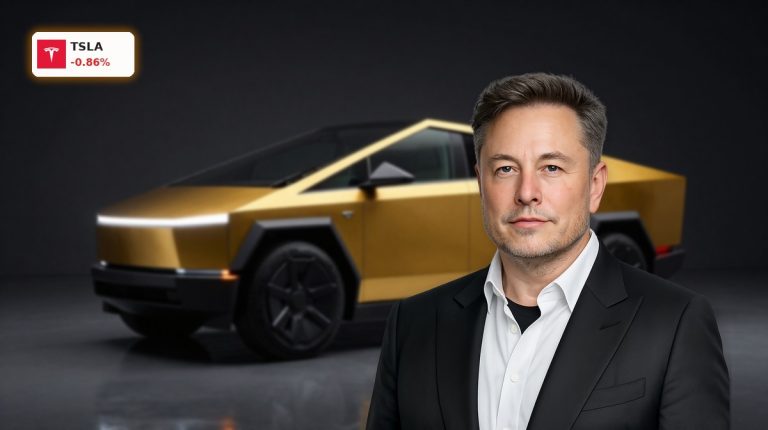
Tesla, Inc. has entered a new phase as the first series-produced Tesla Cybercab rolled out of the Gigafactory Texas, a crucial milestone for Musk’s autonomous ride-hailing vision. Images circulating among industry watchers show a glossy gold, two-seat robotaxi, a visual departure from the matte test mules seen over the past year. Despite the hardware breakthrough, Musk has been tempering expectations, warning that volumes will ramp “extremely slowly” at first as the company scales a new product on a new supply chain.
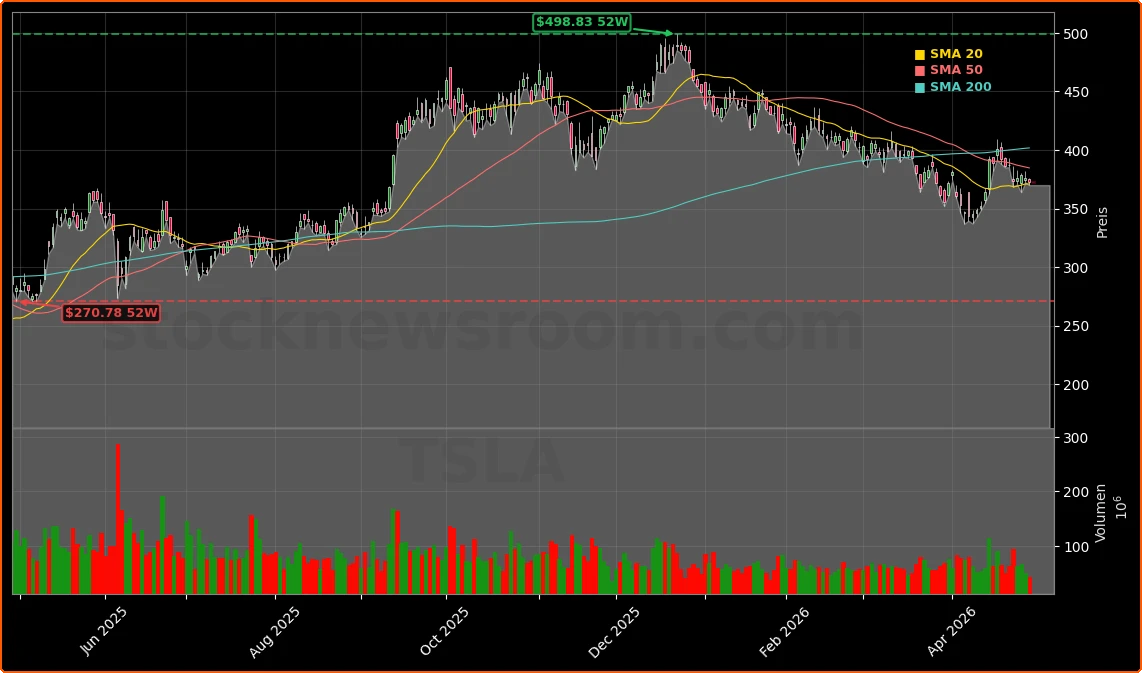
The financial impact will take time. Management does not expect meaningful revenue from the Tesla Cybercab before 2027, even as it pours billions into capacity, AI chips and a new assembly method. That lag helps explain why TSLA has slipped about 0.9% on the day and is down in the mid-teens percentage range year to date, even after a solid Q1 2026 earnings beat. For now, the stock still trades on promise more than profits.
How is Tesla handling regulation and safety?
A key question has been how a vehicle with no steering wheel and no pedals can be cleared for U.S. streets. Instead of pursuing a narrow exemption, Tesla, Inc. is self-certifying the Tesla Cybercab to existing U.S. safety standards, just as it does with its other models. A compliance label is already visible on at least one production vehicle, in theory allowing unlimited production volumes once manufacturing is ready.
The bottleneck now shifts from hardware to software. Musk has reiterated that unsupervised autonomous driving – the true robotaxi capability – is expected to reach customers around the fourth quarter. That timeline is critical, because today’s Full Self-Driving (Supervised) system, though impressive, still requires human oversight. The company has already logged more than 8.6 billion miles on FSD (Supervised), far surpassing rival efforts at companies like General Motors’ Cruise and Alphabet’s Waymo, but regulators will scrutinize any move to fully driverless operation.
Where does Tesla’s ride-hailing rollout stand?
While waiting for the Tesla Cybercab to scale, Tesla, Inc. is quietly expanding its own ride service in select U.S. cities. A pilot network using modified Model Y vehicles is already operating in parts of Texas, with rollout to cities such as Miami, Orlando and Las Vegas planned for the first half of the year. The Cybercab is designed to slot into this network over time, eventually replacing much of the retrofitted fleet.
One of the Cybercab’s core economic advantages is its simplified design. The vehicle reportedly uses about 50% fewer parts than a Model 3, a dramatic reduction that could push unit costs down once volumes rise. Combined with a dedicated robotaxi layout, this could make per-mile economics highly attractive versus human-driven ride-hailing through Uber Technologies or Lyft. For investors, the question is whether utilization rates and regulatory approvals will materialize fast enough to justify today’s lofty forward valuation multiples.
How do earnings and capex frame the valuation?
Q1 2026 results underscored the tension in the TSLA story. Revenue rose 16% year over year to $22.39 billion, while non-GAAP EPS of $0.41 topped estimates and operating income surged 136% to $941 million. Free cash flow jumped 117% to $1.44 billion, and automotive gross margin widened to 21% from 16% a year earlier. Services revenue, including software, climbed 42% to $3.75 billion, supported by 1.28 million active FSD subscriptions, up 51% year over year.
Yet the company plans more than $25 billion of capital expenditures in 2026, funding the Tesla Cybercab program, the Semi truck, Megapack 3 energy storage, the AI5 chip and an Optimus humanoid robot line that Musk says could ultimately produce 10 million units per year. CFO Vaibhav Taneja has already signaled that free cash flow will likely turn negative as these investments ramp. That spending profile has rattled some on Wall Street, even as others argue it lays the groundwork for a high-margin software and services future.
What are analysts and peers signaling?
On traditional metrics, TSLA still looks expensive: a trailing P/E near 345, a forward P/E around 182 and an EV/EBITDA above 100 make it hard to compare with legacy automakers. But bullish analysts at houses such as Morgan Stanley and Goldman Sachs have framed the stock as a leveraged play on AI, autonomy and energy, with upside if robotaxis scale. More cautious firms like JPMorgan have highlighted the risks of a $25 billion capex plan tied to largely unproven businesses.
In the broader “Magnificent Seven” context alongside NVIDIA (NVDA) and Apple (AAPL), Tesla, Inc. remains a key driver of the S&P 500’s tech-heavy narrative. However, Chinese EV competitors such as Nio are pressing on price, and Detroit incumbents are touting their own autonomous ambitions. General Motors, for instance, has emphasized its goal of commercializing driverless technology at scale, even as its own robotaxi efforts have faced setbacks. The Tesla Cybercab therefore not only needs to work; it needs to scale faster, cheaper and safer than the competition.
Related Coverage
Investors looking for a deeper dive into the broader robotaxi opportunity can read “Tesla Robotaxi Boom: Is Autonomous Driving Near a Tipping Point?”, which explores whether Musk’s autonomous strategy can unlock a new profit engine or remains an overhyped promise. That analysis puts the Tesla Cybercab milestone into context by comparing Tesla’s software-first approach with other autonomous driving programs and highlighting key risks around regulation and capital intensity.
The emergence of the Tesla Cybercab as a production reality marks a turning point in how Tesla, Inc. is perceived – less as a pure EV manufacturer and more as an AI-enabled mobility platform. For investors, the stock’s premium valuation will only be sustainable if this robotaxi strategy, including the Tesla Cybercab fleet, translates into high-margin, recurring revenue over the next several years. The next catalysts will be software approvals, production ramp updates from Texas and the pace of ride-hailing expansion, which together will determine whether today’s volatility becomes an entry opportunity or a warning sign.