Are Tesla’s ambitious AI and robotaxi promises enough to outweigh weak deliveries, rising FSD lawsuits and a $20 billion capex bill?

How fragile is Tesla’s setup into Q1 earnings?
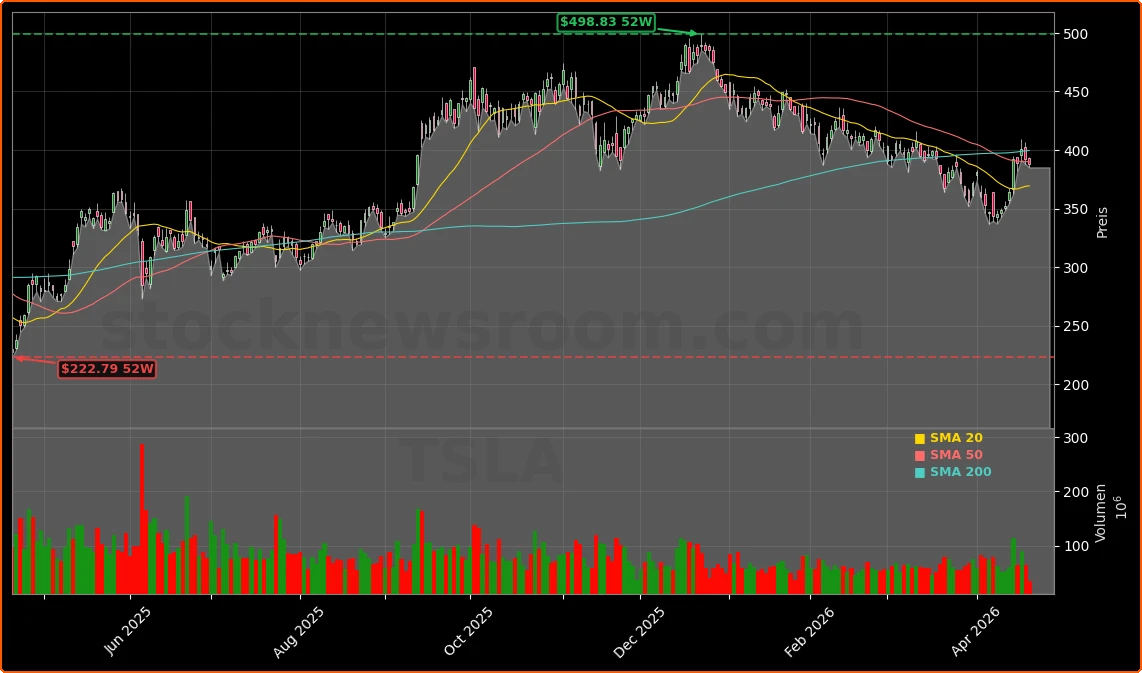
Tesla, Inc. heads into its Q1 2026 report after a choppy quarter for the stock and for global EV demand. The shares, part of the “Magnificent Seven” cohort in the S&P 500 and Nasdaq 100, are up sharply over 12 months but still in a consolidation well below their all‑time high. Consensus for these Tesla Earnings sits near $22.3 billion in revenue and $0.36 in adjusted EPS, implying mid‑teens top‑line growth and more than 30% earnings growth versus a year ago, even as free cash flow is projected to be negative on the back of roughly $20 billion in annual capital spending.
Deliveries remain a key concern: Q1 2026 volumes declined about 14% year over year and missed expectations, with roughly 358,000 vehicles delivered against about 408,000 produced. That 50,000‑unit inventory build is fueling fears that price cuts are losing effectiveness just as competition from Chinese EV makers intensifies and U.S. demand cools. Reuters reports that Tesla’s registrations in California, its most important U.S. EV market, fell more than 24% in Q1, underscoring that weakness.
What are analysts watching in these Tesla Earnings?
For Wall Street, margins and the autonomy roadmap will likely matter more than the precise Q1 line items. After a stronger Q4 2025, analysts expect automotive gross margin to compress again, partly because Tesla shifted Full Self‑Driving from a high‑upfront purchase to a $99 monthly subscription. That move smooths revenue but reduces near‑term profitability. Stifel analyst Stephen Giangaro still rates the stock a Buy with a $508 price target, arguing that most of the valuation comes from FSD and the envisioned robotaxi network rather than the core car business.
By contrast, Jefferies analyst Philippe Houchois, who raised his price target from $300 to $350 but kept a Hold rating, warns of a widening gap between “vision and execution.” At roughly 185 times forward earnings, the stock is priced for successful scaling of AI‑driven services – from driverless ride‑hailing to humanoid robots – not for a cyclical, margin‑pressured automaker. The Q1 call will need to convince skeptical institutional investors that robotaxi expansion this year and progress toward dozens of cities by 2026 remain credible.
Do FSD lawsuits threaten the autonomy narrative?
Legal risks are rising just as Tesla leans harder into its autonomy story. In California, a class‑action suit led by long‑time owner Tom LoSavio accuses Tesla and Elon Musk of overpromising on Full Self‑Driving capabilities since 2016. The case covers thousands of buyers who paid thousands of dollars for hardware and software that, they argue, have never delivered true self‑driving as marketed. Similar efforts are emerging in Australia, and European owners are organizing after some regulators limited FSD access to vehicles with the latest hardware.
The dispute centers on multiple hardware generations: owners upgraded to “Hardware 3” found themselves out of date again when “Hardware 4” rolled out, while the newest FSD updates increasingly require the latest cameras and computers. On earlier calls, Musk conceded that Tesla will “have to upgrade the computer” for lifetime FSD buyers – a potentially costly promise. For now, most analysts see the lawsuits as a headline and reputational risk rather than a near‑term solvency threat, but they add another layer of uncertainty around what premium, if any, investors should assign to FSD revenue in their models.
Can robotaxis and Optimus offset EV headwinds?
The bull case into these Tesla Earnings rests on AI and robotics. Tesla has quietly begun operating a small‑scale robotaxi service in Austin, Texas, with vehicles running without safety drivers but closely monitored. Media reports from an earlier launch in Texas cities described long waits and limited service areas – more of a soft‑launch than a commercial rollout. Musk has also pointed to a Cybercab concept with no steering wheel or pedals and an aggressive production ramp for Optimus humanoid robots at the Fremont facility after premium Model S and X are sunset.
At the same time, Tesla is testing new revenue streams from its energy ecosystem. Utilities such as PG&E in California have approved the Cybertruck and Tesla Powershare equipment for a pioneering vehicle‑to‑everything pilot, allowing households to power homes during outages and sell electricity back to the grid. That positions Tesla alongside players like NVIDIA and Apple in the broader energy‑plus‑AI hardware trend that U.S. investors increasingly track across the S&P 500.
How does competition and China strategy figure in?
While Tesla is still a major global EV player, it no longer dominates as it once did. BYD has taken the global EV sales crown, and Chinese rivals such as XPeng are aggressively pushing smart EVs with advanced driver assistance to challenge Tesla’s tech edge. In China, Tesla is defending share in a fierce price war while also deepening its AI footprint. Reuters notes that Tesla has registered an AI‑driven voice assistant with regulators in Shanghai, one of 158 AI functions approved under China’s evolving rules. Integration of local digital features is critical if Musk wants to hold ground in the world’s largest EV market.
Brand perception is a softer but real risk. In the U.S. and Europe, some consumers have turned away from Tesla over Musk’s polarizing public persona, complicating efforts to build a trusted robotaxi brand that must compete not only with Uber and Lyft but also with comfortable, familiar auto marques. For now, Wall Street models still assume Tesla will overcome that friction – but a prolonged slide in demand could force heavier reliance on discounts and erode the high‑margin autonomy narrative that underpins today’s valuation.
Related Coverage
For a deeper dive into how the FSD controversy could collide with this week’s numbers, see our analysis on whether the Tesla FSD dispute could turn a fragile Q1 earnings setup into a legal and regulatory storm. That piece explores in more detail how dissatisfied early adopters, regulatory scrutiny and hardware upgrade promises may reshape investor expectations for autonomy‑driven profits.
We’ll have to upgrade the computer for customers who bought the lifetime Full Self-Driving package. That is the honest answer and that’s going to be painful and difficult. But we’ll get it done.— Elon Musk, CEO of Tesla, Inc.
In sum, these Tesla Earnings are less about Q1’s exact margin and more about whether Musk can reassure markets that FSD, robotaxis and Optimus justify a premium multiple despite slowing EV demand and mounting legal noise. For U.S. investors, Tesla remains a high‑beta way to express a view on AI‑enabled mobility and robotics within the S&P 500 and Nasdaq. The next few quarters will show whether the company can close the gap between ambitious vision and commercial execution – and whether today’s price still makes sense for long‑term portfolios.