Can the revamped Salesforce AI Strategy turn a bruised cloud giant into a true AI leader just as Wall Street re‑engages?

Is Salesforce regaining momentum on Wall Street?
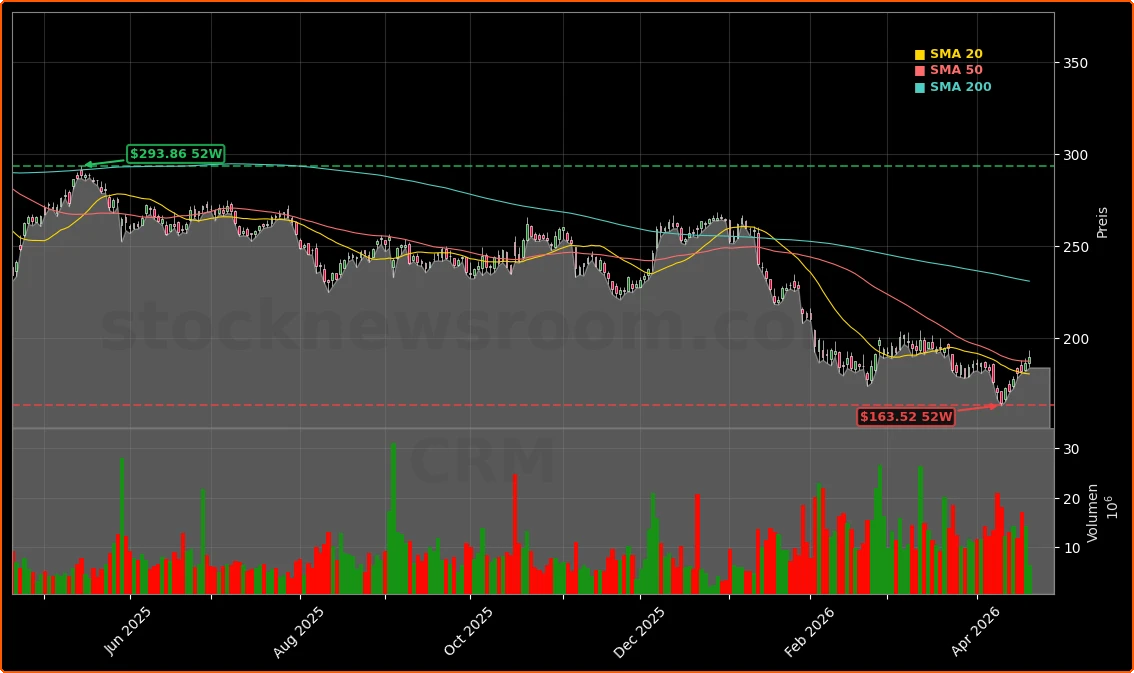
Salesforce Inc. shares climbed 1.76% to $189.56 on Tuesday in afternoon trading, extending a multi‑day rebound that has outpaced a weak broader market. The move follows several AI‑heavy product announcements and comes after the stock nearly halved from around $360 to the mid‑$180s, dragging the valuation down to roughly 23x earnings versus 30x+ at its peak. Technically, chart watchers highlight a long‑term uptrend line dating back to 2016 that has been successfully defended multiple times, with the $165–$170 zone acting as a key support area. As long as the price holds above that trend, the medium‑term bull case remains intact, with $200 cited as the next major resistance level to clear.
On the index level, Salesforce is again one of the stronger names in the Dow Jones Industrial Average, helping lift the blue‑chip benchmark alongside UnitedHealth. Monday already saw CRM up more than 2% on a broadly negative day for the S&P 500 and NASDAQ, signaling that investors are selectively bidding up software names tied to credible AI roadmaps. For portfolio managers underweight enterprise software after this year’s drawdown, the question is less about short‑term momentum and more about whether the evolving Salesforce AI Strategy can drive durable, AI‑priced growth.
What is changing in the Salesforce AI Strategy?
The strategic pivot centers on a deep technical overhaul that moves the platform to an agent‑first architecture. Salesforce recently completed a major redesign dubbed Headless 360, described internally as the most significant change in 27 years. Instead of front‑end screens built primarily for humans, the new stack enables AI agents to operate core CRM workflows directly via APIs and command tools. More than 100 new developer tools are aimed at partners that want to build and orchestrate fleets of enterprise‑grade agents on top of the Customer 360 data layer.
In parallel, an expanded Agent Fabric provides a centralized control plane for multi‑vendor AI environments, making it easier for enterprises to mix models from OpenAI, Gemini, Amazon Bedrock, and Microsoft’s Azure ecosystem. New automated discovery tools, including extended Agent Scanners and a visual authoring canvas for mapping complex workflows, are designed to cut the time from prototype to production. Features like MCP Bridge integration and Informatica‑hosted services promise rapid agent registration with enterprise‑level data quality and security — core requirements for regulated industries and large government contracts.
Critically, Salesforce is adding governance to match the hype. Guided determinism through Agent Script for Agent Broker lets customers codify handoff rules and fixed workflows while still tapping large language model reasoning. On top of that, new LLM controls in the AI Gateway aim to standardize token management, enforce routing, and optimize model selection for cost and latency — a direct response to CIO concerns about AI spend running out of control.
How does this stack up against Microsoft and ServiceNow?
The competitive bar is high. Microsoft and NVIDIA dominate the infrastructure narrative, while ServiceNow, Oracle, and Apple are all pushing their own visions for AI‑native enterprise platforms. Zacks currently rates ServiceNow as a “Sell” on valuation grounds even as it highlights the strength of its AI platform and expanding clientele ahead of Q1 2026 earnings, underscoring how richly priced best‑in‑class AI names have become. By contrast, Salesforce trades at a discount on recurring revenue multiples, reflecting skepticism that it can be a top‑tier AI winner rather than a fast follower.
Guggenheim analyst John DiFucci illustrates this split view. He argues that Salesforce has historically led with marketing and lagged on underlying technology, noting multiple previous AI pushes that failed to deliver a breakout product. With Agentforce and the new Agent Fabric, however, he believes the company finally has something more substantive, even if he still does not see Salesforce as a future AI “leader.” At the same time, DiFucci contends the stock is probably worth more than its current price, trading below roughly 5.5–6x recurring revenue — suggesting value investors may be paid to wait while the Salesforce AI Strategy plays out.
What are investors like Michael Burry betting on?
Value‑oriented investors have started to sniff opportunity. Michael Burry has opened a position in Salesforce, attracted by a combination of compressed valuation, solid margins and cash flows, and a diversified revenue base across sales, service, marketing, data, and analytics clouds. The last reported numbers showed double‑digit growth with guidance for around 10% revenue expansion in the coming fiscal year and potential for substantially higher earnings growth as operating leverage improves.
The risk side of the thesis is clear: macroeconomic slowdown could pressure new bookings and renewal growth, and AI could reduce traditional seat‑based license needs if customers automate entire workflows. Salesforce is already adapting by shifting pricing toward a hybrid of per‑seat plus AI usage, echoing comments from CEO Marc Benioff that “SaaS is not dead” but being reshaped by agentic workloads. For Burry‑style value investing, the key is a margin of safety where even a conservative scenario still supports today’s price, while upside from a successful Salesforce AI Strategy is effectively a free option.
How pivotal is Agentforce adoption ahead of earnings?
Earnings on May 27 will be a crucial checkpoint for the narrative. Management has highlighted rising customer uptake of its Agentforce model, with sequential quarterly gains in AI‑driven use cases across sales and service workflows. Investors will look for concrete metrics: AI‑related annualized recurring revenue, attach rates into existing CRM customers, and early evidence that agentic automation is expanding the total addressable market rather than cannibalizing core licenses.
Technical traders see the recent bounce from the $165 area and the break back toward $190 as a potential bottoming pattern, but many emphasize the importance of closely watching the $160–$165 support band. A decisive break below would challenge the long‑term uptrend thesis, while a clean move through $200 on strong AI‑inflected guidance could invite fresh institutional inflows. For now, most large brokers maintain broadly constructive views on CRM, with several reiterating “Buy”‑equivalent ratings even as they warn of intense competition from Microsoft, Oracle, ServiceNow, and specialized AI vendors.
Related Coverage
For a deeper dive into how government contracts and high‑stakes deployments fit into the broader Salesforce AI Strategy, readers can review our earlier analysis in “Salesforce Agentic Strategy +1.7% Surge on AI Deals”. That piece examines whether agentic platforms and U.S. public sector wins can form a defensible moat and unlock additional upside for CRM shareholders over the coming quarters.
Software as a Service is not dying; it is being transformed by AI, and we intend for Salesforce to lead that transformation.— Marc Benioff, CEO of Salesforce
In the end, the Salesforce AI Strategy is evolving from scattered AI features to a coherent agent‑first architecture anchored by Agent Fabric and Agentforce. For investors, the stock offers a rare mix of blue‑chip CRM dominance, visible cash flows, and a discounted multiple relative to higher‑flying AI peers. The next earnings report will be the real test of whether this strategy translates into measurable AI revenue traction, but for long‑term portfolios, Salesforce’s shift toward governed, enterprise‑grade AI agents could prove increasingly attractive.