

Can Adobe AI Agents and new blue-chip partnerships rewrite the company’s AI story just as investors start to doubt its momentum?

Can Adobe AI Agents shift the market narrative?
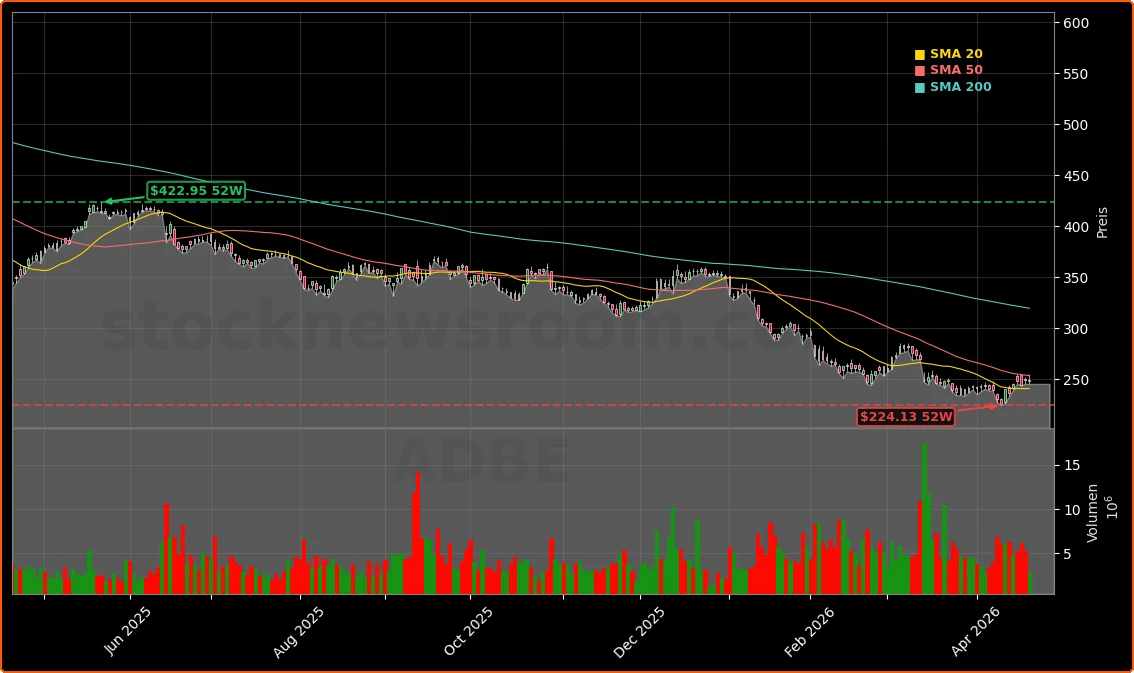
Adobe Inc. (ADBE) shares trade around $248.46, essentially flat on Tuesday and well below recent 52‑week highs, reflecting investor skepticism despite double‑digit revenue growth. In its latest quarter ended Feb. 27, Adobe reported 12% year‑over‑year revenue growth to $6.4 billion, but the stock has been pressured as AI‑native rivals and hyperscalers redefine software economics. At Summit 2026, Adobe is responding with CX Enterprise, an end‑to‑end platform built around Adobe AI Agents that automate marketing, customer engagement and loyalty workflows across channels.
The platform is designed as an “agentic” layer sitting on top of both Adobe’s own Firefly models and third‑party large language models. One flagship component, CX Enterprise Coworker, can coordinate multiple AI agents, pull in business data, generate a campaign plan and execute it across email, web and mobile. That moves Adobe from simply embedding AI into tools toward orchestrating entire multi‑step customer journeys—an area where enterprise buyers still prefer vendors with strong governance, compliance and data‑management capabilities.
How is Adobe partnering with IBM and Xfinity?
Adobe is leaning heavily on blue‑chip partnerships to prove that Adobe AI Agents are enterprise‑ready at scale. IBM Consulting and Adobe announced an expanded collaboration that combines Adobe Real‑Time CDP and Adobe Experience Platform’s Agent Orchestrator with IBM’s watsonx Orchestrate and consulting playbooks for industries like airlines and healthcare. IBM’s research highlights the stakes: organizations that detect and act slowly on customer signals can lose roughly $29 million a year in operating waste, while those that pair AI responsiveness with clear governance report materially higher marketing ROI and customer lifetime value.
Comcast’s Xfinity is simultaneously working with Adobe to co‑innovate around Adobe Brand Intelligence, using AI to enforce brand standards and accelerate creative production. Xfinity is piloting workflows where AI judges tone, layout and visual identity in real time, helping teams assemble and validate hundreds of personalized assets in days rather than weeks. This use case is central to Adobe’s pitch that its agentic tools don’t just generate content—they keep it on brand and compliant, a key differentiator against more open, consumer‑oriented AI tools.
What do deals with DICK’S Sporting Goods show?
DICK’S Sporting Goods offers a retail proof point for Adobe AI Agents. The company plans to use Adobe Brand Concierge and related tools to power “digital coach” agents inside its mobile app, guiding athletes from gear selection to training tips based on their specific goals. Under the hood, Adobe Experience Platform, Real‑Time CDP and Journey Optimizer will unify data signals and orchestrate personalized interactions across e‑commerce, stores and services.
The partnership underlines Adobe’s strategy to embed AI agents into end‑to‑end customer experiences rather than isolated chatbots. For investors, large household‑name brands adopting these tools signal that Adobe can defend and extend its position in digital experience software even as newcomers like Canva and AI design tools from Anthropic intensify competition.
How competitive is Adobe versus other software leaders?
On core financial metrics, Adobe still looks like a high‑quality but slower‑growth compounder within the software cohort. Its price‑to‑earnings ratio near 14.5, price‑to‑book around 8.8 and price‑to‑sales around 4.3 all sit below the broader software peer average, suggesting potential undervaluation. Return on equity at roughly 16.4% is more than double the industry average, and EBITDA of $2.66 billion is over four times peers on average, pointing to strong profitability and cash generation.
The trade‑off is growth: at roughly 12% revenue expansion, Adobe lags faster names like Palantir, Datadog and Synopsys. Some Wall Street voices, including Guggenheim’s John DiFucci, argue that legacy software leaders must treat AI as a new paradigm on par with the internet—and that incumbents rarely dominate the new era. Against this backdrop, Adobe’s move to make Adobe AI Agents central to its experience cloud is as much about multiple support as it is about new revenue streams.
Where does Adobe sit in the broader AI ecosystem?
Strategically, Adobe is positioning itself as a control plane across heterogeneous AI infrastructure. It is partnering with more than 30 AI platforms and cloud providers, from Amazon Web Services and Microsoft Azure to Anthropic, OpenAI and NVIDIA. CEO Shantanu Narayen has framed model providers as the “underlying infrastructure” whose token usage will increasingly be driven by Adobe’s applications. That approach could insulate Adobe from being commoditized at the model layer by focusing on workflow ownership, similar to how Apple built defensible value on top of commodity silicon.
Still, Adobe’s stock remains volatile as Narayen prepares to step down after 18 years as CEO, remaining as board chair during the transition. Leadership uncertainty, intensifying design competition from players like Canva, and AI‑driven disruption in creative tools all weigh on sentiment. At the same time, software as a group has been rebounding on days when growth and AI themes catch a bid, with names like Salesforce, Workday and ServiceNow rallying and Adobe often participating, albeit less aggressively than high‑beta peers.
Related Coverage
Investors looking for a deeper dive into valuation and technicals can explore how AI may underpin a potential rebound in ADBE shares in Adobe Forecast +6.5% Rally: Can AI Moat Fuel a Comeback?. That analysis walks through scenarios in which sustained adoption of Adobe AI Agents and broader generative products could help the company turn short‑term volatility into a longer‑term recovery story.
AI, for me, is the most exciting technology shift. You have to reinvent yourself.— Shantanu Narayen, Adobe chair and outgoing CEO
In summary, Adobe AI Agents now sit at the center of Adobe’s effort to turn AI disruption into a renewed growth engine, backed by deep partnerships with IBM, Xfinity and DICK’S that showcase real enterprise use cases. For U.S. investors, the stock screens as profitable and reasonably valued versus high‑multiple AI peers, but execution on this agentic roadmap will determine whether that discount narrows. The next few quarters of customer wins and product adoption, alongside the CEO transition, will be crucial in showing whether Adobe can secure a durable role as the orchestration layer of the enterprise AI era.